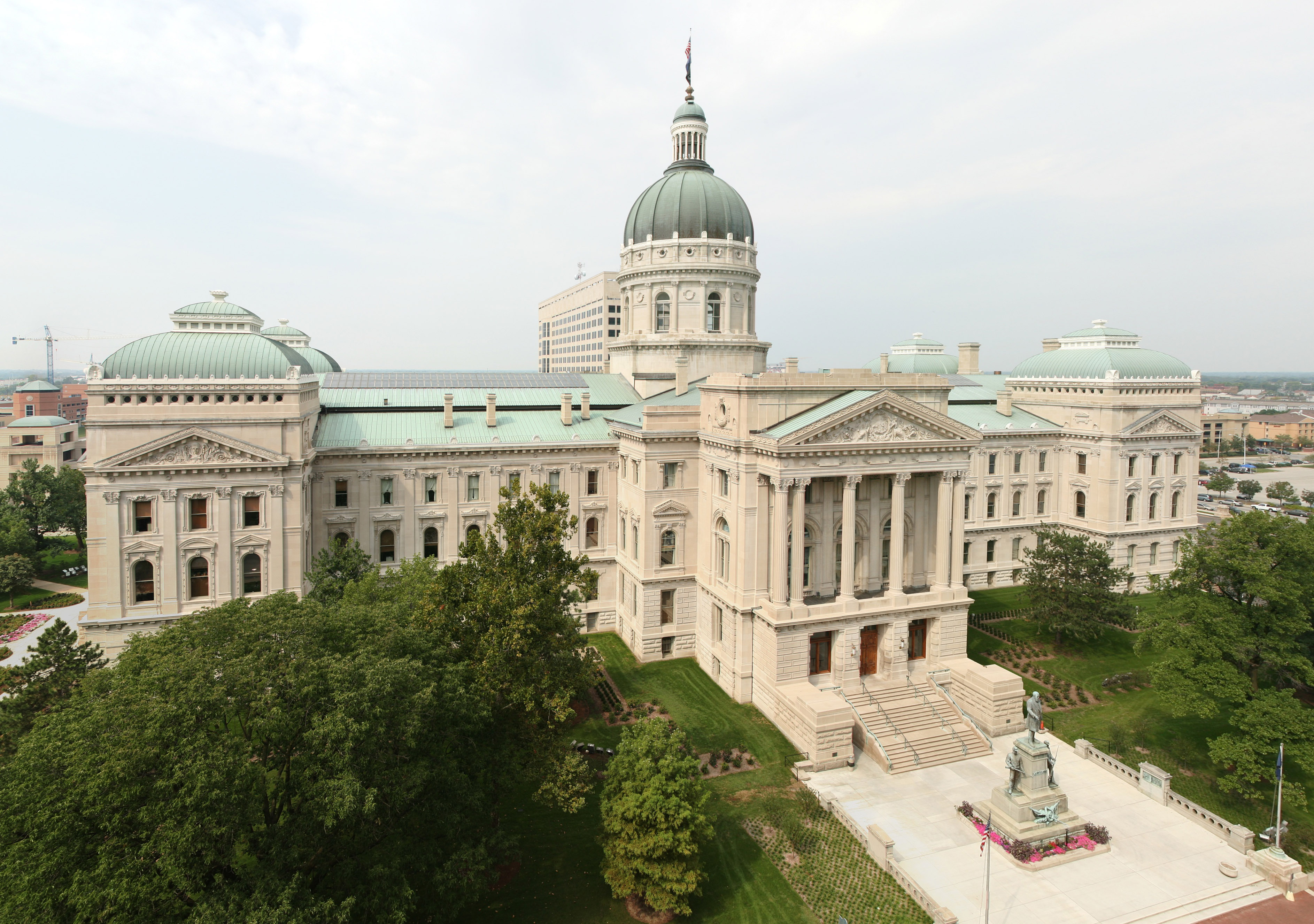
Staff working late at the Indiana Statehouse in Indianapolis hear a mail cart rolling across the marble behind them, squeaky wheels and all. They turn, and nothing is there. He is one of three ghosts pinned to the building, and none of the three is written down anywhere.
The worst part of the Indiana Statehouse in Indianapolis is the squeaky wheels. Staff working late on the upper floors say they hear a mail cart rolling across the marble behind them, dry axle and all, and when they turn to look, there is no one pushing it.
The story attaches the sound to a mailroom worker from the late 19th century who went over the fourth-floor balcony, cart and all. A fall or a jump, depending on who tells it. The lore has never settled which, and there is no record either way: no name, no year, no line in any archive that the man existed. The ambiguity is the whole story. The cart starts rolling when the building empties, and it stops when you go looking.
He is one of three. Down in the basement, where the building once kept stables, people report horses whinnying late at night. The story is of a worker a horse reared up and kicked in the head, killing him where he stood. And on the upper floors there is a woman in a long, flowing 19th-century gown, long hair, who appears and vanishes just as fast. Staff call her the Ghost Lady. Nobody has ever figured out who she was, and no source has ever attached a name to her.
Three accidents, three corners of the building, all of them from the capitol's first decades, and not one traced to a coroner's record or a newspaper. The deaths live only in ghost-tour narration and staff anecdote, never in a document. A tour company that runs the building lists the ghosts plainly: "Black orbs, phantom horses, and the 'Ghost Lady' are just a few of the entities that stake their claim on the Statehouse." The spot the staff avoid most after hours is the spiral staircase to the top floor, where they say things move at the edge of your vision.
The building they haunt is the third statehouse on the site, finished in 1888. Its architect, Edwin May, won the commission with a design he titled "Lucidus Ordo," Latin for "a clear arrangement." He never saw it finished. May was paralyzed partway through the project, traveled to Florida to recover, and died there in February 1880. His draftsman, a Swiss architect named Adolph Scherrer, carried the work to completion eight years later. May had named a building he would not live to walk through.
It still houses all three branches of Indiana's government, the legislature and the governor and the courts under one dome. The people who hear the cart and avoid the staircase report for work there every day.