TLDR
A 35-year-old widow built this Pensacola house in 1871. The most-seen ghost is a woman who matches her, in Victorian dress.
The Full Story
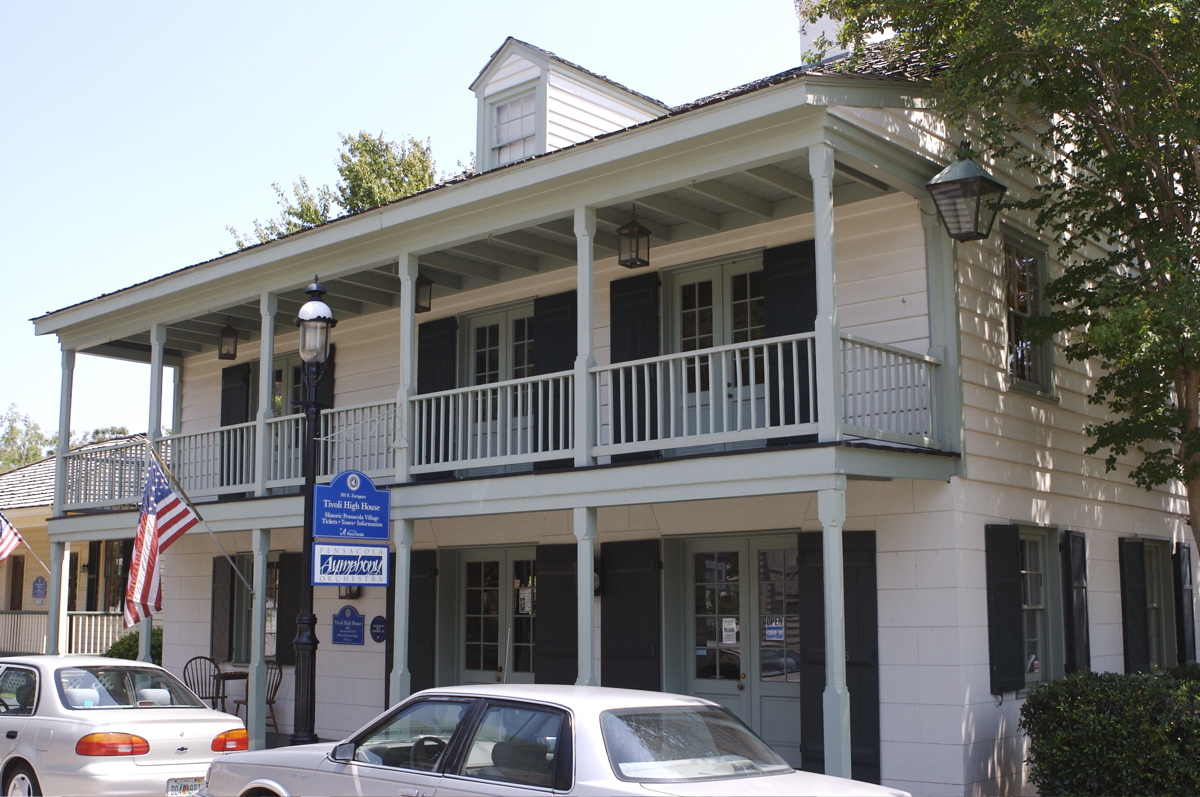
The translucent woman in Victorian dress drifts across an upper room and stands on the second-floor balcony. Visitors who watch long enough say she looks about thirty-five. Clara Barkley Dorr was thirty-five when she commissioned the house in 1871, a recent widow with five children and money from her husband's lumber business.
So the apparition that turns up across every paranormal-trade write-up of the house matches the woman who built it. The whole pitch sits in that one sentence.
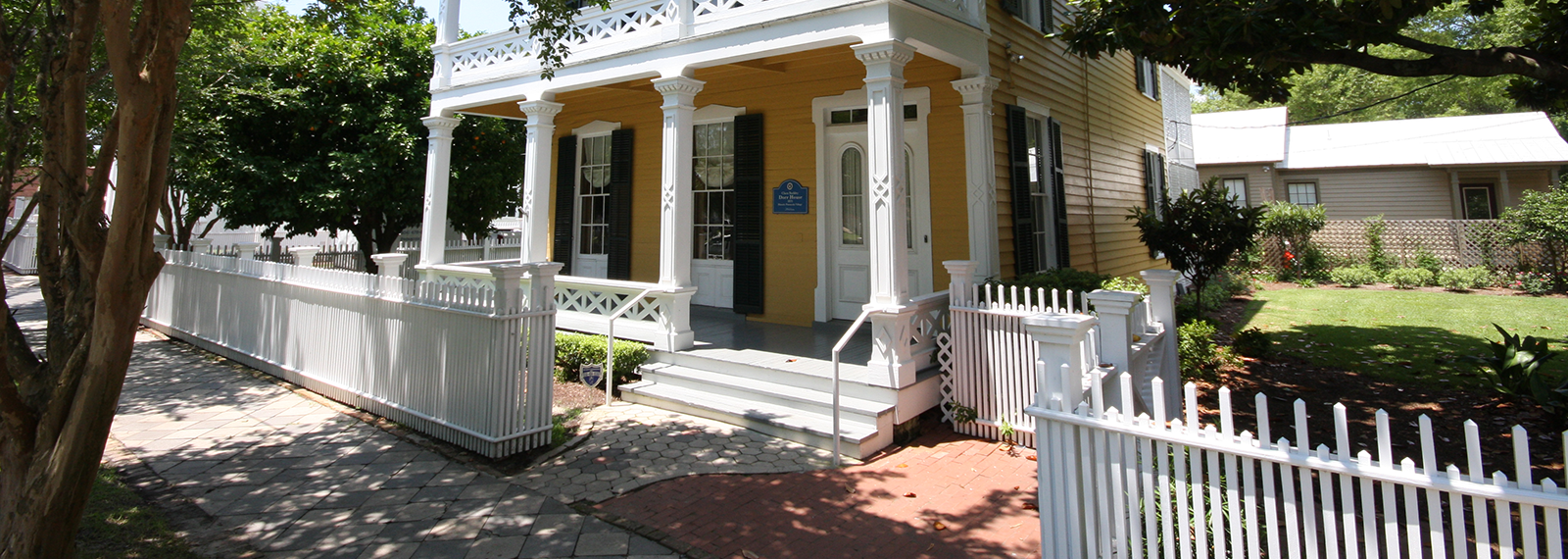
The Dorr House sits at 311 South Adams Street on the west side of Seville Square, one of the older squares in Pensacola. Clara had married Eben Walker Dorr in 1849, and they'd lived up the road in Bagdad, Florida, where Eben worked for the Ezekiel Simpson Lumber Company. He died in 1870. The next year Clara built the house out of yellow pine and local brick and moved her family in.
It's Greek Revival, which is the architectural part that's actually weird. By 1871 the rest of the country had moved on from Greek Revival a decade or two earlier. Clara built one anyway, with dentil molding running along the cornices and a Greek-style "free meander" key pattern carved into the bay window's cornice. Two stories of porches, very high ceilings, tall windows, the foundation lifted off the ground for air. It's a house designed for the Gulf climate by someone who wasn't going anywhere.
The family kept the place until the early 1900s. After that, decades of slow deterioration. The Pensacola Heritage Foundation bought it in 1965 and restored it, with the Junior League's piece of the work led by Mary Turner Rule Reed. The National Register of Historic Places picked it up on July 24, 1974, reference number 74000619. Today the UWF Historic Trust runs it as a Victorian-period house museum inside Historic Pensacola Village. Historic Pensacola itself calls it "the best preserved example of post Civil War Classical Revival architecture in the Pensacola Historic District," a line you only get to write if you're right.
The genealogy around the family is where the Pensacola tour-circuit version of the story starts to embellish. Local sources like to say Eben's grandfather "rode with Paul Revere." The cleaner version is that an Ebenezer Dorr, a Roxbury leather dresser, carried the alarm on the night of the Midnight Ride with William Dawes through Roxbury, in the same alarm network as Revere but not literally beside him. Pensacola sources also say Eben's father was Escambia County's first territorial sheriff, which shows up in two paranormal-trade write-ups but traces back through secondary repetition rather than a primary record this research pass could pull. Treat both as family-tradition claims with real bones underneath.
The hauntings cluster in a few specific rooms. The formal sitting room has a floor-to-ceiling mirror, and Florida Haunted Houses describes a recurring thing there: when a female visitor in a short skirt stands in front of it, "there is something unseen that tugs on the skirt," like someone trying to lengthen the hem. Read that as Mrs. Dorr would have. She built a Victorian house and apparently still has Victorian standards.
In the sick room, which doubled as the sewing room, hauntedplaces.org notes that "the soft cries of a female can sometimes be heard." No witness is named, no date is given. It's described as a recurring quiet thing rather than a single incident.
Throughout the house, visitors and staff report the smell of fresh-cut roses. Roses were Mrs. Dorr's favorite flower. The rose smell is often immediately followed by a sharp drop in temperature in the same spot, a one-two combo that's hard to fake by accident.
The last thread is the one that gives the whole place its personality. Across the paranormal-trade sources, the consensus is that Mrs. Dorr does not allow rudeness inside her house. By tradition, docents at Historic Pensacola Village greet the house's mistress when they open and close, a quiet acknowledgment that she's still the host. Visitors who are dismissive or disrespectful in the rooms, by the same trade accounts, leave with a feeling of having been politely shown out.
The gaps are part of why the page reads honest. There's no dated incident report on the public record, no October-of-such-and-such guest who saw a specific thing at a specific time. No named investigator team has worked the house for the public. There's no tragic death story binding Clara to the building. The activity reads as residual presence, a woman who loved the house she built and stayed in it, rather than something traumatic. For a haunting, that's a pretty mild motivation. It's also the through-line: the translucent lady on the balcony, the rose scent, the hand at the hem of the skirt. Every one of those reads as Mrs. Dorr being a host, not a victim.
The translucent lady is on the balcony. The roses are in the air. The hem of the skirt moves down.
Researched from 6 verified sources. How we research.