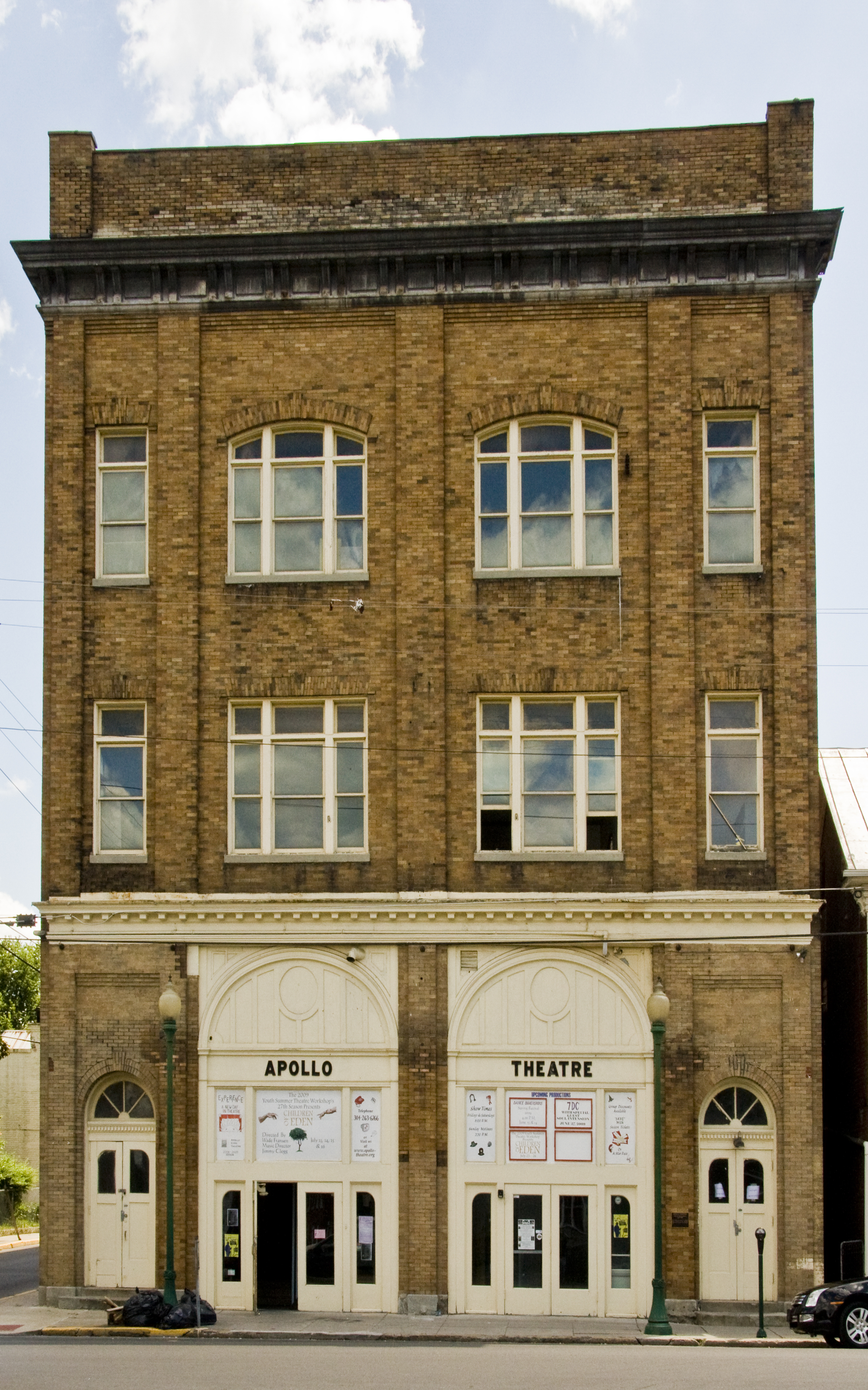
The Apollo Civic Theatre in Martinsburg, West Virginia smells like cigar smoke before curtain, and nobody there smokes. The board president who collected the theatre's ghost stories started with his own: shadows on the back balcony, footsteps on the stairs, 1975.
The Apollo Civic Theatre in Martinsburg, West Virginia smells like cigar smoke before the curtain goes up. Performers and visitors report it in the minutes before a show, a strong tobacco drift through what the theatre's own Halloween page calls a building where nobody has lit one in decades.
Who it belongs to depends on who you ask. Rosemary Ellen Guiley's account of the place gives the habit to Charlie, a manager who worked at the Apollo in the 1920s and was fond of cigars. The theatre itself hands the smell to George, a bearded stagehand in a brown-checked shirt and bib overalls who has been glimpsed at the back of the house since the mid-1970s.
Charlie, in Guiley's telling, doesn't stay inside. He turns up on the sidewalk in a fedora with his jacket collar pulled up. A woman living in a nearby apartment saw him out on the street one day, took him for an actor in costume, and watched him vanish in front of her.
An Apollo board member described taking a curtain call in the early 1980s and looking out at an old man seated toward the back of the auditorium, plaid shirt, cigar. "No one but me saw him," he said, "and suddenly he was gone."
Most of what's known here was collected by one man, and he started with himself. Michael L. Noll, the theatre's board president, was alone in the building one night in 1975 when he saw shadows moving across the back balcony and heard footsteps creaking up and down the stairs. He locked the place and left.
After that, people brought him theirs. A woman in a long white dress. Something backstage that shoves people from behind. A phenomenon nobody could explain that left an outbreak of hives. And a couple upstairs in the ballroom, trying to strangle one another, in the same rooms where the Cotillion Club once held its debutante balls.
The Apollo opened with a gala on January 19, 1914, and its architect is the strangest thing in the file. Reginald W. Geare of Washington, D.C. designed it alongside a local Martinsburg man, Chapman E. Kent. The building's 1979 National Register nomination praises it as the work of "an architect who was later to become nationally notorious."
Eight years after the Apollo's opening night, Geare's Knickerbocker Theatre in Washington collapsed under a record snowfall and killed 98 people. A coroner's jury blamed the design and construction. A grand jury indicted him for manslaughter. He was never convicted. He died by suicide in 1927.
Of all the theatres Geare built, three are still standing. One of them is the Apollo, and people there keep reporting it full.