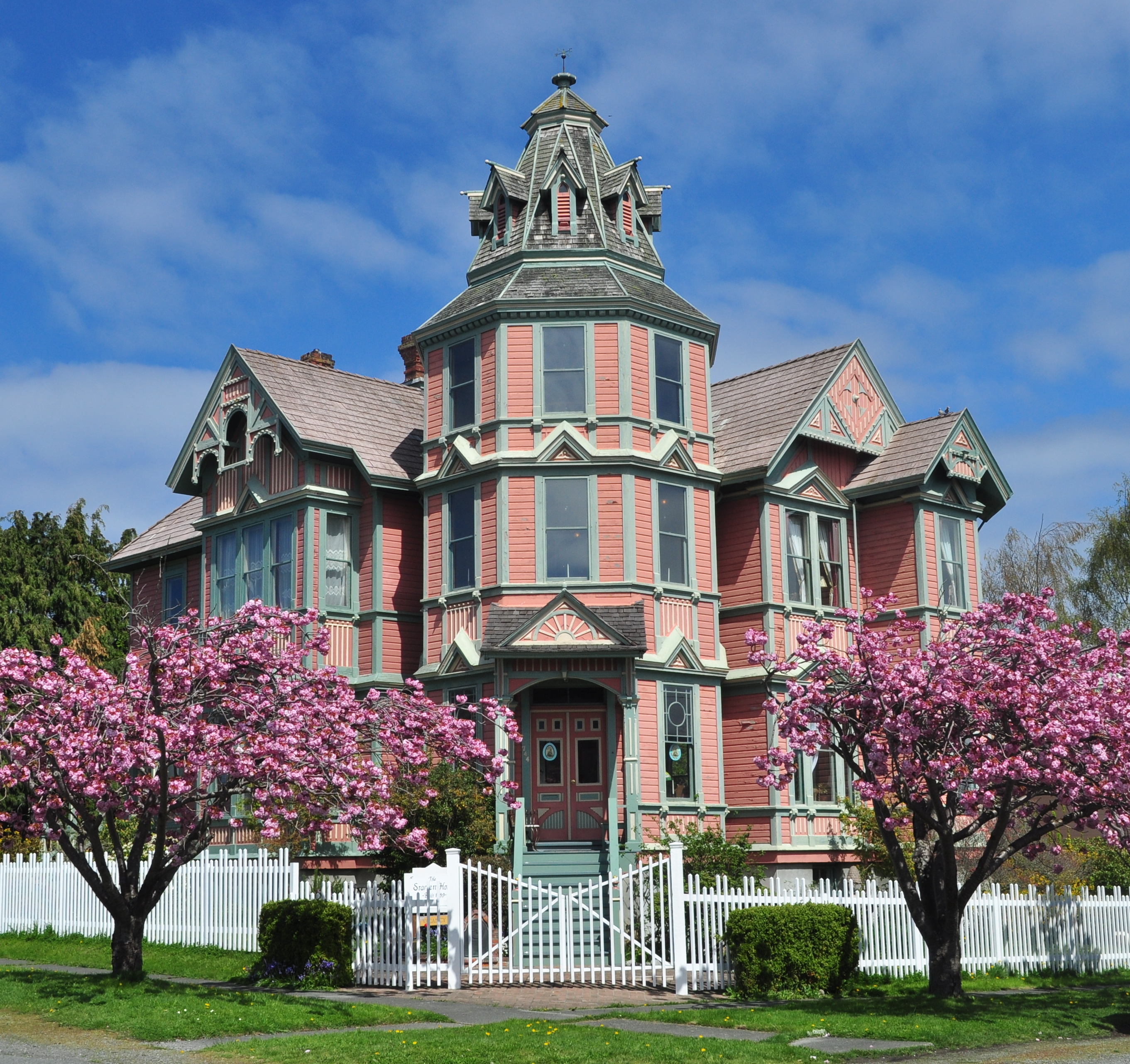
The Starrett House in Port Townsend, Washington rents a guest room called The Nanny's Room, and guests say the nanny never moved out. She kills the lights, drops pictures off the walls, and swats anyone who speaks ill of the house.
The Starrett House in Port Townsend, Washington rents four guest rooms, and one of them is named for the woman people keep meeting inside it. The Nanny's Room was the nanny's own bedroom on the second floor, and staff and guests alike describe a partial reflection of her in the gilded mirror of its built-in armoire. Never a whole figure. Just enough of an older woman, gray-haired and dignified in some tellings, in a black dress in others.
She is the busiest of the three spirits said to share the house, and the only one with rules. The ghost listings credit her with switching off lights guests left burning, dropping pictures off the walls, and setting the fine crystal ringing in the grand parlor. They also say she thumps guests who talk crass, or who speak ill of the house, its owners, or the town of Port Townsend. A haunting with a code of manners.
The other two are the couple she worked for. George E. Starrett came from Maine to Port Townsend in 1885 and became the town's leading builder, and in 1889 he put up the house at 744 Clay Street for $6,000. Nearly every account calls it a wedding present for his wife, Ann, though the marriage certificate has them wed in February 1887, two years before the first nail went in. George, Ann, their son Edwin, his nanny, and two servants lived there for more than twenty years.
What George built was part house, part instrument. Eight fresco panels of the seasons line the domed entrance tower, eight small windows ring the top of it, and a chip of ruby-red glass sits at the center of the paintings, so at the turn of each season the light throws a red arrow onto that season's panel. The seasonal figures are believed to be Ann herself, painted in four different outfits.
She is reported below them to this day: a red-haired woman drifting the halls and the free-hung spiral staircase, most often near the calendar her husband made for her, described as peaceful and even welcoming. A male figure walks with her sometimes. People take him for George.
On October 31, 2002, the Peninsula Daily News reported that several visitors had separately described the same woman on that circular staircase, in a white nightgown, hair pulled into a bun, carrying a brass candlestick. The 1970 National Register nomination, written 32 years before that story ran, notes one small thing about the stairs in passing: "the brass candle light fixture which formerly topped the newel post now graces a table in the house."
Nobody knows the nanny's name. Not the 1970 nomination, not the census of the household, not one of the listings that describe her so precisely. The most active presence in the house is the one nobody can identify, and her room rents by the night like any other.