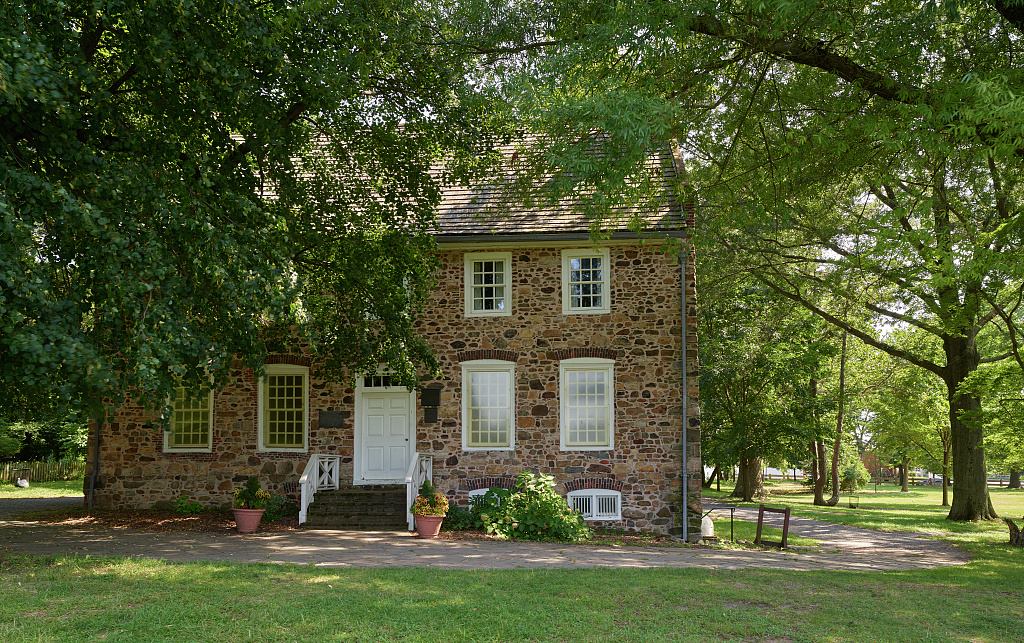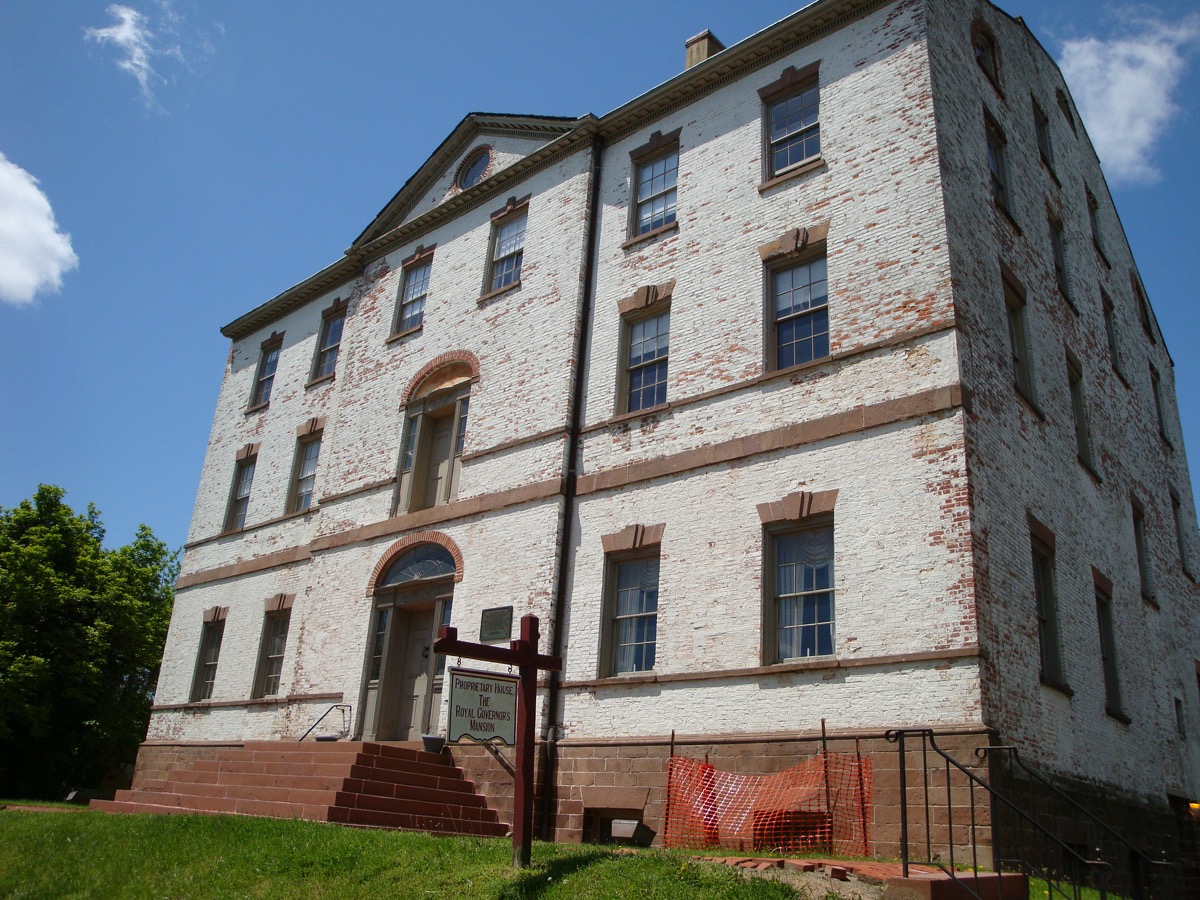
The Proprietary House in Perth Amboy, New Jersey is the last royal governor's mansion still standing in the original thirteen colonies. Its signature ghost is a small boy in a blue coat who opens the door, walks you upstairs, and then is gone.
At the Proprietary House in Perth Amboy, New Jersey, the story people keep telling is about a small boy in a blue coat. He answered the front door for a delivery man one day, the way a child would, and led him silently up to the third floor. When the man looked again, the boy was gone. He's the museum's signature ghost, and no record ties him to any documented child who died in the house. Visitors have reported him since, a small face at the glass, a child going up the stairs ahead of them.
The building he haunts is the last one of its kind. Completed by 1764, it's the only official royal governor's mansion still surviving anywhere in the original thirteen colonies, a three-story brick Georgian that now sits in a plain working-class neighborhood off Kearny Avenue.
Its most famous resident was William Franklin, New Jersey's last royal governor and Benjamin Franklin's son. When the colonies turned toward independence, father and son turned away from each other. William stayed loyal to the crown. In 1776 he was arrested at this house and taken north, then imprisoned in Litchfield, Connecticut, and released two years later in a prisoner exchange. He never lived here again, and he never reconciled with his father. That break is the wound the house's lore keeps circling.
After the Revolution a fire gutted the interior. An advertisement in 1792 described "the remains of the house lately burned." It was rebuilt and enlarged into a resort hotel, then leased to a Presbyterian home for ministers' families, then subdivided into building lots, then nearly demolished, before an association incorporated in 1966 to save it. It's a museum now, owned by the state and open for Sunday tours.
The boy isn't the only one people report. Visitors describe a woman standing in the dining room window, and a Revolutionary War soldier, and cold air that settles over a room with nobody in it. In a Season 4 episode of "Ghost Hunters," the TAPS team recorded footsteps, watched a flash of light, and one investigator felt something flick his ear. They caught an EVP that answered "no" when they asked if it was afraid of them. Their own verdict was careful. "While there is definitely paranormal activity," they concluded, "it's hard to say for sure that the mansion's haunted."
The boy in blue keeps answering the door anyway, and keeps walking strangers up the same staircase to the third floor before he disappears.