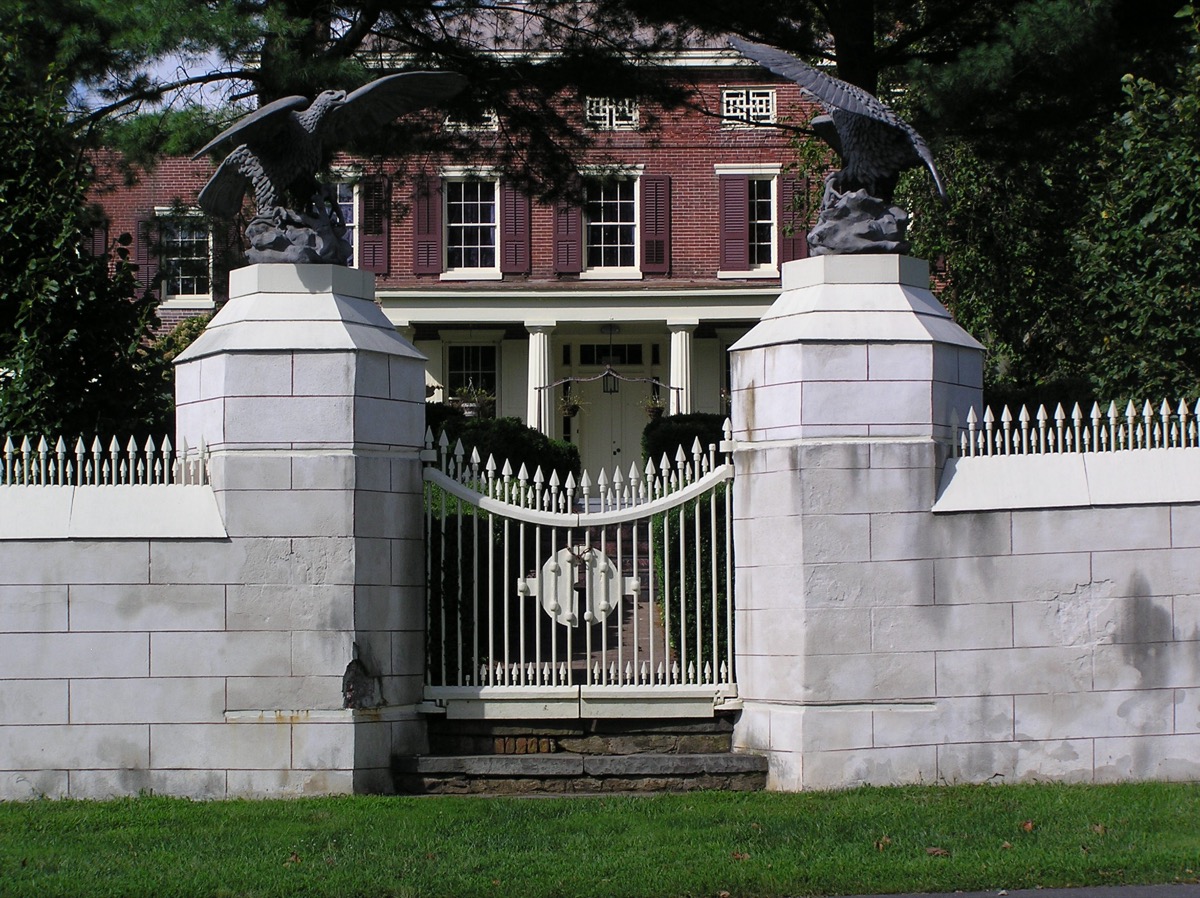
At Smithville Mansion in Burlington County, New Jersey, staff and visitors report piano music with no one at the keys and voices in empty rooms. The house belonged to a man so afraid of being moved that he had himself buried in an iron cage set in concrete.
At Smithville Mansion in Burlington County, New Jersey, the curator says there's piano music every so often when nobody is at the piano. Staff and visitors report voices in empty rooms, apparitions crossing rooms, lights switching on and off. The house belonged to Hezekiah Bradley Smith, and the people who keep it say he never quite left.
Smith was an inventor and industrialist from Lowell, Massachusetts. In 1865 he bought a failed company town for $20,000, renamed it Smithville after himself, and made it an international center for woodworking machinery and the high-wheeled Star Bicycle. He held more than 40 patents. He kept a private marching band that traveled with him after he won office, and trained moose to pull his carriage, which alarmed the neighbors.
He served a term in Congress, then lost the life he'd built around it. During the campaign he was exposed as a bigamist; he had married in Vermont in 1846, separated a year later, and never finalized the divorce before marrying again. The scandal collapsed his political career. That first marriage is also the one that haunted his grave.
He was buried, in 1887, in an iron coffin. The coffin sat inside an iron cage of bolted iron bars, and the whole thing was set in solid concrete at Saint Andrews Cemetery in Mount Holly. He built it that way on purpose. Smith was certain his estranged first family would come dig him up, and he meant to make it impossible.
In 1897 his eldest son Elton came to move the remains north to Vermont. The cage held. The man had spent a fortune making sure he'd never leave, and he didn't.
The house holds him too, by the telling. South Jersey Ghost Research, led by Dave Juliano, has brought motion sensors, thermal cameras, and recorders through the mansion more than once and counts it among the most haunted places it has worked. The team documented orb photographs and one EVP: an unclear whisper that says "Watch out." The hauntings are attributed to Hezekiah and his second wife, Agnes, a trained physician who edited his trade journal and died in her early forties.
The coldest spot comes with the music. "It gets absolutely freezing when Larry plays the pipe organ upstairs," says Bill Stepler, who helps maintain the house. "It's unbelievable."
The mansion still hosts weddings. On Halloween 2023, six couples married there, the county clerk officiating in a witch costume. The current Friends-group president, Jim Denworth, is a blood descendant of the man in the iron cage.