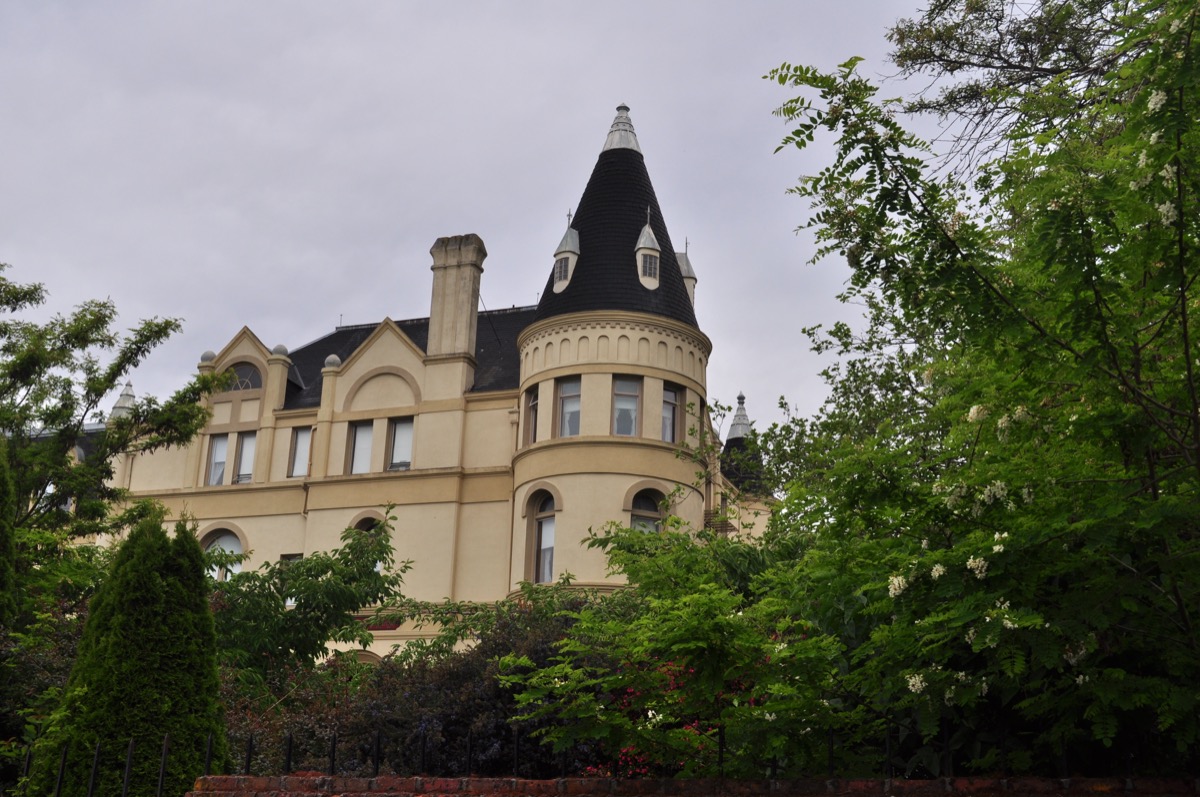
Both of Manresa Castle's famous ghosts were invented by a bartender in Port Townsend, Washington, to quiet guests who kept asking about footsteps in the attic. The made-up stories sit on top of a drowned priest and a child's coffin nobody can name.
Guests at Manresa Castle in Port Townsend, Washington keep reporting the same two rooms. In 306, a woman in a white gown standing at the window, dresser drawers left open, covers pulled off the bed in the night. In 302, footsteps overhead in an empty attic and the sound of a rope dragging across the ceiling.
Both rooms have a story attached. Both stories were invented by a bartender.
His name was Nick Gael. In 2003 the hotel's former manager told the Peninsula Daily News that Gael made up the pair of them. There was English Kate, a young Englishwoman said to have waited at the castle around 1921 for a sailor whose ship went down, and who jumped from the window of 306 when word reached her. In every telling, the sailor lived. And there was the Jesuit seminarian, caught in unsupervised visits with a local nun, said to have hanged himself from the rafters of the turret attic directly above 302. The Olympic Peninsula Paranormal Society, which investigated the building, puts it plainly on its own page: "Both haunts are stories created by an old Bartender of the castle."
Gael's motive was small and practical. He was answering guests who pestered him about strange things in the hotel, "like footsteps in the attic and voices in empty rooms." The stories arrived second. The noises were already there.
The building was finished in 1892 for Charles Eisenbeis, a Prussian baker who came to Port Townsend in 1858 selling hardtack to ships and became the city's first mayor. Thirty rooms, four stories, three turrets, brick out of his own yard. The Jesuits took it in the 1920s and renamed it Manresa Hall, after the town in Spain where Ignatius Loyola founded the order. They left in 1968. It is a hotel today, and the hotel's own website does not mention ghosts anywhere on it.
No woman matching English Kate exists in the record. The paranormal society worked through the Washington death certificates and the county obituary index and could tie only one female death to the family at all: Charlotte Eisenbeis, 13, of a heart infection, in a Seattle hospital.
One man attached to the Jesuit house did die. Father John Alden Murphy drowned in Puget Sound on Thursday, September 2, 1943. The society found the newspaper report and the death certificate to confirm it. His clothes were on the shore, neatly folded. No body was ever recovered.
Then in October 2006, one of the three sandstone slabs over the Eisenbeis burial vault at Laurel Grove Cemetery cracked from weathering and fell in. It broke the glass lid of the coffin holding Charles's first wife, and it smashed a second, smaller coffin sitting on top of Charles's own casket. A child's. Nobody in the family knew a child was down there. "The child's casket was a complete surprise," great-granddaughter Ann Welch told the Peninsula Daily News. No one has identified the body since.