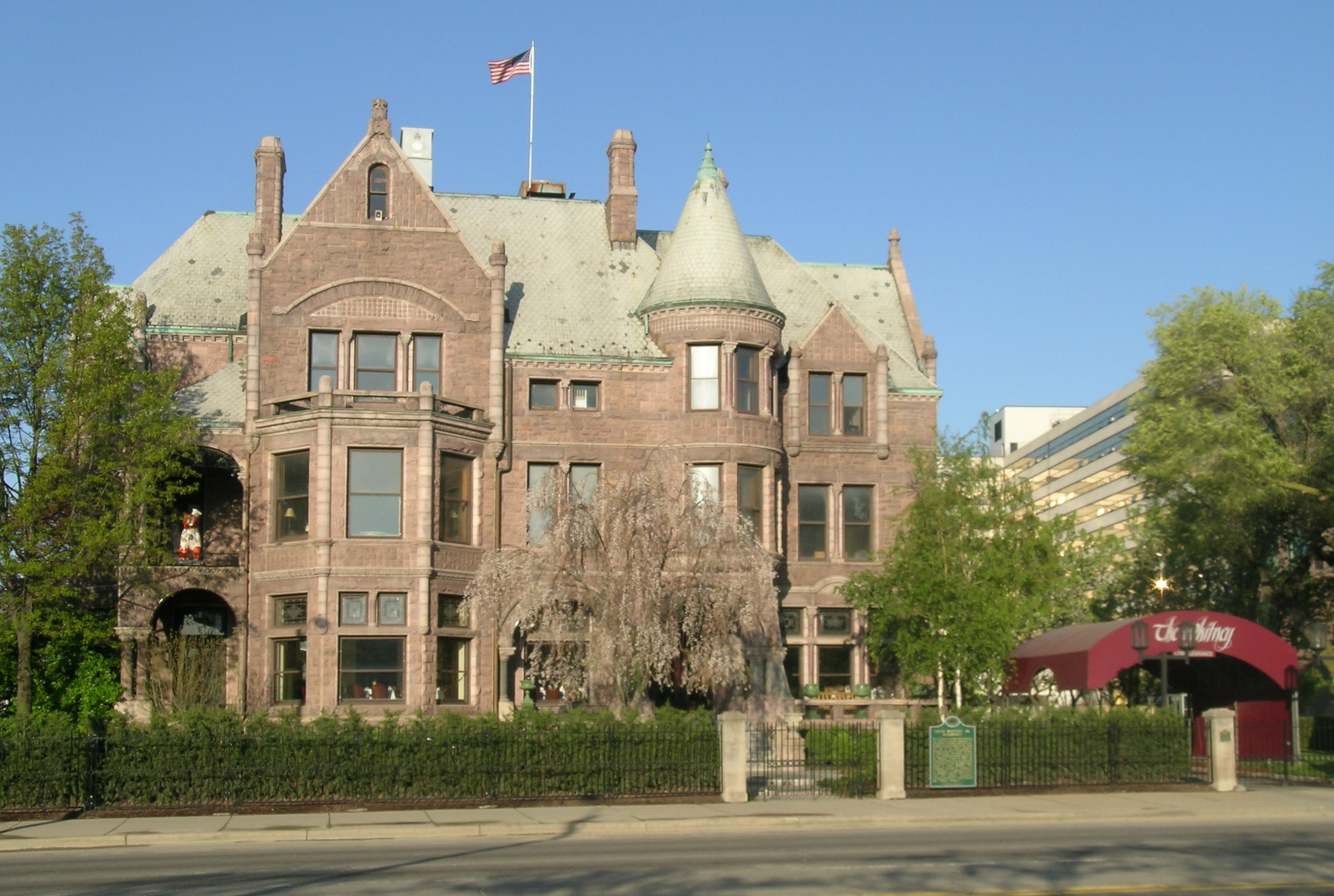
The Whitney, a rose-pink stone mansion on Detroit's Woodward Avenue, is a fine-dining restaurant now. Guides and staff tell of a woman crying in a third-floor restroom, coughing in the upper halls, and children's voices in the carriage house out back.
The Whitney, a rose-pink stone mansion on Woodward Avenue in Detroit, is a fine-dining restaurant today. The stories its guides tell are stranger than the menu. People report a woman crying in a third-floor restroom, coughing fits in the upper halls, and children's voices drifting out of the carriage house behind the main building.
The coughing has an explanation that's worse than no explanation. The mansion was built between 1890 and 1894 for David Whitney Jr., the lumber baron once called Mr. Woodward Avenue and, in his day, Michigan's wealthiest man. He poured around $400,000 into 52 rooms of rose-pink South Dakota jasper, with Tiffany stained glass throughout and the first private residential elevator in Detroit. Then he lived in it only about six years before he died there in 1900. His second wife Sara, the younger sister of his first wife, died in the house in 1917. Sources cite at least three deaths inside it, though no record names them all.
After the family left, the building spent 1932 to 1956 as the Wayne County Medical Society's headquarters, used in part as a tuberculosis hospice. The coughing in the upper halls, the story goes, belongs to patients who never left. Richard Kughn, the Lionel Trains magnate, bought the property in 1979 to keep it from being torn down, and The Whitney opened as a restaurant in December 1986.
The carriage house out back is the most-reported spot. When the Detroit PBS series One Detroit filmed there, investigators put a spirit box inside a Faraday cage and asked the carriage house whether the spirits were happy to have them. Three of them — Andrea Riley, Chris Jordan, and Leland Stein — say they each independently heard a girl's voice answer "No." There's a tea set kept in that carriage house, too, and the staff story is that you must not move it; do, they say, and china starts falling off shelves in the main house until it's put back.
The restaurant leans into all of it. The top-floor bar is called the GhostBar, named for the spirits said to reside there, and a husband-and-wife team runs paranormal dinner tours twice a month. When Syfy's Ghost Hunters investigated in 2016, they debunked the elevator that seemed to run by itself — its doors open automatically every five minutes, on whatever floor the car has stopped. But Dave Tango and a cameraman both watched something else that night: "a floating light move its way down the stairs and turn and leave the room." In the carriage house, when the team moved that tea set, the recorder caught a woman's voice at the same moment they heard footsteps.
Wikipedia notes there's no verifiable evidence behind any of it. The coughing is just a story. The ward that the story remembers was real.