The Detroit-Leland Hotel in downtown Detroit has been called Michigan's Cecil Hotel for the deaths stacked up inside it. Clubgoers describe a white-haired ghoul scrambling the staircase on all four limbs, and a sealed fourth floor that people say still holds Jimmy Hoffa.
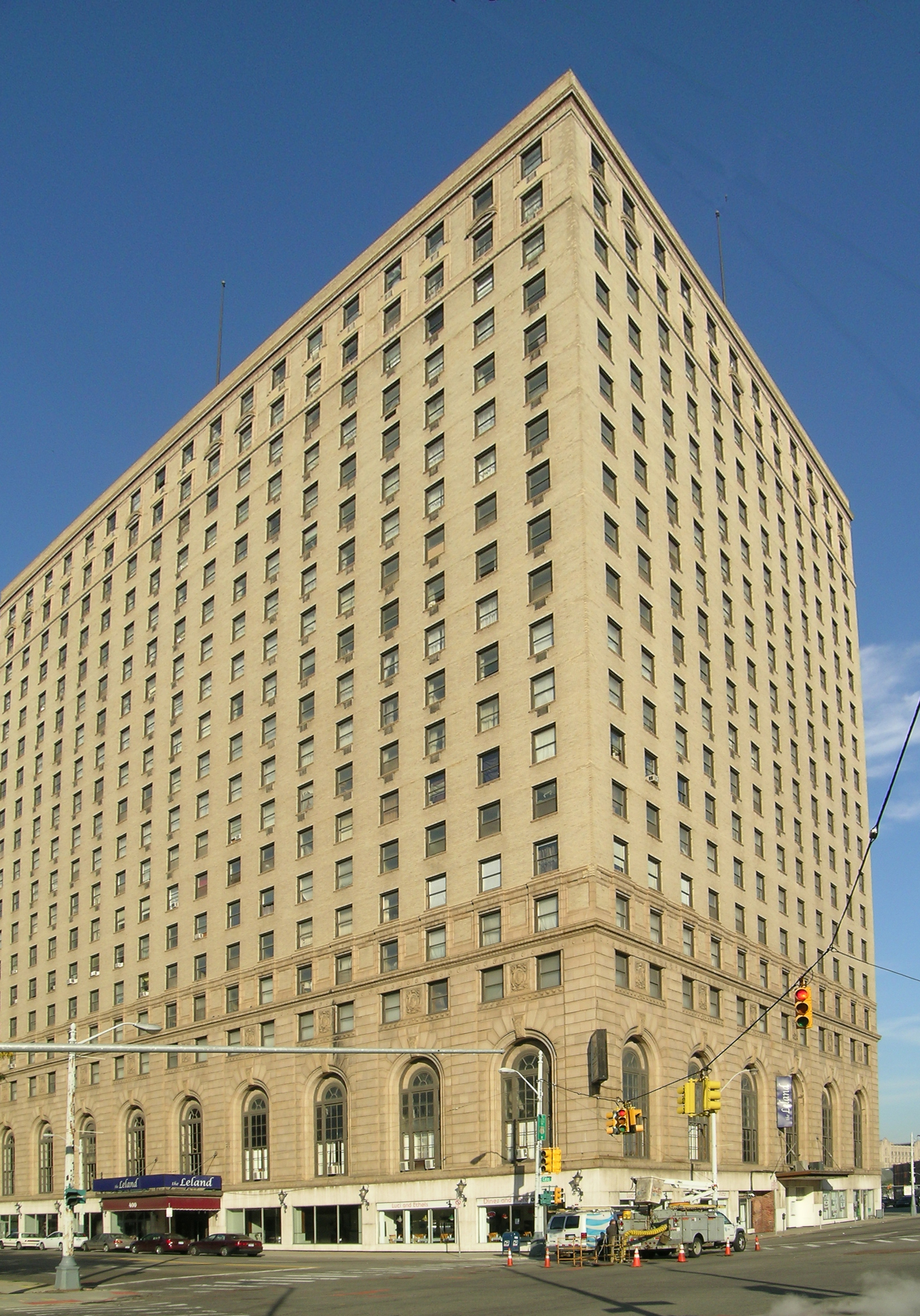
The Detroit-Leland Hotel, at 400 Bagley Street downtown, has been called Michigan's Cecil Hotel — Visit Detroit's words, for "the astonishing number of deaths, murders, suicides, overdoses, and freak accidents" inside it since the doors opened. The thing clubgoers describe is worse than a number.
Down in the old ballroom, a goth-industrial nightclub called the Leland City Club has run since 1983. People there report a ghoul with long, disheveled white hair and bulging eyes, and the way they tell it, it doesn't walk. It scampers up and down the club staircase on all four limbs. Others describe phantom gangsters and their victims, an aggressive spirit that announces itself through sounds of choking, and dreams that turn bad after a night inside.
To understand a place like that, you go back to April 1927, when it opened as an 800-room hotel at the corner of Cass and Bagley, designed by the Chicago movie-palace firm Rapp & Rapp and built for roughly $4.5 million. The bar drew a hard crowd from the start. It was said to be a hangout for the Purple Gang, the Jewish-American syndicate that ran Detroit's bootlegging, gambling, and extortion through Prohibition. Jimmy Hoffa was said to frequent the place too. Hoffa vanished on July 30, 1975, last seen at a restaurant outside the city. He was declared legally dead in 1982, and no one has ever found him.
This is where the building's strangest story takes hold. On the fourth floor, the legend goes, the elevator still opens onto a black iron door — padlocked, welded shut, rusted, pocked with what look like bullet holes. Behind it was a bar Hoffa supposedly favored. Visitors who press to the gap in the door claim to glimpse him in the dark on the other side, shuffling around in a room sealed off from the rest of the building. None of it is in any record. It lives only in the accounts people bring back, and it grafts a man who disappeared miles away onto a floor nobody can open.
The City Club still operates in the ballroom, though the building itself has fallen on hard times. It has worn a string of names over the decades — Ramada Inn, Leland House, then back to the Leland around 2006 — and through all of them the stories never thinned out. What stays with you isn't the architect or the room count. It's the official tourism office reaching for the Cecil Hotel — the most notorious death-house in America — and deciding that was the fair comparison for this place.