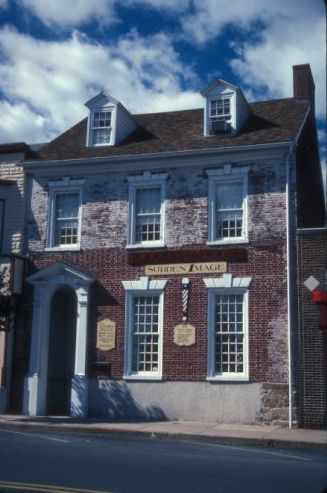
The Rodgers House in Havre de Grace, Maryland survived the British burning of the town in 1813 — they set it on fire three times and it would not burn. Tenants say a woman still keeps the second floor, watching over the place she never left.
At the Rodgers House on North Washington Street in Havre de Grace, Maryland, the people who live in the upper floors describe a woman on the second floor. They don't describe her as frightening. They describe her as protective — a strong female presence who belongs there, who keeps the place. The third floor is the one they don't like, near the bathroom, where something feels charged and far less welcoming.
The house has reason to hold on to whoever it holds. It was built in 1788, and it is the only 18th-century building left in town, the oldest documented structure in Havre de Grace. On May 3, 1813, a British squadron under Rear Admiral George Cockburn attacked the town and burned most of it to the ground. Elizabeth Rodgers's three-story tavern stood in the middle of it. The British set fire to the house three times. Each time, it went out.
A clergyman who was there wrote it down that same year. "The enemy set fire three times to Mrs. Ro(d)gers' house," he recorded, "but it fortunately each time was extinguished, though they defaced and mutilated much."
Elizabeth's husband, Colonel John Rodgers, was a Scottish immigrant and Revolutionary War veteran who ran taverns and a ferry on the Susquehanna. George Washington once dined with him here, by his own 1787 diary. They had eight children, and the family put its name in the history books for a century after: the eldest son became a Navy commodore who helped defend Fort McHenry, and by the local record, five rear admirals since 1900 came out of this one family.
But the youngest daughter, also named Elizabeth, never married, and never went anywhere. She lived in the house her whole life. The investigators who recorded there think she might be the woman on the second floor, though no one can say that for certain.
Those investigators, a pair named Ed and Robbin, ran recording sessions in the building starting in July 2010. A single open staircase runs straight up the center of the house, and it does something to sound. They came back with the voices of two women talking on the second floor, one of them remarkably crisp and clear. Male voices from a room that was empty. Shadow figures near the third-floor bathroom, where the tenants already felt the conflict. And on the bad nights, voices that mimicked them, repeating the investigators back to themselves in the dark.
The British couldn't burn it down. Whatever stayed inside doesn't seem to want to leave either.