A veiled marble mourner leans over the Jackson plot at Riverview Cemetery in Parkersburg, West Virginia. Leave a coin or a bottle of wine and the town says she grants an unselfish wish. Mock her and she trips you, pulls your hair, tears at your clothes.
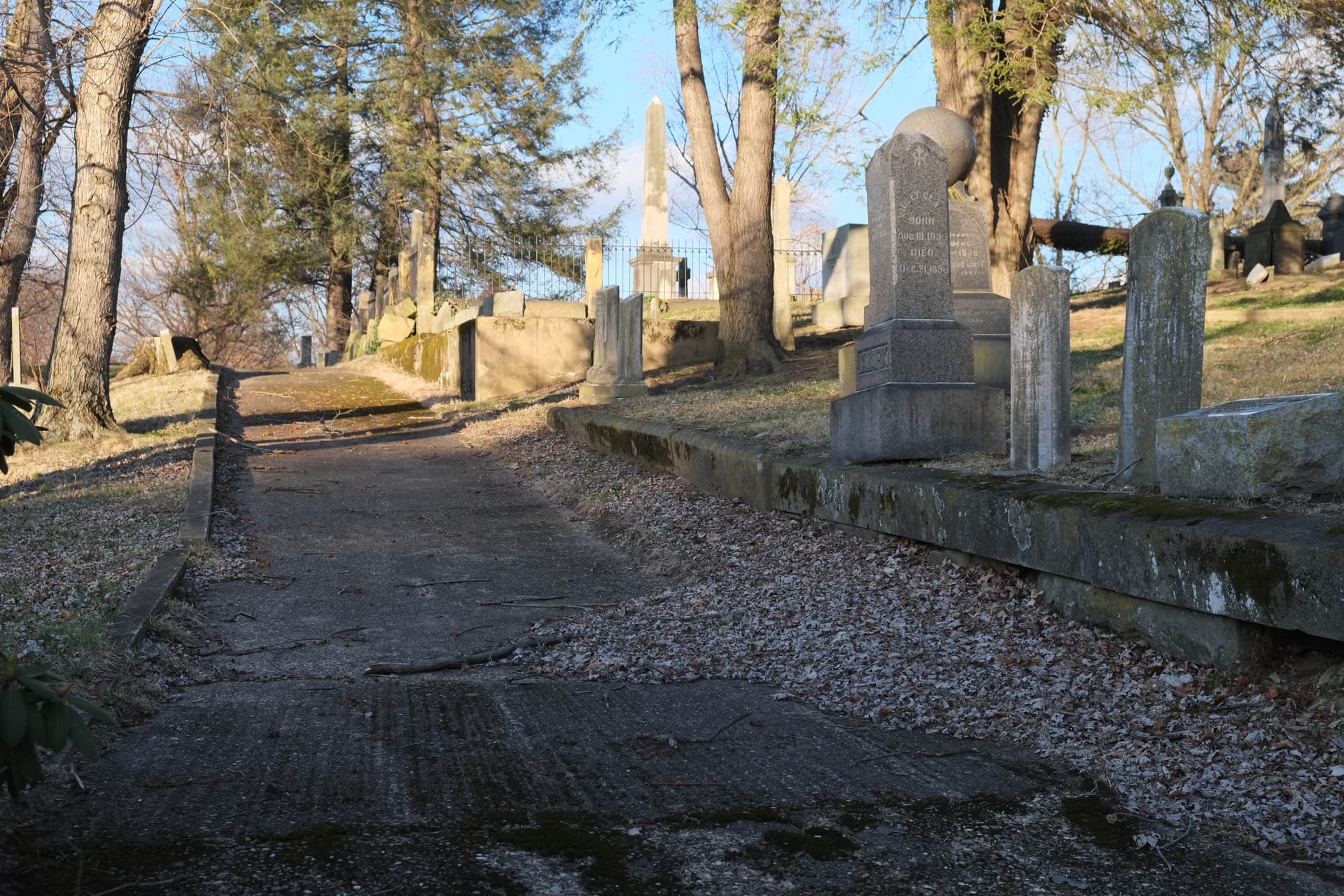
Near the back fence at Riverview Cemetery in Parkersburg, West Virginia, a marble woman lies collapsed across a headstone. She is veiled and draped, one arm thrown over her face, the other holding a carved scroll that reads "In the silence and to thee, JACKSON." A century outdoors has streaked the white stone gray and green and black. On the stone headrest beneath her, people leave flowers, coins, and small bottles of wine.
The wine is payment. Parkersburg calls her the Weeping Woman, and the arrangement, as locals tell it, is simple: leave a token, and if you are pure of heart and your wish is genuinely unselfish, she grants it. The strand people repeat most is fertility. She is said to be especially good at granting a pregnancy within a year of a woman touching her, and at least four are supposed to have come back to say so, though nobody names them and no account carries a date.
The rest of the legend covers what happens if you mock her. Her spirit trips visitors on level ground. It pulls hair. In the fuller telling it tugs at clothing, rips it, unzips pants, a marble mourner taking petty revenge on the rude. She is said to weep real tears under moonlight and to turn her gaze when nobody is looking. At midnight on a full moon, one local version has her stepping down off the plinth and pacing the rows, wringing her hands over the souls lost in the Civil War. The quieter version only has her hands, or her head, sitting differently than the last time you looked.
The statue was carved in the late 1800s and set over the Jackson family plot, and who she is meant to be is a fight. A detailed monument writeup by J.M. Plumbley argues she is Lily Irene Jackson, a Parkersburg painter who may have designed her own memorial, reading two of her titles, "Watching and Waiting" and "Anticipation," as a life spent thinking about death and eternity. Judith Smith, president of the cemetery's board of trustees, says no. "It is not, as many think, a replica or to be illustrated as Lily Irene Jackson," she told WTAP. In her account, John Jay Jackson Jr. bought the figure for the ordinary reason of marking the family plot.
A Bucknell-hosted Jackson genealogy holds what is left of her: a death in Parkersburg in 1928, of a diabetic coma; exhibits at the 1884 Cincinnati Exposition; a seat on West Virginia's Board of Lady Managers at the 1893 Chicago World's Fair; and a will offering her paintings to the city on one condition, that it house them as "The Lily Irene Jackson Gallery." The same compilation has Parkersburg declining and the pictures going to auction.
The gallery never happened. What the town attaches her name to instead is a veiled woman on the Jackson plot, taking coins and wine from strangers, and the woman who runs the cemetery says that isn't her either.