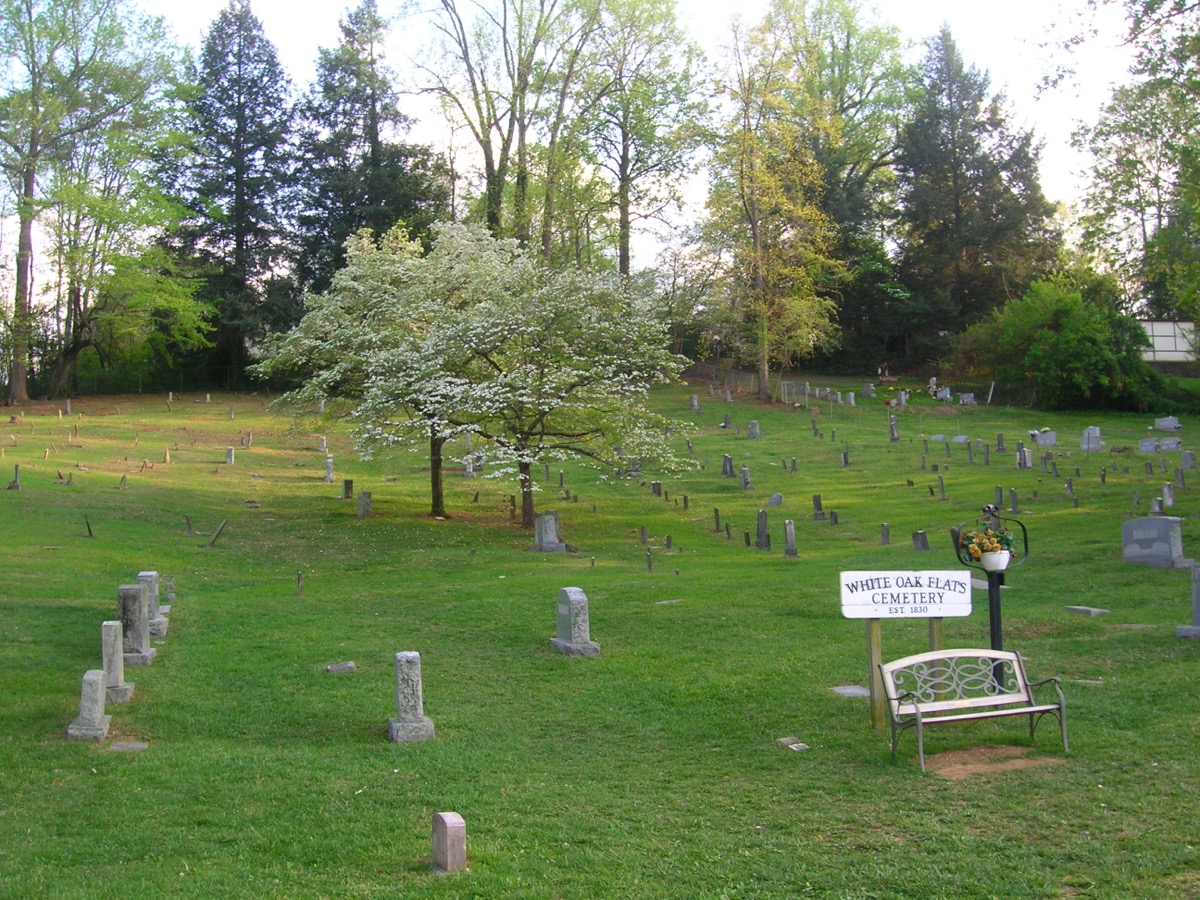
White Oak Flats Cemetery is the oldest graveyard in Gatlinburg, Tennessee, hidden behind a souvenir shop on the tourist strip. Guides say a scarred figure in a bird-skull mask paces its rear fence all night, then sits on it and fades at dawn.
There's a figure that paces the rear fence of White Oak Flats Cemetery in Gatlinburg, Tennessee, all night long. Guides describe her the same way every time: blonde and gaunt, in a long cloak and a mask made from a bird's skull, her body covered in scars from cutting herself. She keeps to the back line until sunrise, and then she sits on the fence and slowly fades into thin air. They call her the Gatlinburg Witch.
The ground she paces is the oldest thing in town. White Oak Flats was Gatlinburg's original name, taken from the white oaks that once covered these mountains, and the cemetery was laid out in 1830, one of the oldest in Tennessee. It sits now in the middle of the tourist strip, tucked behind a Fannie Farkle's souvenir shop, two centuries of mountain founders under soft sandstone while pancake houses and summer gridlock press in on every side. Even the catastrophic 2016 wildfires that tore through Gatlinburg left it untouched.
The people buried here carved the settlement out of the Smokies by hand, and braved disease and hunger to do it. William Ogle prepared the logs for the first cabin but died of malaria in 1803, before he could bring his family over the ridges; his widow, Martha Huskey Ogle, made the crossing and finished it. The Ogles alone account for more than 120 of the burials, alongside the Reagans, Maples, McCarters and Huskeys whose descendants still run shops in town. Many of the graves have no marker at all, because families were too poor to afford carved stone, and the marked ones are mostly hand-etched sandstone worn illegible after nearly two centuries.
The witch has company. A woman in black drifts the grounds examining headstones, protective of her plot, said to have scratched tourists who disrespected it. One man reported watching a shadow figure vanish off a headstone, then feeling himself shoved and raked by something he couldn't see. A group of teenagers who snuck in from their hotel said rocks came flying at them out of empty air. Visitors describe cold spots that go bone-deep even in Gatlinburg's muggy summers.
And the shadow figures don't keep to the fence line. People report them sitting on the headstones, crawling up the walls and the trees, and sometimes drifting out past the gate, down the strip, among the tourists filing between the souvenir shops, most of whom never knew a pioneer graveyard was tucked back there at all.