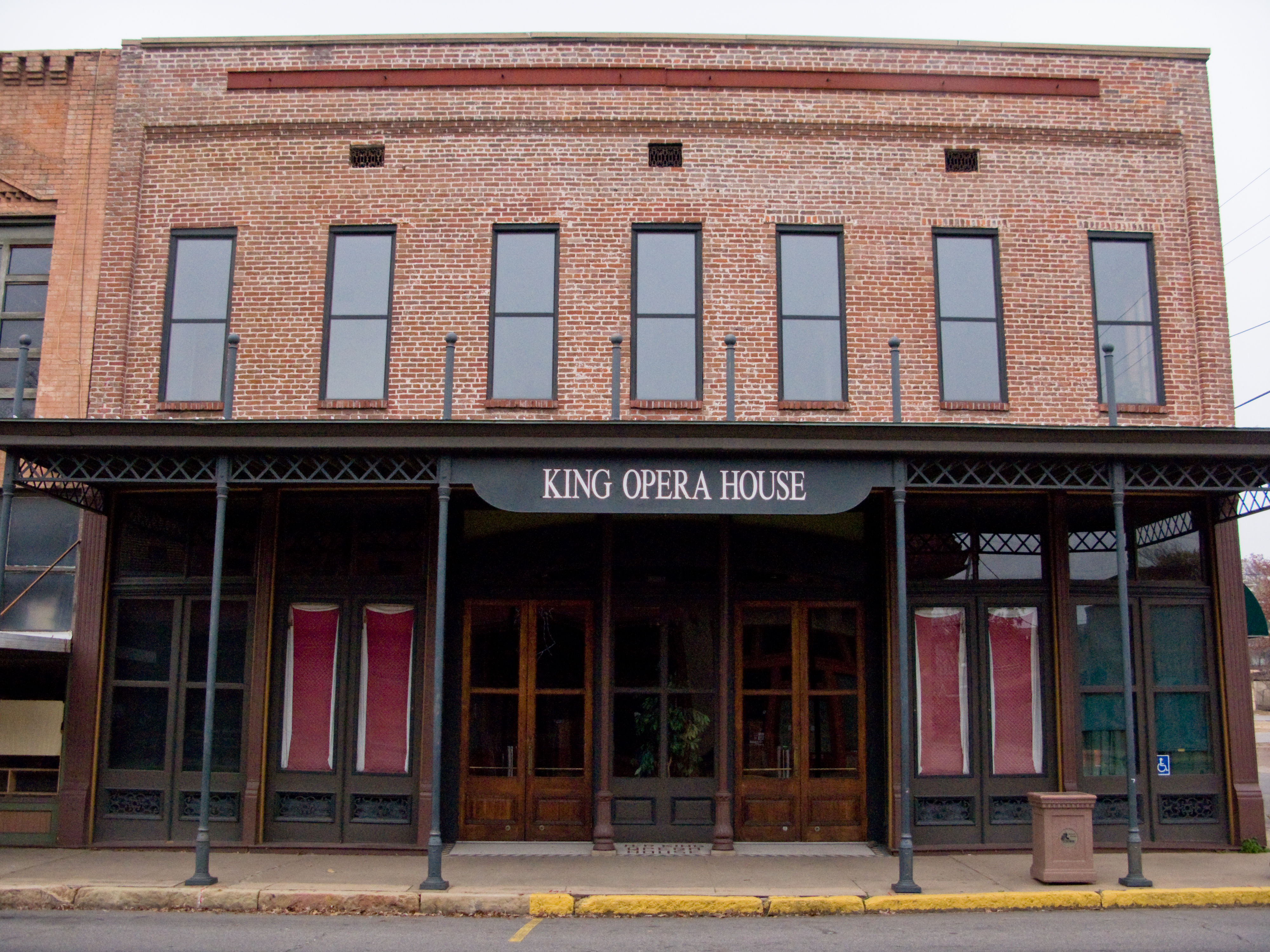
About This Location
This Victorian-era performance hall on Main Street first opened in 1891 and continues to host performances. Its ornate interior preserves the grandeur of 19th-century theater.
The Ghost Story
The building that would become the King Opera House was constructed in 1891 on Main Street in Van Buren, Arkansas, first appearing on the 1892 Sanford-Perris fire insurance map. Originally known as the Wallace Block, the ground floor housed the Willard Billiard Parlor on one side and the Wallace Saloon and Restaurant on the other, while the Van Buren Press newspaper occupied the second floor. In 1898, Colonel Henry P. King purchased the property after returning from the eastern United States, where he had been inspired by theatrical productions. On October 18, 1901, King presented Faust as the venue's inaugural performance, and the opera house quickly became the cultural heart of Van Buren, hosting notables including orator and politician William Jennings Bryan during its vaudeville heyday from the mid-1890s through the early 1930s.
The opera house's darkest chapter began in late September 1903, when the Tolson Stock Company arrived for a week of vaudeville performances. Charles C. Tolson, born December 25, 1868 in Newton, Mississippi, was the troupe's owner and lead actor, a charismatic performer who had been married since 1896 to Lorena Blanch Graves Miller, an actress in his own company. During the engagement, seventeen-year-old Allye Parchman, daughter of local physician Dr. William L. Parchman, became infatuated with Tolson and reportedly dreamed of escaping small-town life with the traveling actor. A local salesman named C.G. Murray informed Dr. Parchman that Allye planned to meet Tolson at the Frisco Train Depot at 7:45 AM on October 4, 1903, and elope with him. Whether Murray fabricated the elopement story out of his own romantic interest in Allye has never been determined.
On the morning of October 4, Dr. Parchman waited inside the depot. When Tolson arrived to board the train to Fort Smith with his troupe, Parchman called out his name followed by "I want to see you." As Tolson turned, Parchman fired his .44 caliber revolver. The first shot missed as Tolson began to run. The second struck his back just above the hip with such force that it spun him around to face his attacker. The third shot hit Tolson's chest but struck his pocket watch, and the impact knocked him to the ground. Critically wounded, Tolson was placed on the arriving train to Fort Smith and admitted to Belle Point Hospital, where he died the following day, October 5, 1903. Notably, Allye Parchman was not at the station when the shooting occurred. At trial, Dr. Parchman was acquitted of murder -- both Allye and Murray had left town and were not present to testify. The case was significant enough to be reported in the Journal of the American Medical Association. Tolson was buried at Oak Cemetery in Fort Smith, where fellow musicians who knew the dead actor assembled to serenade over his grave.
The opera house endured its own traumas in the decades that followed. On March 14, 1914, a fire that began in a dry-cleaning storefront gutted the entire interior. By November 1914 plans were announced to renovate the building into a moving picture house, and in February 1919 it reopened as the Van Buren Theater. In 1937, it was renamed the Bob Burns Theatre after Van Buren's most famous son -- Robin "Bob" Burns, the comedian who invented the bazooka musical instrument (the weapon was later named after his horn due to its similar blunderbuss appearance). The national premiere of Our Leading Citizen, featuring Burns, took place at the venue. Malco Theatres operated the building from the 1930s until it closed in 1974 due to deteriorating conditions. In 1979, the City of Van Buren purchased the property and undertook a restoration completed in 1991, returning it to its opera house configuration with 218 ground-floor seats and 96 balcony seats. In 2022, the nonprofit Arts on Main assumed management, continuing renovations including a new sound system and period-correct seating.
It is Tolson's ghost that staff and visitors most frequently report encountering at the site of his final performance. The apparition appears dressed in a long black Victorian coat, top hat, and cape, and has been seen by multiple witnesses over more than a century of reports dating to the early 1900s. One former director of the Young Actor's Guild, which regularly performed at the opera house, reported closing up one night and carefully turning off every light, only to return the next morning to find every light in the theater switched back on. A woman in a white dress has been seen in the hallways and men's restroom, asking startled visitors "Have you seen Henry?" before vanishing -- her identity and connection to Colonel King remain unknown. Other witnesses have reported a tall man in 1920s clothing who disappears into thin air, red eyes lingering near the stage, and an overwhelming sensation of being watched when alone in the building. During a dance recital, young performers reported a bathroom sink turning on by itself repeatedly despite being shut off. One visitor described a sudden temperature drop in an upstairs bathroom accompanied by an intense odor resembling blood, which ceased as abruptly as it began.
Paranormal investigators who have visited the opera house report electromagnetic field fluctuations near the stage and dressing rooms, and audio recordings have captured faint whispers, including one phrase that stands out: "It wasn't supposed to end this way." In 2021, a visitor named Haven identified herself as a descendant of Charles Tolson and visited the opera house with her family to pay respects at the site of his last performance. In 2023, filmmakers Gavin Webb and Diego Lane produced The King Opera House: A Paranormal Documentary, investigating whether the building deserves its reputation as one of the most haunted places in Arkansas. The film is available on Amazon Prime Video and Tubi. Haunted Rooms America now hosts overnight ghost hunts at the venue, providing EMF meters, trigger objects, and guided investigation sessions in the building where a murdered actor still refuses to leave the stage.
Researched from 12 verified sources including historical records, local archives, and paranormal research organizations. Learn about our research process.