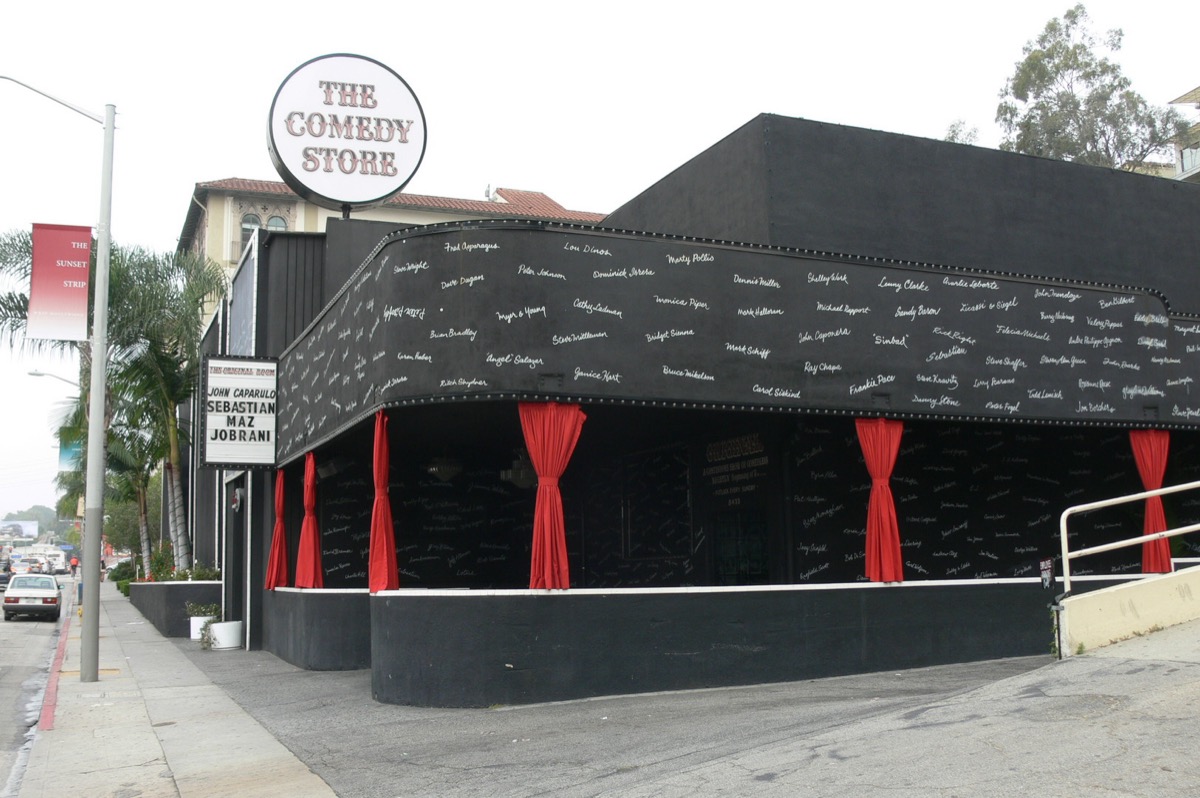
The Comedy Store

The Comedy Store

🎭 theater

West Hollywood, California · Est. 1940

About This Location

The building that houses The Comedy Store was built in the late 1930s and opened as Ciro's nightclub in 1940, becoming the premiere hangout for Hollywood stars and mob figures including Frank Sinatra, Nat King Cole, Cary Grant, and gangsters Bugsy Siegel and Mickey Cohen. The Mob "had its fingers in this club," with the basement allegedly used for torture and killings. After Ciro's closed, the building became The Comedy Store in 1972.

👻

The Ghost Story

The building at 8433 Sunset Boulevard was completed in 1935, initially housing the ill-fated Club Seville where patrons danced on a glass floor above live fish. In 1940, Hollywood Reporter publisher Billy Wilkerson transformed it into Ciro's, instantly becoming the Sunset Strip's most glamorous nightspot. Marilyn Monroe, Humphrey Bogart, Lauren Bacall, Frank Sinatra, James Dean, Judy Garland, Lucille Ball, and Desi Arnaz all frequented its tables. But so did darker clientele—mobsters Bugsy Siegel and Mickey Cohen, who became known as "The King of the Sunset Strip."

Cohen ran his criminal empire from a second-floor office at Ciro's, where it's said he carried out multiple murders. The basement became the mob's torture chamber and killing room during the bloody "Sunset Wars" of 1947 when gangsters fought for turf control. Legend holds that Cohen buried some victims under the basement floor. The building still contains peepholes and handgun stations from that era. Doormen were mob hitmen, and customers with unpaid gambling debts had their legs broken in the basement.

When comedian Sammy Shore and his wife Mitzi opened The Comedy Store in 1972—the world's first all-stand-up comedy club—they inherited more than a building. Richard Pryor, Robin Williams, Jay Leno, Roseanne Barr, and countless others launched careers here, but the dead from Ciro's never left.

At least two deceased mob doormen haunt the premises. "Gus" appears in the main showroom wearing his trademark black suit and fedora, watching the crowd and eyeing the staff. He has a temper—when one comedian joked about the ghosts, an ashtray lifted from a nearby table, floated several feet through the air, and struck him. Another enforcer named Anthony also roams the building.

Blake Clark, who worked as doorman and security guard while building his comedy career, experienced horrors that made him vow never to enter the basement. One quiet afternoon, while playing video games near the kitchen, he felt a presence three feet behind him. A man in a WWII brown leather bomber jacket stood watching—but when Blake turned to speak, he could see right through the man, who faded away before his eyes. Another night, Blake watched a chair slide across the stage on its own—three feet, ten feet, twenty feet—until he fled.

At 3 AM one morning, Blake heard a guttural growl from the basement. He descended to find the padlocked metal gate "bending out into the hallway" as if something was pushing to escape. When the gate snapped back, a massive dark form stood before it—seven feet tall, featureless, radiating what Clark described as "tremendous malevolence." The entity moved in serpentine patterns before flying away at supernatural speed.

Fellow comedian and doorman Joey Gaynor had his own encounters. At 3 AM, he repeatedly blew out candles that reignited each time he turned away. After taunting the spirits, an ashtray flew at him. He heard sounds behind the stage and discovered chairs mysteriously stacked in the aisle—no one present. Another night, employee Lou Deck found 400 chairs piled to the ceiling in a room that returned to normal moments later.

The Belly Room, a small second-floor venue, is haunted by Sam Kinison, the screaming comedian who died in 1992. During his lifetime performances, voices chanted "It's him" angrily over the speakers, and when he once demanded the ghost show itself, all the lights in the building went out. Jay Mohr reports always feeling cold on the right side of his face when performing there.

In the basement, a woman's crying and moaning echo late at night—the ghost of someone who died from a botched back-alley abortion during the Ciro's era. General Manager Jody Barton suggested the "Belly Room" name itself may reference these tragic underground procedures performed on pregnant prostitutes.

The 1979 Comedy Store strike added another spirit. Comedian Steve Lubetkin was blacklisted after the labor action and banned from performing. On June 1, 1979, he jumped from the fourteen-story Continental Hyatt House next door, reportedly aiming to land on The Comedy Store but missing. His body struck the cement parking ramp beside the club. His suicide note read: "My name is Steve Lubetkin. I used to work at The Comedy Store." His ghost reportedly still watches performers, seeking redemption.

Dr. Barry Taff, the UCLA parapsychologist, investigated in 1982 and experienced agonizing pain in his legs upon entering the basement—a psychic echo, he believed, of mob torture victims. Two coins fell from the ceiling inexplicably. In 1994, he observed three men in 1940s suits with wide lapels standing at the back of the main room; when he approached to acknowledge them, they vanished before his eyes.

Ghost Adventures investigated on January 1, 2021, with comedians Jeff Ross and Jay Mohr sharing their experiences. The crew captured EVPs of disembodied voices demanding "GET OUT," "DIE," and "HELP." An amber orb flew over an investigator's shoulder on camera. Zak Bagans felt cold spots throughout the building, lending credence to the torture chamber legends.

Vice President Michael Becker once watched a man in a 1940s tweed jacket walk between desks, glance at him, and vanish through a doorway. The adjacent office saw no one pass through. The upstairs piano plays itself in empty rooms. Over 70 years of mob violence, tragic deaths, and restless spirits have made The Comedy Store one of Hollywood's most haunted landmarks—where laughter echoes alongside screams from another era.

Researched from 12 verified sources including historical records, local archives, and paranormal research organizations. Learn about our research process.

More Haunted Places in California

🏥

Camarillo State Mental Hospital Site

Camarillo

🎓

Santa Clara University

Santa Clara

🏨

Delta King Riverboat Hotel

Sacramento

👻

Griffith Park

Los Angeles

🏥

Linda Vista Community Hospital

Los Angeles

🏨

Mission Inn Hotel & Spa

Riverside

View all haunted places in California

More Haunted Theaters Across America

Orpheum Theater

Madison, Wisconsin

Belasco Theatre

New York, New York

Colonial Theatre

Laconia, New Hampshire

Springer Opera House

Columbus, Georgia