TLDR
In 2019, a backhoe at the 1886 Crescent Hotel pulled up hundreds of jars from a 1930s fake-cancer clinic. One held a bedsore.
The Full Story
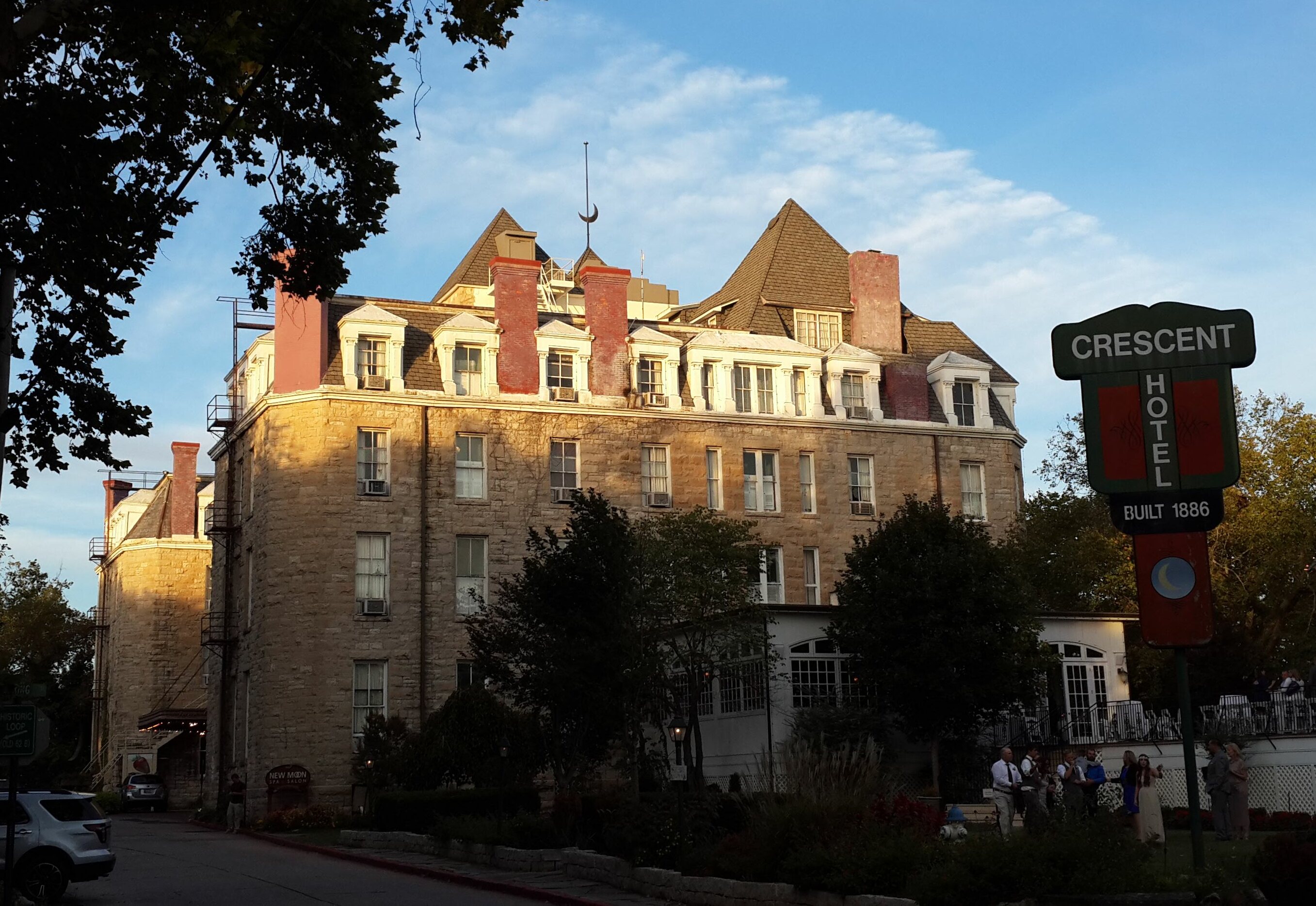
On February 5, 2019, a landscape gardener at the 1886 Crescent Hotel in Eureka Springs was expanding a parking pad with a backhoe when the bucket hit glass. He kept digging. By the end of the day there was a pile of medical-looking bottles in the dirt. The Arkansas Archeological Survey took over, and University of Arkansas analysts went through hundreds of artifacts dating to 1938-40. The contents lined up with what locals had whispered about for eighty years. One specimen jar held a removed bedsore, which was strange, because the clinic that buried this stuff was not supposed to be doing surgery at all.
The clinic was Norman Baker's Baker Hospital and Health Resort, and it ran out of the Crescent from 1937 to 1939. Baker had no medical training. The Iowa Supreme Court had already shut down his medical practice in 1931, and the FRC had pulled his Muscatine radio station's license the same year. None of that stopped him. He bought the hotel, painted the lobby bright purple with geometric designs, drove a custom lavender Cord around town, and started taking in terminally ill cancer patients. His marketing called Eureka Springs the "Switzerland of America" and promised "Where Sick Folks Get Well."
The treatment was called Formula 5. Alcohol. Glycerol. Carbolic acid. Ground watermelon seed. Corn silk. Clover leaves. Injected directly at cancer sites, up to seven times a day. Patients who died were wheeled to the basement morgue, which had an autopsy table and a walk-in cooler. The morgue is still there. It is part of the nightly ghost tour.
Federal mail-fraud charges opened in September 1939. In January 1940 the court called the cure "pure hoax" and "utterly false." Baker did time at Leavenworth from May 1941 to July 1944, then drifted to Florida, where he died of cirrhosis in September 1958. Sources disagree on what he extracted from his patients. Encyclopedia of Arkansas pegs it at roughly $4 million; Smithsonian says $10 million. Millions, either way, from people who came up the mountain because they had nowhere else to go.
That is the real history. The hauntings sit on top of it, and you can guess which floor most of them live on.
The lead ghost is Michael, said to have been a 17-year-old Irish stonemason who fell from the second floor during construction in the 1880s and landed in what is now Room 218. No primary record of the fall has surfaced. Ghost-tour guides have told the Michael story for decades, and guests book 218 ahead of any other room in the hotel, but the documentary trail is empty. Guests in 218 describe hands coming through the bathroom mirror, the shower curtain pulled back, the sound of a body hitting the ceiling. Longtime Eureka Springs ghost-tour guide Dan Bennett described an incident there during a paranormal weekend: "the upper-right-hand drawer was slowly opening all by itself. This is one of the things people talk about." That is the cleanest named account in the sources. Most of what guests report is aggregated; no dated witness, no name attached.
Room 419 belongs to Theodora, a woman said to have been one of Baker's patients. Room 212 belongs to Dr. John Freemont Ellis, who was the hotel's in-house physician around the turn of the century. Staff in 212 say they catch the smell of his cherry pipe tobacco, sometimes strong enough that guests assume someone is smoking in the hall. Baker himself supposedly turns up in the lobby in his signature lavender shirt and white linen suit, which matches how he actually dressed when he ran the place.
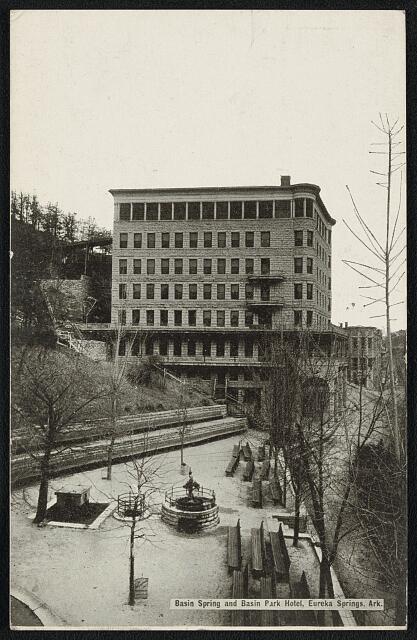
The hotel was built by the Eureka Improvement Company, headed by former Arkansas governor Powell Clayton, and designed by St. Louis architect Isaac S. Taylor as a blend of Richardsonian Romanesque and French Renaissance. Construction cost $294,000. The walls are 18-inch-thick magnesium limestone blocks, hand-quarried near Beaver on the White River and hauled up the mountain by Irish stonemasons. It opened May 1, 1886, with a banquet on May 20 honoring James G. Blaine, and was added to the National Register of Historic Places on January 26, 2016. Between the resort era and Baker, it operated, with interruptions, as the Crescent College and Conservatory for Young Women from 1908 into the early 1930s. A fire in March 1967 took the fourth floor and penthouse. Marty and Elise Roenigk bought the building in 1997 for $1.3 million and started restoring it. Elise still owns it.
The hotel does not pretend the Baker years did not happen. The ghost tour walks you through the morgue. Local actor Keith Scales performs a one-man piece as Baker. Rebecca Becker keeps a fourth-floor museum and library about the hotel's history. The TAPS team filmed a Ghost Hunters episode in the morgue, "The Crescent Hotel & Dr. Ellis," and called a thermal-camera figure they captured down there something other than a reflection. Ghost Adventures filmed in 2019.
You can find a ghost tour at half the old hotels in America. Most of them are a script and a flashlight and a list of cold spots that does not survive a second drink. The Crescent is not that. The thing that distinguishes it is not Michael or Theodora or the lavender lobby apparition; it is that a backhoe broke ground in 2019 and pulled up the actual physical evidence of one of the cruelest medical scams in twentieth-century American history. Somebody who came up here to die had a bedsore cut off them and bottled, and that jar sat under the dirt for eighty years waiting to be found. The ghosts are downstream of that.
The basement is on the night tour. The autopsy table is still there. So is the cooler.
Researched from 11 verified sources. How we research.