About This Location
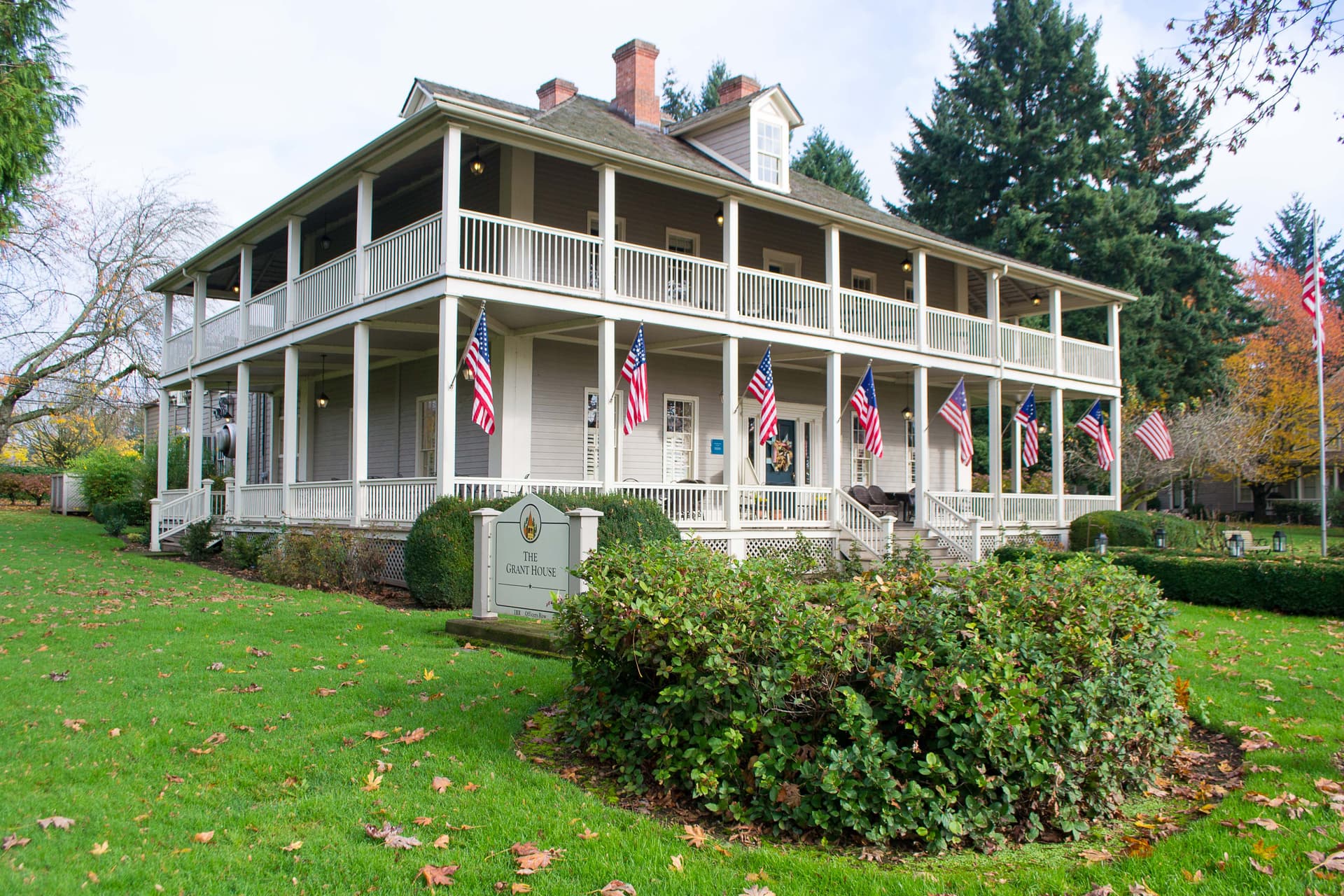
A National Historic Site featuring Officers Row and the 1849 Grant House, the oldest building on the row, once headquarters for Army commanders.
The Ghost Story
Fort Vancouver began as a Hudson's Bay Company fur trading post established in the winter of 1824-1825 by Chief Factor John McLoughlin on the north bank of the Columbia River. Under McLoughlin -- known as the "Father of Oregon" -- the post grew into the commercial and administrative headquarters for all HBC operations west of the Rocky Mountains, controlling 34 outposts, 24 ports, six ships, and 600 employees at its peak. Its influence stretched from Alaska to California, and when American settlers began pouring down the Oregon Trail in the 1840s, McLoughlin defied company orders to provide them with food, supplies, and credit. The 1846 Oregon Treaty ceded the territory to the United States, and on May 13, 1849, Companies L and M of the U.S. Army First Artillery arrived and raised an American flag on a fir tree to establish Camp Columbia on the bluff above the aging fur trade fort.
The Grant House, built in 1849 by Captain John S. Hatheway and his 76-soldier company, is the oldest surviving structure on Officers Row -- a congregation of 21 former military residences that would eventually house some of the most consequential figures in American military history. Constructed of hand-hewn logs later faced with wood lap siding, the building served as both headquarters and commanding officer's residence. Despite its name, Ulysses S. Grant never lived in the house. He arrived in 1852 as a brevet captain and regimental quartermaster with the 4th Infantry, quartered instead at the Quartermaster's Depot near the river. The installation was renamed four times -- Camp Vancouver, Columbia Barracks, Fort Vancouver, and finally Vancouver Barracks in 1879 -- and its Officers Row residents over the decades included Major General Oliver Otis Howard (Medal of Honor recipient, founder of Howard University, commander of the Department of the Columbia 1874-1880) and Brigadier General George C. Marshall, who commanded a 3rd Division brigade from 1936 to 1938 and later authored the Marshall Plan.
The primary ghost of the Grant House is General Alfred Sully, who commanded Vancouver Barracks from September 23, 1877, until his death there on April 27, 1879. Son of the famous portrait painter Thomas Sully, Alfred graduated from West Point in 1841 and fought in the Second Seminole War, Mexican-American War, and Civil War, where he commanded a II Corps brigade at Fredericksburg before being reassigned to lead punitive expeditions against the Sioux in the Dakota Territory. By the time he reached his final posting at Vancouver Barracks, he was suffering from chronic illness -- likely an esophageal ulcer that caused him considerable pain and sleepless nights pacing the hallways. His death was ruled an aortic hemorrhage due to complications from the ulcer. He was buried at Laurel Hill Cemetery in Philadelphia, but his restless spirit apparently never left Officers Row.
Staff and visitors have reported Sully's presence in the eastern end of the building's second floor, near his former quarters. Cold spots and deliberate pacing footsteps echo through the upstairs hallway. An unplugged telephone rang repeatedly in the Grant House, baffling staff. Doors open and close on their own. A restaurant owner reported that Sully's ghost once locked a telephone repairman inside the house, and the general apparently appeared to at least one visitor, telling her: "I lived here before, and I am just looking around." Restaurant staff reported a hostess who saw a boy in a suit sitting quietly in the waiting area, though coworkers saw no child. An accountant working late heard footsteps outside her office with no one present, then felt a cold sensation pass through her body. A museum curator who lived in a back apartment kept an orange cat named Chadwick who would track invisible presences through the rooms, following something unseen with the focused attention cats reserve for things humans cannot perceive. English muffins repeatedly fell from stable shelves during investigations. One visitor described overwhelming anxiety ascending the narrow stairs to the top floor, "as if we were expecting someone to pop out and say 'Boo!,'" and upon fleeing, observed a man in the window of the top floor.
But the Grant House is not the only haunted building on the former military reservation. Author and historian Jefferson Davis, a retired Army major who worked at Vancouver Barracks for 32 years and co-authored Weird Washington, has documented spirits across the entire site through his "Spirit Tales of the Vancouver Barracks" walking tours. A spectral sentry patrols the parade ground near the guard house -- Davis traced this to an 1880s newspaper account of a soldier who finished his sentry shift and then killed himself with his own rifle. Along Officers Row, the ghost of a nanny haunts the Windermere Realty building, connected to a woman who reportedly killed herself after bearing a child by the master of the house. At an old Army building converted to offices, an entity named Elizabeth confronted dates brought home by a man with a home office, telling one woman to "leave, but be careful on her way out" and advising another to "stop drinking." In the post hospital, Davis himself spent a night in the basement outside the morgue door -- where, during the 1918 influenza epidemic, so many soldiers died that overflow bodies had to be stored across the street at the post dentist's office. During his investigation, a table began rocking across the floor on its own, and afterward, all three investigators' synchronized watches displayed different times. The Admiral Paul Nelson Mansion on Officers Row has reported blood dripping from its walls and grass dying and reviving in unnatural cycles.
Fort Vancouver National Historic Site encompasses 366 acres as part of the Vancouver National Historic Reserve, established in 1996. A full-scale replica of the Hudson's Bay Company fort, reconstructed on its original foundations beginning in 1966, is open to the public. Officers Row was acquired by the City of Vancouver beginning in 1980, with the Grant House and 19 other structures purchased from the Veterans Administration for one dollar. The Grant House now operates as the Eatery at the Grant House restaurant, where Sully apparently enjoys supervising the staff and occasionally helping himself to a cup of coffee. Jefferson Davis leads his Spirit Tales walking tours through the grounds, combining his expertise as a military historian and paranormal investigator to connect the ghostly reports to the documented tragedies that produced them.
Researched from 16 verified sources including historical records, local archives, and paranormal research organizations. Learn about our research process.