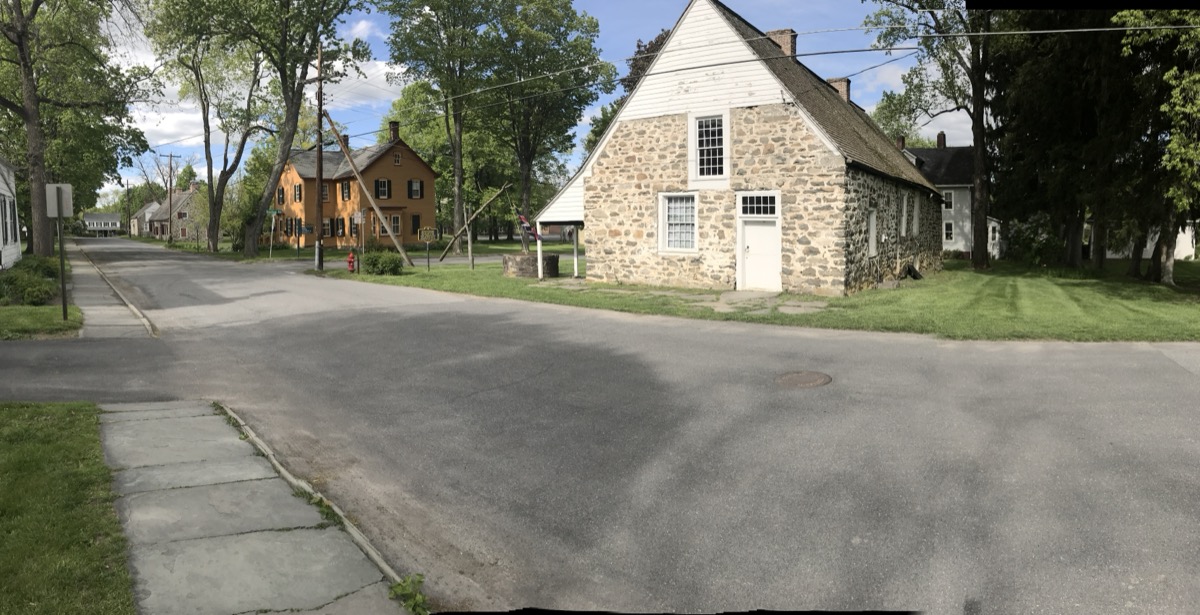
Historic Huguenot Street in New Paltz, NY is a row of seven early-1700s stone houses, and the story is that each one kept its own ghost. Curators say a portrait keeps moving on its own. A woman in white sobs at a well where a real death happened.
Historic Huguenot Street in New Paltz, New York is a row of seven early-1700s stone houses, and the trouble curatorial staff describe starts with one of the portraits. It hangs in the Deyo House, a likeness of Gertrude Deyo, and they keep finding it where they didn't leave it. Moved to another room. Turned face-down. Sometimes hung to face the wall.
Gertrude sat for that portrait three months before her daughter was born, already showing the signs of the tuberculosis in her. She died 17 days after the birth. The story told on the street is that she left a fertility curse on the house before she went.
The street is one of the oldest continuously inhabited settlements in the country. French Huguenot families settled here in 1678 after negotiating with the Esopus Indians, and the stone houses went up not long after, the oldest dated by its timbers to 1721. Seven of them survive in a row, and each, the staff will tell you, came with a resident.
Down at the Freer House, the resident is a woman in white. On July 14, 1931, Annie M. DuBois threw herself into the homestead well and died there, intestate; the property was sold off the following year. Visitors and staff say a woman in a long white gown is seen sobbing at the edge of that well, and people report a wave of grief near the spot they can't account for.
Not every ghost on the street died gently. Howard Hasbrouck Grimm, an 82-year-old widower and an officer of the historical society that runs the place, was murdered with an axe at his New Paltz home in 1970 by a young exchange student. His ghost, the story goes, still walks the street at night. In the Abraham Hasbrouck House, tour lore tells of a man in a long dark coat with an axe and a black dog, looming over sleeping people, though that figure lives only in the telling.
The houses hold older, harder history too, and this part is documented. A human skull was unearthed near the Deyo House around 1894. In 2013, a SUNY New Paltz anthropologist identified it as a middle-aged man of African descent, likely enslaved by the Deyo family. He was reinterred at the Old French Church Burial Ground, under a stone carrying an African Sankofa motif. "That's irrelevant, in a way," the site's director of education said of his unknown name. "He's representing hundreds of others who lived here as slaves." A 1755 census records four enslaved people in the Abraham Hasbrouck House alone, likely housed in the cellar.
The organization keeps a light burning in the windows of the houses at night. A tour guide explains it as comfort for the spirits inside, or a way to ward off the unkind ones. Seven houses standing in a row, four centuries deep, and a small flame left on in each one after dark.