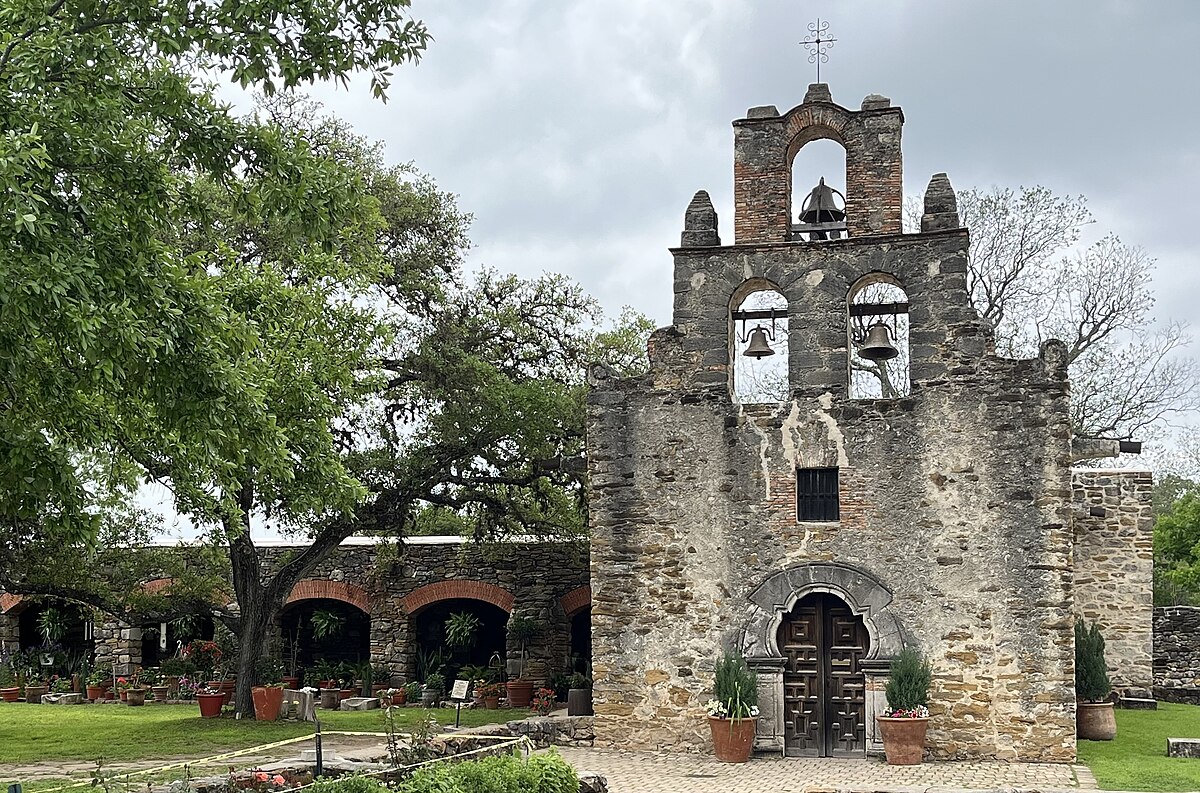
At Mission Espada, the southernmost of San Antonio's Spanish missions, visitors and volunteers report a conquistador standing in the courtyard, soldiers in armor riding across it, and a man praying at an altar nobody else can see.
A volunteer at Mission Espada, the southernmost of San Antonio's Spanish missions, was looking out at the courtyard one day when a very large man appeared on the far side. He was dressed in full conquistador regalia, and he seemed to be taking in the grounds. Then he was gone. "He described him as larger than life," Park Ranger Dava McGahee told the San Antonio Express-News in 2005. "But just like that, he was there and then he was no longer visible."
McGahee ran the visitor center at a different mission, San José, and she has never seen an apparition at the missions herself. The volunteer brought the story to her, and she carried it to the paper. He was never named, and no date was ever attached to what he saw.
The same 2005 article collects two more Espada sightings, both arriving through the local author and tour guide Docia Williams. One person described an American Indian praying at the altar inside the chapel, who then disappeared. Someone else described Spanish soldiers in full armor riding across the courtyard. Every witness in the record is a visitor or a volunteer, because nobody lives on the mission grounds.
Espada was the first mission in Texas. It was founded in 1690 out in East Texas as a buffer against the French, and it moved four times before it was planted on this bank of the San Antonio River on March 5, 1731 and renamed for the sword. A period description of the mission has its bells clanging three times a day, "startling in the still country air."
Then 1826. Comanches raided the cornfields and killed the livestock, and a kitchen fire that same year took most of the buildings. Only the chapel survived. Every account of the raid is careful to say the Comanches killed animals, not people, and there is no documented death at Espada that the conquistador or the soldiers could be pinned to. Estella Kierce, a Coahuiltecan descendant featured in the park's Four Voices exhibit, says her great-great-grandmother was born at Mission Espada on February 23, 1826, the year of the raid and the fire. Descendants worship in that surviving chapel today.
Williams did not think any of it was hostile. "I don't feel like there's anything evil there," she said of the missions. "If there are spirits there, it's more from a caretaker's feeling." McGahee had a similar read on the man in the courtyard: maybe he was only there to see how the mission had turned out.
The older story on the South Side is not gentle. Longtime residents told Williams about a large black dog or wolf at Espada, and a 2017 write-up gives it dangling chains. It grows as it chases its target, they say, and disappears moments before catching its prey.