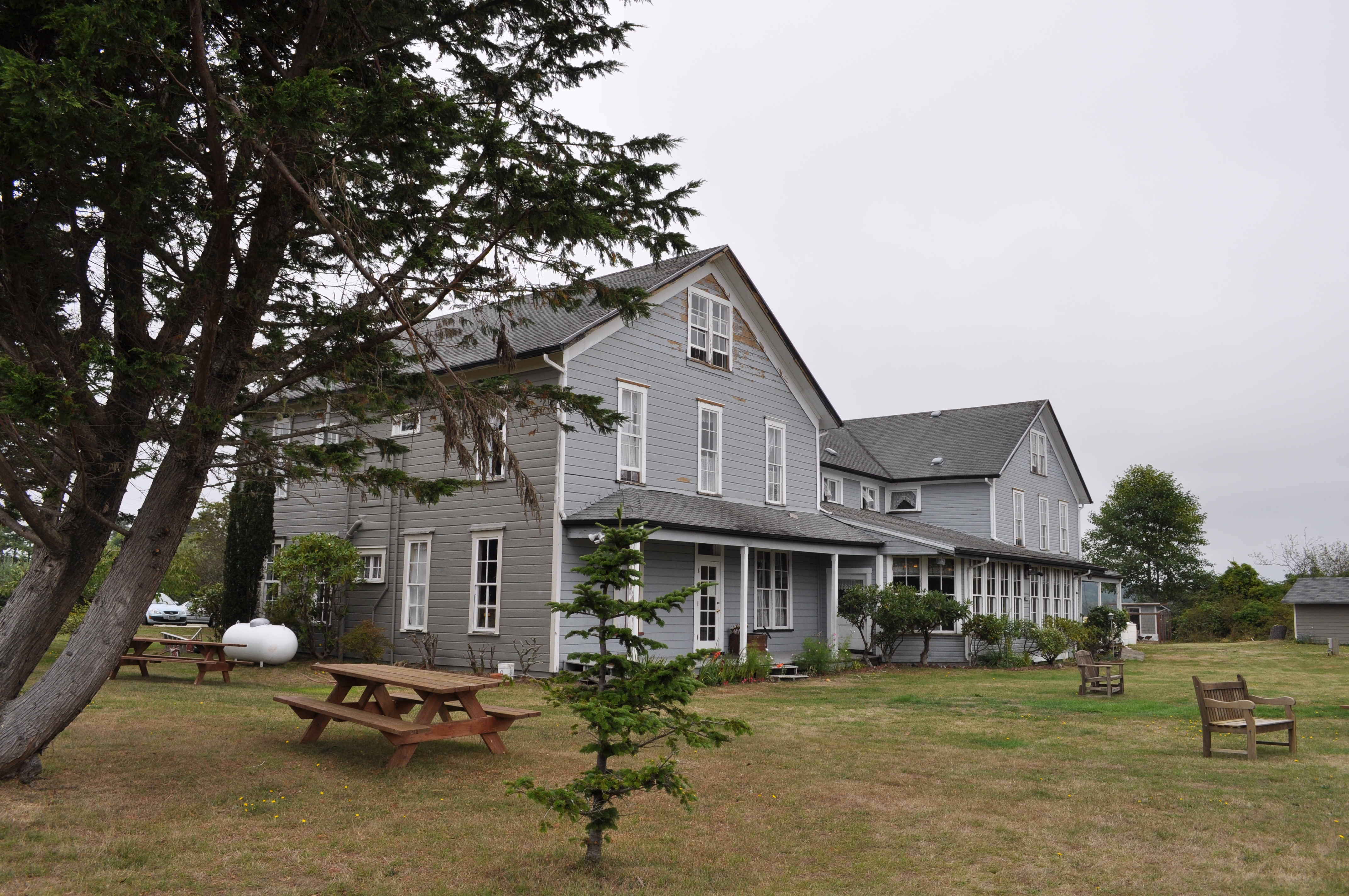
The Tokeland Hotel on the Washington coast keeps a logbook of strange occurrences that came with the building as a furnishing. Most of the 50 or 60 entries point at Charley, hidden behind the parlor fireplace, who died there when somebody lit a fire.
The Tokeland Hotel sits on a low finger of land in Tokeland, Washington, between the Pacific and Willapa Bay, and for decades it has blamed a man named Charley for the dinner plates. They lift off the tables in the dining room, spin, and settle back down. One former owner told of local fishermen watching a plate rise, turn, and reset itself in front of them.
Charley died in the walls. Every telling agrees on that much, then splits. The ghost-lore version has him a Chinese immigrant smuggled toward the Pacific Northwest railroads during the Exclusion era, jumping ship off Toke Point, swimming ashore, and being hidden by the family who built the place in a compartment behind the parlor fireplace. General manager Nic Krause tells it with no ship in it at all: Charley had escaped indentured servitude, was already living and working at the hotel, and got put behind the fireplace when the men owed his service came looking for him. Both versions end the same way. Somebody lit a fire without knowing he was back there. Sources disagree on what killed him, carbon monoxide or smoke or simply the air running out.
No record of him exists. No death notice, no coroner's line, no name in a newspaper. The hiding place is still a small room, Krause says. The hotel stores firewood in it now.
What the building does have is a logbook, which came with the hotel as a furnishing and holds 50 or 60 accounts reaching back 30 or 40 years: shadow figures, taps in the night, something glimpsed in a mirror, something that zinged across a room.
Two nights before Krause spoke to KIRO Newsradio in October 2019, the only two guests in the building emailed him around four in the morning. They were in Room 9. "There is a knocking in in the walls at the hotel," they wrote, "it has a rhythm to it that is a bit frightening and we're wondering if there's anyone else here, if you could investigate." He went and looked. Nobody, nothing, everything locked up tight.
Guests report a cat too, the weight of one landing on the foot of the bed and crossing the covers before it goes through a wall.
And there are headstones on the lawn. Two belong to Lizzie Kindred's half-brothers: Albert, who at 10 got stuck in the mud of a tidal slough and drowned as the water came in, and Leonidus, shot dead at 24. The shore just west of here is the fastest-eroding coastline on the West Coast, and the cemetery that held those graves is gone. Moved out ahead of the water, says one account. Taken whole by a storm in the 1970s, says another, the stones recovered later by duck hunters. That second account counts a third stone, separated from whatever remains the ocean took. It is marked only CLL. Nobody has identified the burial, and some at the hotel have decided the initials are Charley's.