TLDR
A Texarkana mansion shaped like a playing card, built in 1885 with $10,000 from a single poker hand. Anchor stop on the city's Ace of Clubs ghost walk.
The Full Story
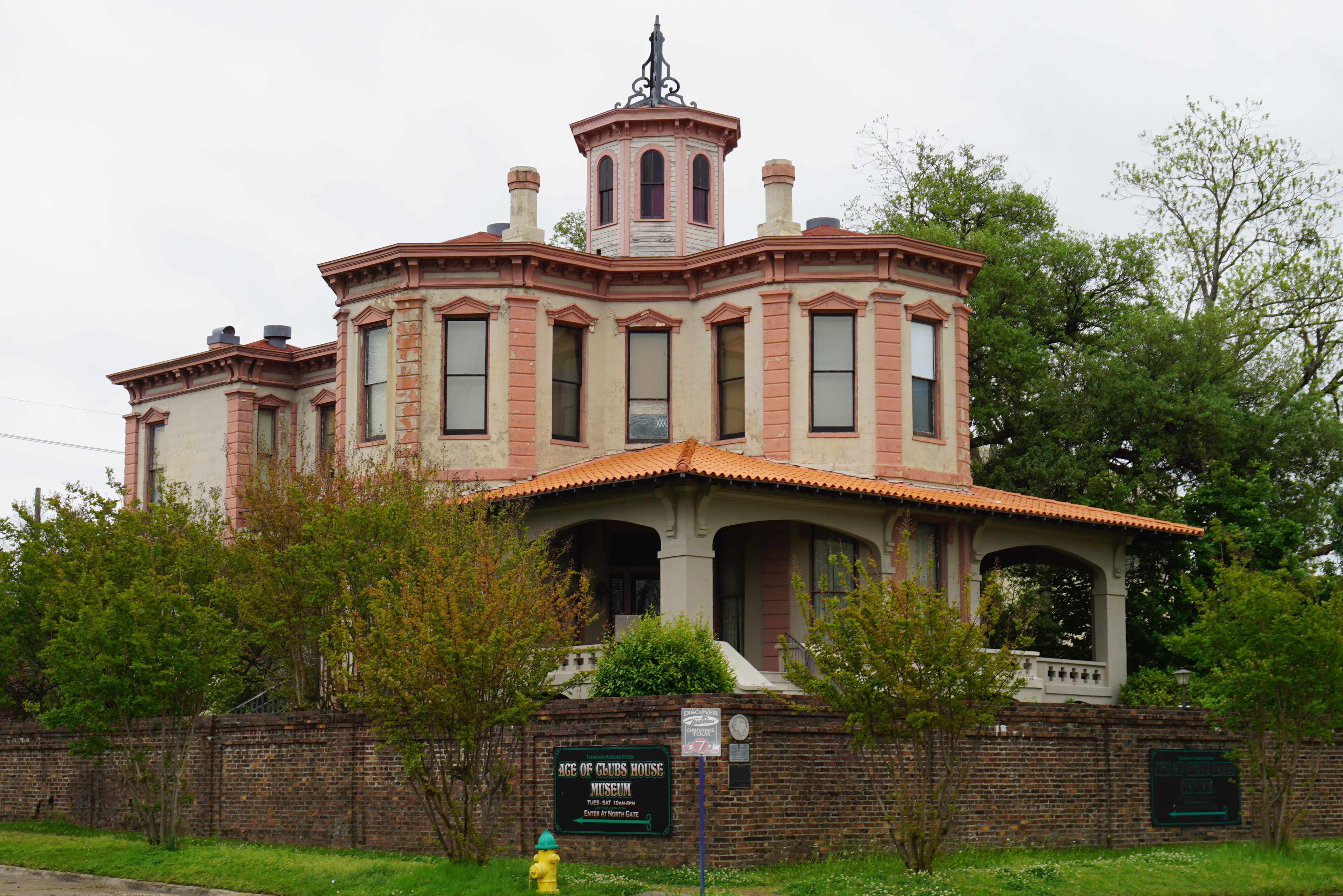
The house is shaped like a playing card. Look at it from above and you see the club suit, more or less: three octagonal wings fanning around a central octagonal rotunda, with a rectangular wing trailing off the back as the stem. Twenty-two sides total. A twenty-foot tower rises off the rotunda with a spiral staircase coiled inside it. There is nothing else like it in Arkansas, or in Texas either, depending on which side of State Line Avenue you're standing on when you ask.
The story local tour guides tell is that James H. Draughon won the money to build it on a single hand of poker. Ten thousand dollars, ace of clubs as the winning card. Draughon liked the joke enough to put the answer in the architecture. The Library of Congress catalog notes the legend without endorsing it, and no primary record settles whether the poker game actually happened, but the floor plan is real and the story is what Texarkana has decided to remember.
Draughon was a real man. He was born in Waverly, Tennessee in 1843, fought with the 22nd Tennessee Infantry, took a wound at Shiloh in 1862, and settled in Texarkana in 1873, the same year the Texas side of town was founded. He ran dry goods and lumber, served as the city's second mayor, and presided over First National Bank for a decade. He built the Ace of Clubs in 1885 and lived there with his first wife Alice until her death in 1892. He left Texarkana around 1890, married Anna Northen of Georgia in 1893, and eventually founded his own town in Arkansas called, of course, Draughon.
After he left, the house passed through a short line of owners. William Lowndes Whitaker Sr. acquired it in 1887 and held it until 1894. (Sources disagree on the exact end of Whitaker's tenure; 1890 appears in some accounts, 1894 in most, and the research couldn't settle it cleanly.) Henry Moore Sr., an attorney, bought it in 1894. Henry Moore Jr. moved in with his wife Olivia in 1920. Olivia outlived her husband by more than forty years and stayed in the house until she died in 1985. She willed it to the Texarkana Museums System. Restoration began in 1987 and the house opened as a museum in 1988.
The haunting is quieter than the architecture, and the research file makes it clear it should stay that way. The story passed around on the Texarkana Ghost Walk is that one of Draughon's youngest sons fell from a tree in the front yard and died, and that a small boy is sometimes glimpsed near where the tree used to stand. There is no obituary, no census line, no family record that confirms this. The Encyclopedia of Arkansas lays out Draughon's ten children carefully and notes only that "one died in infancy." The tree-fall story has lived in Texarkana's oral tradition for decades and shows up in local newspaper features, but no one has produced the boy's name or the year. So the legend gets told here for what it is: a legend, on a walking tour, in the dark.
No paranormal investigators have worked the house. No EVPs, no cable-TV crews, no thermal-camera footage. The Texarkana Museums System does not market it as haunted. What they do market is the Ghost Walk, which starts at the Ace of Clubs and threads downtown past the Hotel Grim, the Swampoodle District, and the Silvermoon Theater. The tour's own description is honest about its register: "you will hear some of the history of Texarkana not often told, along with some of the unexplained legends." Unexplained legends. Not investigations. Not evidence. The right frame for the place.
Most of what's worth seeing here is daylight stuff anyway. The interior is staged in layers. The library set to the 1880s, the parlor and dining room to the turn of the century, the kitchen to the 1920s, the master bath and music room to 1930s Art Deco, one bedroom to the 1940s. The Moore family did the practical updates: bathroom and kitchen wings in the late 1890s, and a Spanish Revival porch swapped in for the original iron galleries in the 1920s. The collection inside is unusually rich for a small-city house museum. There is a Steinway baby grand from around 1902. An English walnut chest-on-chest from the late 1720s. An RCA color television from 1958 said to be the first in Texarkana. More than five hundred pairs of Neiman Marcus shoes that Olivia accumulated and apparently never threw away.
The house earned a Recorded Texas Historic Landmark designation in 1964 and joined the National Register of Historic Places on June 29, 1976. It sits at 420 Pine Street on the Texas side of State Line Avenue, which is a technicality Texarkana has always been comfortable ignoring — the city is one place that pays taxes to two states, and the Ace of Clubs gets listed as Arkansas and Texas with equal frequency.
If you want the ghost story, take the night walk and let the guide tell it the way Texarkana tells it. If you want the building, go in the day. The bronze marker the Texas Historical Commission set in 1964 still sits out front, and it describes the floor plan in the language of card games: "Has 3 groups of octagonal rooms (leaves of a club) opening on a rotunda backed by long rectangular rooms (the Club's stem)."
Researched from 8 verified sources. How we research.