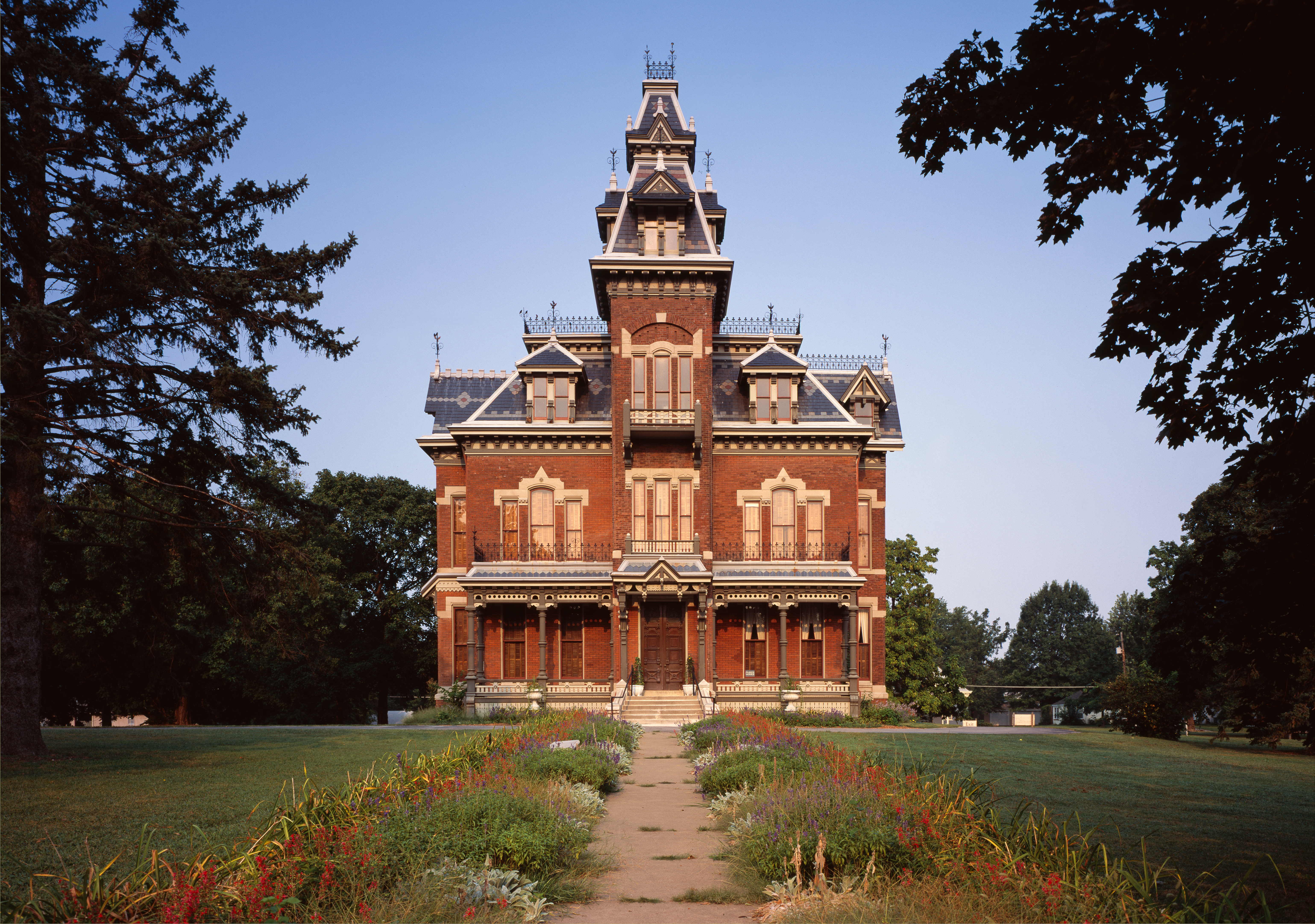
At Vaile Mansion in Independence, Missouri, a woman in white watches from the second-floor windows, then is gone when you look again. She's said to be Sophia Vaile, who died in that room in 1883 while her husband was a thousand miles away in court.
The woman in white at Vaile Mansion in Independence, Missouri shows up at the second-floor windows. Visitors out on the lawn catch her looking down at them, and when they glance back she's gone. The staff and the ghost-tour tellings say she's Sophia Vaile, and that the room she watches from is the one where she died.
The story most people repeat about her isn't that one. It's the glass coffin. The way it goes, Harvey Vaile was so undone by grief that he buried Sophia on the front lawn in a glass-topped casket set flush with the ground, so he could look at her face whenever he wanted, until the neighbors made him stop. Museum staff have flatly denied it, and the ghost-hunt accounts call it a tale with "no truth to this story." It's the most-told legend at the mansion, and it almost certainly never happened.
What did happen is worse, and it's on the record. Harvey built the place in 1881 for roughly $150,000, a 31-room Second Empire showpiece with nine marble fireplaces and the first indoor plumbing in Jackson County. He'd made his fortune financing the Erie Canal and running a mail route from Independence to Santa Fe. Then those same mail contracts put him in federal court. He was charged with fraud in the Star Route Scandal, and he spent the early 1880s in Washington fighting two separate trials, eventually spending more than $100,000 to clear his name.
In February 1883, while he was a thousand miles away at the second trial, Sophia died in the house. She'd recently been diagnosed with stomach cancer. The cause was a morphine overdose, and most sources call it a suspected suicide. Whether she meant it, the records can't say. Harvey was acquitted both times. He came home to an empty house, became a recluse, and died there of a stroke in 1894.
A woman in white has been reported on the grounds ever since, and it's the second-floor window where she keeps turning up, looking out over the lawn.
She isn't the only one people describe. A young man is said to roam the third floor, lore tying him to the years the house later ran as a sanitarium, when he's thought to have spent his life up there. Something angrier turns up in the basement, in disembodied voices, loud bangs, and the occasional full-bodied figure. For a stretch the house was closed to paranormal groups altogether, after a psychic incident the staff have never explained.
Charlie Beck of the Vaile Victorian Society, which restored the place, says neither he nor a fellow member ever witnessed any of it. Asked about the ghosts, he gave the only answer he had. "Maybe the ghosts don't like me," he told a reporter.