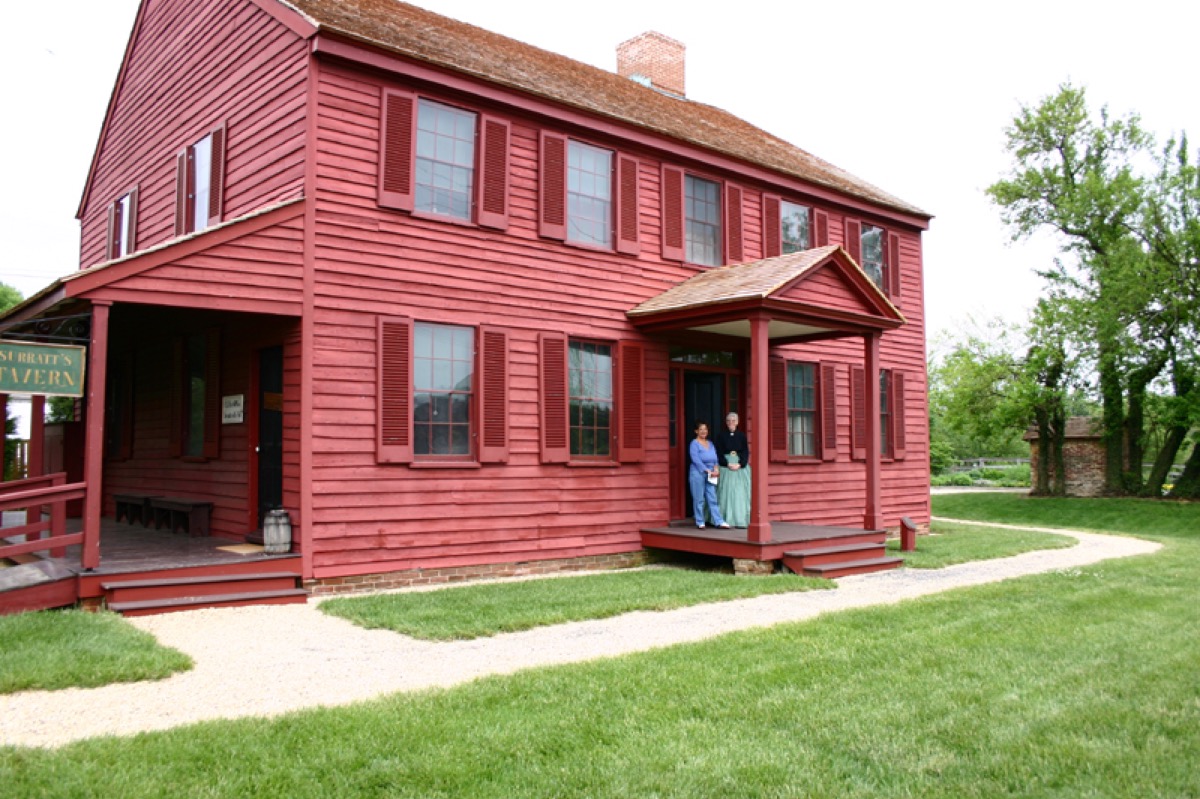
At the Surratt House Museum in Clinton, Maryland, the director took the job not believing in ghosts and still doesn't claim to. But a roomful of staff once heard a man's heavy boots come in the front door, cross the hall, and leave by the back. Nobody was there.
Laurie Verge ran the Surratt House Museum in Clinton, Maryland for more than 25 years, and she took the job not believing in ghosts. She still won't claim to. But there's one thing she can't square: the footsteps.
One afternoon she and five or six employees were sitting in her office when they all heard it at once. Someone came in the front door, walked down the hall, and went out the back. The footsteps "sounded like somebody had walked in the front door, walked down the hall, and walked out the back door," she said. So they searched the house, all of them, room by room. Nobody was there. No door had opened. "I can't explain the footsteps," she said. "I absolutely can't."
It wasn't the first time she'd heard them. Years before, she'd caught a man's footsteps upstairs when she knew she was alone in the building. "I've never seen anything," she said, "but I've had strange feelings."
It's a man's boots, heavy, the same path every time. The footsteps aren't the only thing. A tour guide named Julia Cowdery once heard a whistle inside the house, "like a 'come here' kind of whistle," and found no one when she looked. Another time her tour group heard a teacup rattle in the dining-room exhibit downstairs, as if someone had picked it up and set it back on the saucer, while the house was otherwise empty. And Verge has a theory about whose boots she keeps hearing.
The farmhouse was built in 1852, and over the years it was a tavern, a post office, a polling place, and a Confederate safe house in Southern Maryland. John Wilkes Booth knew it. Before the assassination, conspirators hid two Spencer carbines, ammunition, and binoculars at the tavern. On the night of April 14, 1865, after he shot Lincoln, Booth and David Herold stopped here first to collect the weapons before riding south.
By then Mary Surratt had rented the place to a man named John M. Lloyd. At her trial, Lloyd testified about the weapons she'd helped arrange. His testimony helped hang her. On July 7, 1865, Mary Surratt became the first woman executed by the United States federal government.
That's whose boots Verge thinks she hears. Not Mary, whose ghost the legends prefer — Verge discounts that one. She means the tenant. "We think the heavy footsteps, which are definitely a man's boots walking, may be Mr. Lloyd," she said, "doing penance down here for getting his landlady hanged."