The Ghost Story
Deep in the Connecticut woods near the border of Middlebury and Waterbury, crumbling miniature stone structures rise from the forest floor like the remains of some forgotten fairy kingdom. This is Little People's Village—a place where verified history and dark legend have become inextricably intertwined, creating one of New England's most unsettling mysteries.
The true story begins in 1924 when William Joseph Lannen (1886-1958), a master electrician born in Naugatuck, purchased land off Straits Turnpike along Old Waterbury Road. Lannen built a gas station there, strategically positioned on the major thoroughfare between Middlebury and Waterbury. But his timing proved disastrous—in 1928, a new highway route was blasted through Pine Rock, bypassing his station entirely. Suddenly stranded on a forgotten road, Lannen's business was doomed.
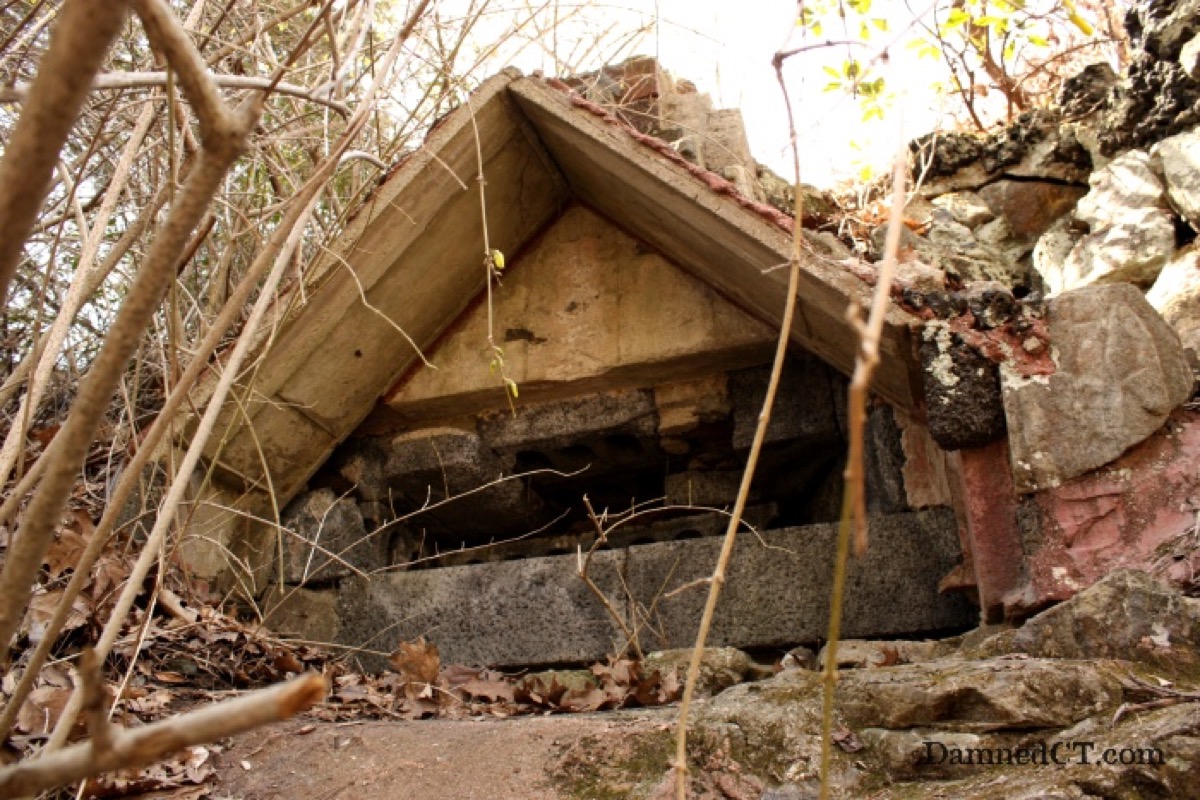
Rather than abandon the property, Lannen began an ambitious transformation. Using his electrical expertise, he constructed an elaborate miniature landscape: tiny brick and concrete houses standing just three to four feet tall, complete with a church, a lighthouse, winding paths, stone steps, rainwater pools, and fireplaces. He even wired the structures with "newfangled electric lights" that would have created an enchanting glow in the forest at dusk. The adjacent stone building served as a gift shop, while an ornate stone throne formed the centerpiece of an elaborate fountain system that distributed water through the fairy houses among carefully planted gardens.
By 1939, however, Lannen had abandoned the project entirely. A newspaper reporter visiting that year wrote that the overgrown miniature village "looks like somebody's dream crumbling to dust." Lannen had married Elizabeth Kennedy of Naugatuck in 1936 and taken employment with Connecticut Light and Power Company, leaving his fairy village to nature. The couple had no children. Lannen sold the property seven months before his death in 1958, and it passed through various private owners who never developed it.
As decades passed and the structures decayed, locals who stumbled upon the ruins—with no knowledge of Lannen or his failed nursery—invented their own explanations. The legends that emerged are far darker than the prosaic truth.
The most common tale describes a couple living in the stone house who began hearing voices from the "little people"—fairies, demons, or some other woodland spirits. In some versions, only the wife heard the voices; in others, both were afflicted. The creatures commanded them to build a village for the fairy folk to inhabit. House after house rose from the forest floor, but the voices never stopped demanding more. The enchantment slowly faded into madness.
Another version casts a solitary man as the builder, driven insane by whispers in the trees until he could no longer distinguish reality from the fairy realm. Some accounts say the man killed himself; others claim the wife, believing herself crowned queen of the little people, was commanded to murder her husband before taking her own life.
The centerpiece of these legends is the so-called "Throne of the Damned"—the actual stone throne that was part of Lannen's fountain system. According to local folklore, this was the throne of the Little People's King, and anyone who dares to sit upon it will die within seven years. The curse became so well-known that generations of Connecticut teenagers made pilgrimages to the site, each daring the other to test their fate.
"Even though visitors all heard the same story about the throne—'you will die in seven years if you sit on it'—many have sat on it anyway," noted one researcher. Those who have taken the challenge and survived report the legend continues to hang in the air despite being thoroughly disputed by the living.
Visitors who brave the overgrown path to the village report far stranger phenomena than a mere death curse. One account describes a paranormal encounter in vivid detail: "I stood, by myself, in sort of an open area away from the structures and all of sudden it felt like a ghost passed directly through me. I felt a tingly energy and fuzzy feeling surrounding me. Everything went silent except for a low sounding white noise and everything around me looked like the slight static you might see on a TV screen. This only lasted 30 seconds but it felt like it lasted minutes."
Other visitors report hearing disembodied voices and laughter echoing through the trees, overwhelming feelings of dread and "negative energy" that seem to follow them along the path, cold spots that materialize suddenly in the humid Connecticut woods, and an undeniable "presence" watching them from among the ruins. Some claim that if you linger long enough, you too will begin to hear the voices of the little people—and that hearing them is the first step toward madness.
The larger "castle-like" stone structure with barred windows—which many assume was the cursed couple's home—is actually the last surviving remnant of Lannen's gas station garage. The bars were simply practical security, not evidence of imprisonment or insanity. Yet even this prosaic explanation cannot fully dispel the site's atmosphere of decay and abandonment.
The village's true location has also been subject to legend: while universally called the "Little People's Village of Middlebury," the structures actually sit a few feet over the border into Waterbury. Some accounts erroneously connected it to the trolley line serving Lake Quassy Amusement Park, claiming it was once called "The Fairy Village" and operated as a trolley-side attraction. However, Quassy's director of marketing, Ron Gustafson, definitively stated: "It was never associated with Quassy Amusement Park."
Dr. Robert L. Rafford, Middlebury's municipal historian, has confirmed the structures were Lannen's original creation—the work of an entrepreneur, not a madman. Yet he also acknowledges the village's hold on the local imagination and has called for preservation efforts before the site is lost entirely.
Time and vandalism have reduced the village to scattered ruins. By 2024, only a few structures remain visible through the overgrown vegetation. The throne is "almost totally intact" but heavily weathered. The outline of the village still stretches across the forest floor, but each year claims more of Lannen's dream.
The site's future is uncertain. Construction plans for a revised Interstate 84 Exit 17 interchange may destroy whatever remains. State-owned land now surrounds the village, and "construction vehicles and the construction process will almost certainly destroy all that remains of the legendary village," according to preservation advocates.
Whether the spirits of the little people ever truly inhabited these woods—or whether the ghosts are simply the echoes of Lannen's abandoned ambitions—the village continues to draw visitors who feel something watching them from among the crumbling stones. As one researcher concluded: "Though some visitors witnessed no fairy tale creatures or heard any magical voices during their visit, there is definitely a presence to be felt here."
Researched from 12 verified sources including historical records, local archives, and paranormal research organizations. Learn about our research process.