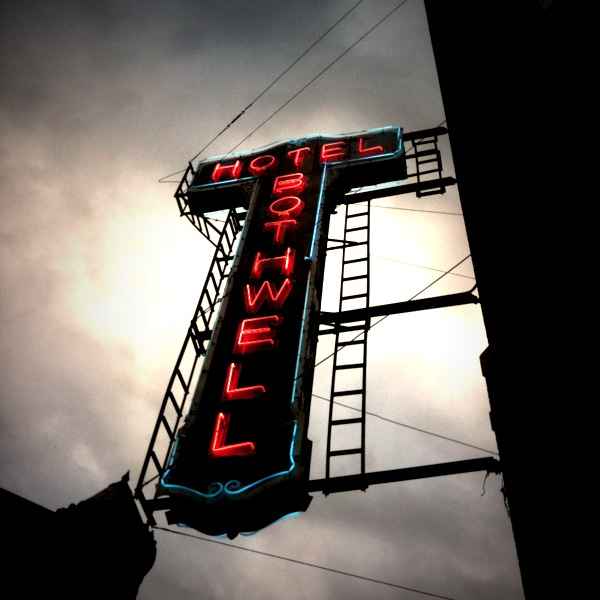
On the third floor of the Hotel Bothwell in Sedalia, Missouri, guests and staff keep meeting a little girl in a white nightgown. They hear children running the hallway, a girl laughing, footsteps with no one there. No record says who she was.
The third floor of the Hotel Bothwell in Sedalia, Missouri has a little girl in a white nightgown. Guests see her in the hallway and down in the basement. Staff hear her before they see her, children running the length of the corridor, a girl laughing, footsteps in a hall that turns up empty when they go check.
She is the figure people report most, and the rest comes around her. Doors open and close on their own. A guest's watch or ring goes missing overnight and surfaces across the room by morning. Voices carry up through the air vents. An elevator runs itself between floors. Most of all, people describe the weight of someone sitting down on the edge of the bed in the dark. A guest from St. Louis wrote that something kept settling onto the mattress and waking her, again and again, through the night.
Nobody can tell you who the girl is. A worker was once told she died in the building, fell from a banister, or worse, but there is no incident in the hotel's records and nothing in any newspaper to back it. The story is older than its proof. She has no name, and neither does anyone else people report here.
What the building has plenty of is the documented kind of history. John Homer Bothwell, a Sedalia lawyer, opened it on June 10, 1927 as a seven-story Classical Revival hotel built for $400,000, the social center of the town. He died at his hilltop lodge north of Sedalia two years later, in 1929, with barely any of it spent. The hotel kept going without him. In 1934, Harry Truman was a guest here when word reached him that he'd been picked to run for the U.S. Senate, the first rung of the climb that ended at the White House. Bette Davis dined in the Palm Room in 1942.
Then it nearly stopped being a hotel at all. It ran as a senior-living home through the 1990s before a former bellhop bought it back in 1998 and restored it. He had little to undo. The 1927 building is almost entirely itself, the marble floors and original doors and the carved ceiling work all the ones it opened with. "It's still the original architecture," the general manager says, which makes it one of the few historic Missouri hotels nobody ever gutted.
Through all of it, the third floor kept its hallway, and the girl kept running it. Walk in and ask for a room up there, and the front desk will hand you the key, and they won't talk you out of the stories.