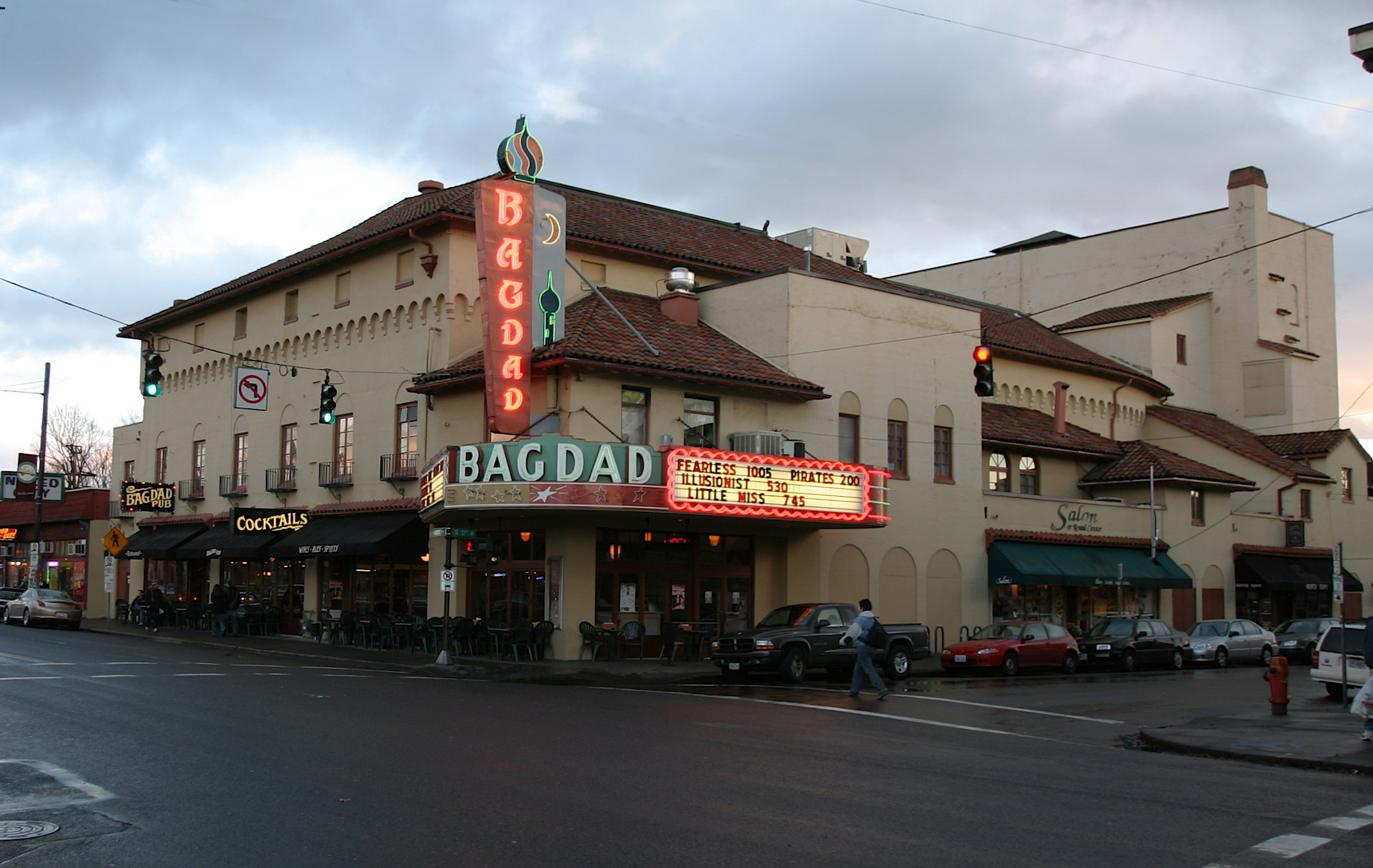
The Bagdad Theatre in Portland has kept a stagehand who wanted to perform and never could. The story says he hanged himself backstage; now he crosses in front of the screen while the trailers roll, and whispers from behind it.
At the Bagdad Theatre in Portland, Oregon, the figure people notice doesn't keep to the wings. He crosses in front of the screen while the trailers are still rolling, a shape passing between the seats and the picture, and the whispering that goes with him seems to come from behind the screen rather than in front of it.
The story that's drifted through the building for decades explains who he is. A young stagehand, it's said, wanted to be on that stage instead of working behind it, and hanged himself in the back of the house. He spent his life kept off the boards. In death, he finally crosses them, in full view of a paying audience, every night the lights go down.
The Bagdad opened on January 14, 1927, a Mediterranean fantasy of trompe-l'œil tiles and arched doorways that Universal Pictures built for about $100,000. Jack Nicholson sat in this auditorium for the Oregon premiere of "One Flew Over the Cuckoo's Nest" in 1975, and "My Own Private Idaho" premiered here in 1991. Mike and Brian McMenamin bought the place in 1991, restored it, and turned it into a brewpub-cinema, where the old stage became a bar.
The stagehand isn't the only one people describe. Down in the basement restroom, visitors say they catch the smell of old men's cologne and the sense of someone watching over the stall. One witness who felt it shrugged the whole thing off to America's Haunted Roadtrip: "if a dead guy wants to peek over a bathroom stall at me, all the more power to him." A more recent visitor was less calm about it, describing a white hand that swooshed under the stall door.
Staff talk about another presence, a fussier one, that seems to mind how they do their jobs. Paperwork shifts on a desk between glances. Cleaning supplies move. Footsteps trail the closing crew through the empty house late at night. A staffer once described it as "a mom or a grandma making sure I am doing it the right way."
But the one people keep circling back to is the stagehand. He wanted the stage and never got it, and the story stops there: nobody named, no date that survives, nothing written down to say a death ever happened. What's left is the figure a roomful of strangers watch cross the screen, the whisper from behind it, and a punchline that's hard to shake. The dead man finally got what he was after.