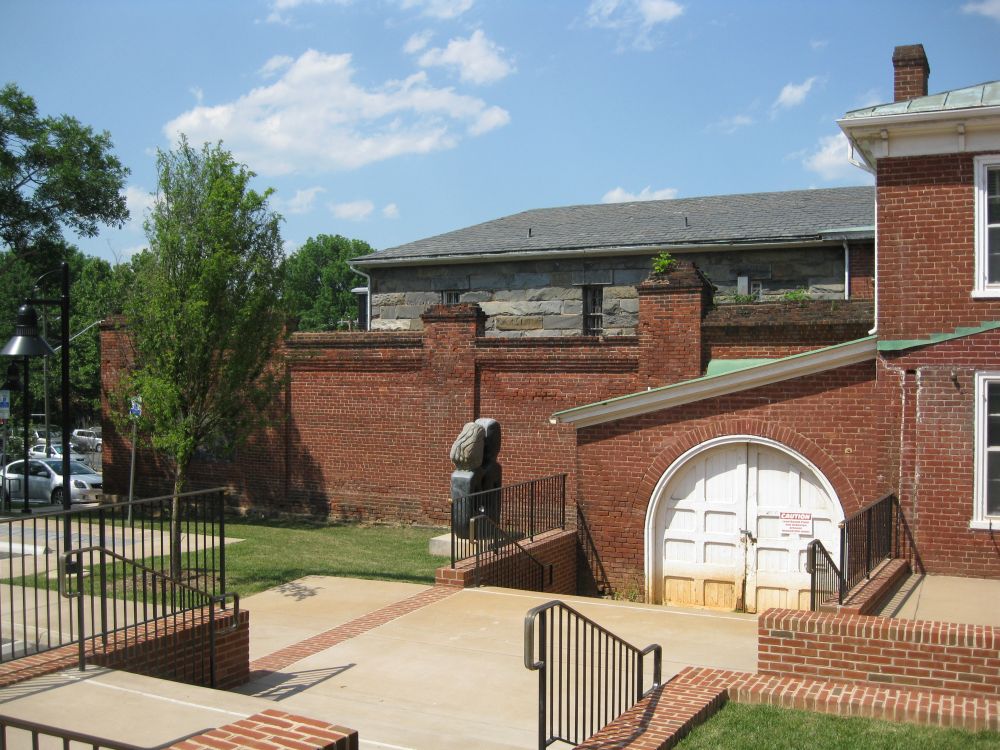
Charlottesville's stone Albemarle County Jail hosted a botched 1905 hanging of its former mayor. Footsteps still pace the breezeway.
The trap sprung at 7:34 a.m. on February 10, 1905. Life was extinct at 7:53. The body came down at 8:00. Nineteen minutes between drop and death, because the rope was knotted poorly and the former mayor of Charlottesville strangled instead of dropping cleanly. The man on the rope was J. Samuel McCue, three-term mayor of the city, and the place where he died was the two-story stone jail one block north of Court Square, where he'd waited five months for the gallows.
Tour guides at the Spirit Walk now say he paces that breezeway.
The jail is still there, at 409 East High Street, almost exactly as Charlottesville architect George Wallace Spooner left it. Construction started September 15, 1875. The stones came partly from the earlier jail that stood on the same lot, recycled into a 20-by-68-foot rectangle with walls three feet thick and tiny splayed windows behind iron bars. A brick annex and jail yard went up in 1880. The jailer's residence was added in 1886. By the time it was done, three buildings sat clustered on the lot across a decade, all built to hold people in.
It held them until 1974, when Albemarle County opened a new facility south of town and the old jail slipped into use as county storage. It's closed to the public. A 2014 board vote directed staff to work with the Albemarle Charlottesville Historical Society on turning it into a museum, but as of 2021 those efforts hadn't panned out. So once a year, when the historical society runs its Spirit Walk fundraiser, the doors open for living-history reenactments, and the rest of the time the jail sits dark.
The McCue story is what everyone comes for, so let's get into it.
Fannie Crawford McCue was 45 when she was found dead in the upstairs bathtub of her home at 601 Park Street on September 4, 1904. She had been strangled, clubbed, shot, and drowned. Four distinct injuries. The bathtub itself is a strange detail to sit with, because less than 14% of American homes had one at the time, which tells you something about the McCues and how the household lived. The next morning her husband, sitting mayor of Charlottesville, placed a $1,000 reward ad in the Daily Progress claiming burglars had attacked them.
The burglar story did not hold. McCue had served three terms as mayor, 1896 to 1900 and again from 1902 until September 1, 1904, three days before Fannie's death. His teenage son testified the household had been violent. The trial pulled national press, including the New York Times. The Virginia Supreme Court of Appeals refused a writ of error on January 12, 1905, and declined a rehearing on January 26. Two weeks later he was on the gallows.
Before the drop, three witnesses, George L. Petrie, Harry B. Lee, and John B. Turpin, signed a statement McCue dictated:
> "J. Samuel McCue stated this morning in our presence and requested us to make public that he did not wish to leave this world with suspicion resting on any human being other than himself; that he alone is responsible for the deed, impelled to it by an evil power beyond his control; and that he recognized his sentence as just."
A small note on the lore around this place. The Library of Congress HABS caption and several ghost-tour writeups call McCue's hanging the last legal execution in Virginia. That isn't right. Joel Payne was hanged in Virginia on April 9, 1909, four years later, and the state had switched to the electric chair the previous October. What's true, and what the local sources back up, is that McCue's was the last legal execution in Albemarle County, the last hanging at this jail. Worth getting right, since the inflated version travels and the county-level execution is striking enough on its own.
The rope, supposedly, is in the archives at the University of Virginia's Alderman Library. McCue was exhumed from the family burial grounds on December 13, 1908, and reburied in Riverview Cemetery next to Fannie. Three years and ten months after he killed her, they were back in the same dirt.
The haunting itself is thinner than the history, and the research is honest about that. There's no 19th- or early-20th-century newspaper account of anything paranormal at the jail in the searched record. No paranormal team has published evidence from inside. What you have is recurring tour-guide reports of footsteps pacing the breezeway, heard year-round, and the same hedged guess about who's making them, either a long-dead jailer or McCue himself. Both are framings, not historical identifications. Take them as such.
One specific anecdote travels more than the others. A US Ghost Adventures writeup recounts an employee named Paul who, dressed as a jailer with a lantern for a Spirit Walk reenactment, heard footsteps in the breezeway that weren't part of the script. The same lantern-and-footsteps beat shows up across the ghost-tour ecosystem, but it traces back to a single retelling. It's Spirit Walk lore, repeated by guides who run the building once a year. The historical society does not officially vouch for it.
Other claims you'll see recycled around the web, four prisoners to a cell, one meal a day, are harder to pin down. The LocoHistory blog says total capacity ran 35 to 40 inmates, which is at least a number. The per-cell figure and the one-meal-a-day detail don't tie back to any contemporary record. If they're true, they're true, but the research file flags both as soft.
What's left, when you strip the speculation out, is enough. A stone jail with three-foot walls in the middle of a working courthouse square. A mayor who beat his wife to death in their bathtub and went to the gallows in the building where his predecessors had locked up cattle thieves. Nineteen minutes from the trap to the moment a doctor called him dead. Footsteps that may or may not pace a breezeway nobody is supposed to be inside.
The Spirit Walk is the Albemarle Charlottesville Historical Society's biggest annual fundraiser, and the McCue story is its biggest staple. Which means the only reliable way inside the jail is to go to a ghost tour run by the people who keep the building's records. There are worse trades.
The rope is at Alderman Library if you want to look at it.