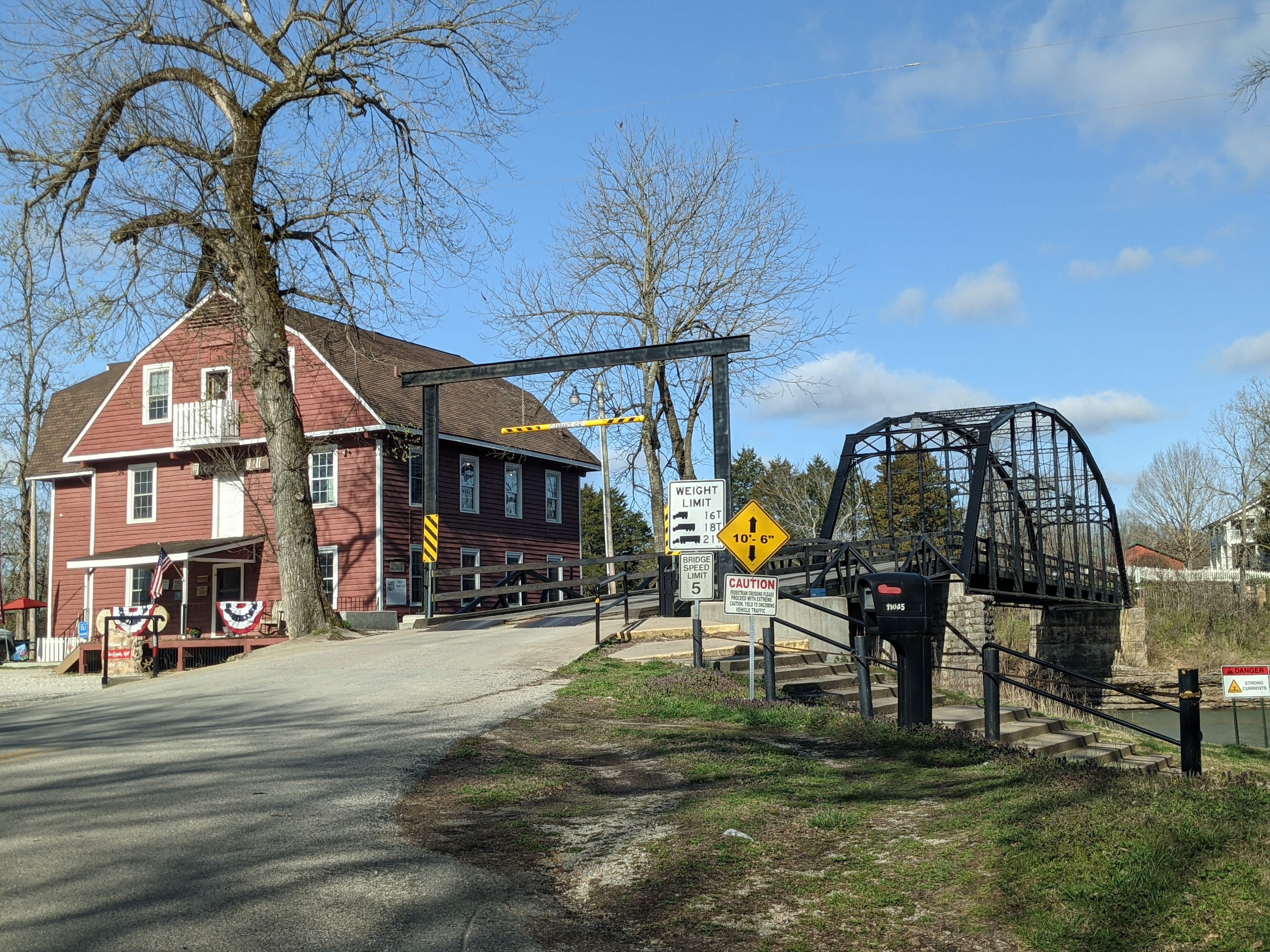
At War Eagle Mill near Rogers, Arkansas, some accounts describe a Confederate soldier shimmering on the riverbank, and the third-floor Bean Palace is said to fling tea-dispenser lids after hours. A real mill has stood here since 1832, lost four times over.
At War Eagle Mill, in the northwest corner of Arkansas, the spookiest reports come from the third floor. The restaurant up there is called the Bean Palace, and after closing, the story goes, something in it gets to work — noises from the empty kitchen, chairs that have moved on their own, and the lids of the tea dispensers flying across the room. No one tells it the same way about who's doing it. The identity, the lore admits, is unknown.
Down at the water, some accounts describe a second figure: a Confederate soldier who marches the riverbank as a shimmering, uniform-clad shape, hard to focus on. A few who tell it tie him to the men who once burned this mill.
That part is real. A mill has stood at this bend of the War Eagle River since 1832, and the river and fire have taken it four times. A Baptist preacher named Sylvanus Blackburn arrived that December, paid $80 for 160 acres, and by 1838 had built the first gristmill in Benton County. A flood washed it downstream in 1848. The Blackburns rebuilt, and during the Civil War — two days before the Battle of Pea Ridge, in 1862 — the second mill was burned to keep it from Union use. General Earl Van Dorn marched his retreating army past the ruins. It wasn't replaced until 1873. It burned again in 1924.
Some say Blackburn himself never left the place. There's reason the founder lingers in the telling. When his wife Catharine died on March 13, 1890, as the story is told, he directed that her grave be dug and left open until he could be laid beside her. Five days later, on March 18, he was.
The mill standing now is a 1973 reproduction, raised from the original blueprints. Its 18-foot cypress water wheel turns to this day, grinding corn meal and flour for the store below the Bean Palace. It is the fourth mill on a spot that has buried three.