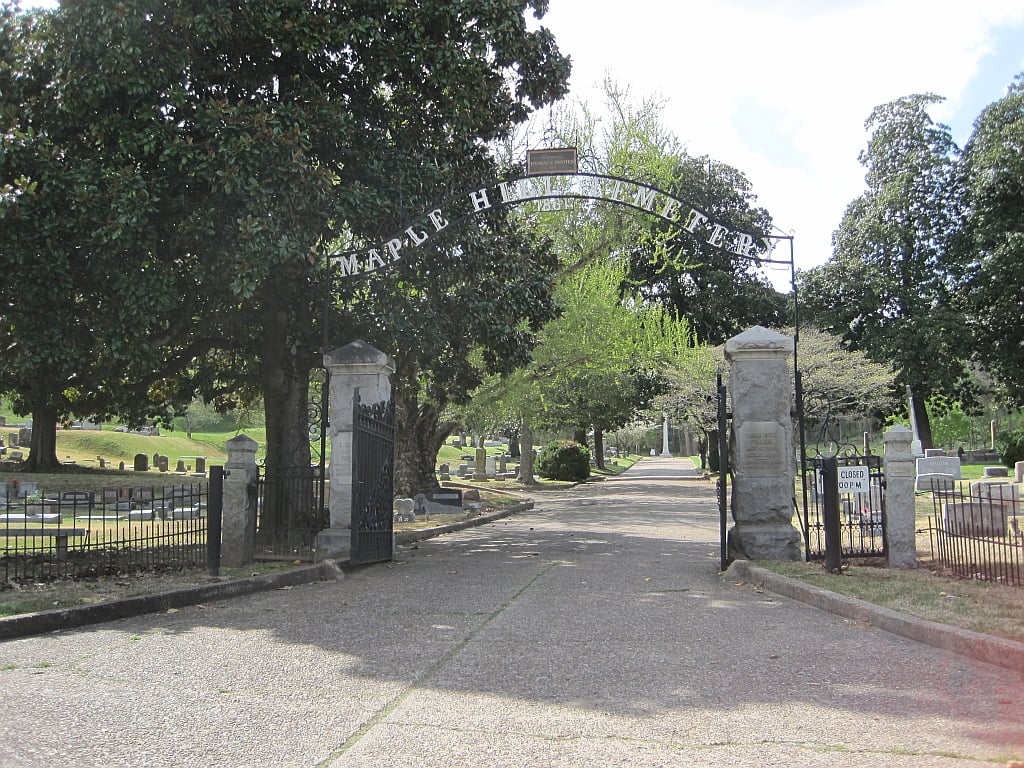
The most photographed grave at Maple Hill Cemetery in Helena, Arkansas belongs to a dog. After his owner was murdered in 1893, the setter Pedro waited at the grave for two years until he died, and folklore says you can still hear him crying for the man.
The most photographed grave at Maple Hill Cemetery in Helena, Arkansas belongs to a dog. He sits carved in stone on top of the monument, an Irish setter with his head up and alert, his collar marked Pedro, and a single word raised beneath him: WAITING.
Pedro belonged to a town doctor named Emile Overton Moore. On the night of February 16, 1893, another physician shot Moore dead. Both men had been called to the same patient, and the rival was already in the room when Moore arrived, called him outside, and called him a vile name. The other doctor drew a .38 and fired. Moore died that night. The killer was tried and acquitted on self-defense, and years later the Arkansas Supreme Court denied Moore's widow his life insurance, ruling that Moore had started the fight that killed him.
His family did not accept that, and the stone says so. They raised a pink marble shaft carved MURDERED FEB. 16, 1893, with an inscription still seething at the "time serving, two faced hippocrites" — their spelling — "who conspired to have him murdered." One line on the same stone lets it go: He is now beyond the reach of blame or praise.
Then there's the dog. After the burial, Pedro walked to the grave and stayed. Neighbors brought him food. He wouldn't leave, and for the next two years people nearby could hear him howling in the cemetery at night. Around 1895 he finally died, and the family buried him with his owner and set the carved setter on top.
The haunting is one quiet line. The University of Arkansas Press wrote down the local saying in its folklore project: "It is said you can still hear Pedro crying for his owner." That is all of it — no recent sighting, no investigation, just a sentence repeated until it settled onto a stone dog on a ridge above the Mississippi. The other stories people tell here, Civil War figures drifting through the old graves, don't turn up in anything documented. The only ghost anyone agrees on is the dog.
People don't climb the bluff for the generals buried up here or the view of the river. They come for the setter with his head up and his name on his collar, still waiting on a man who's been gone since 1893.