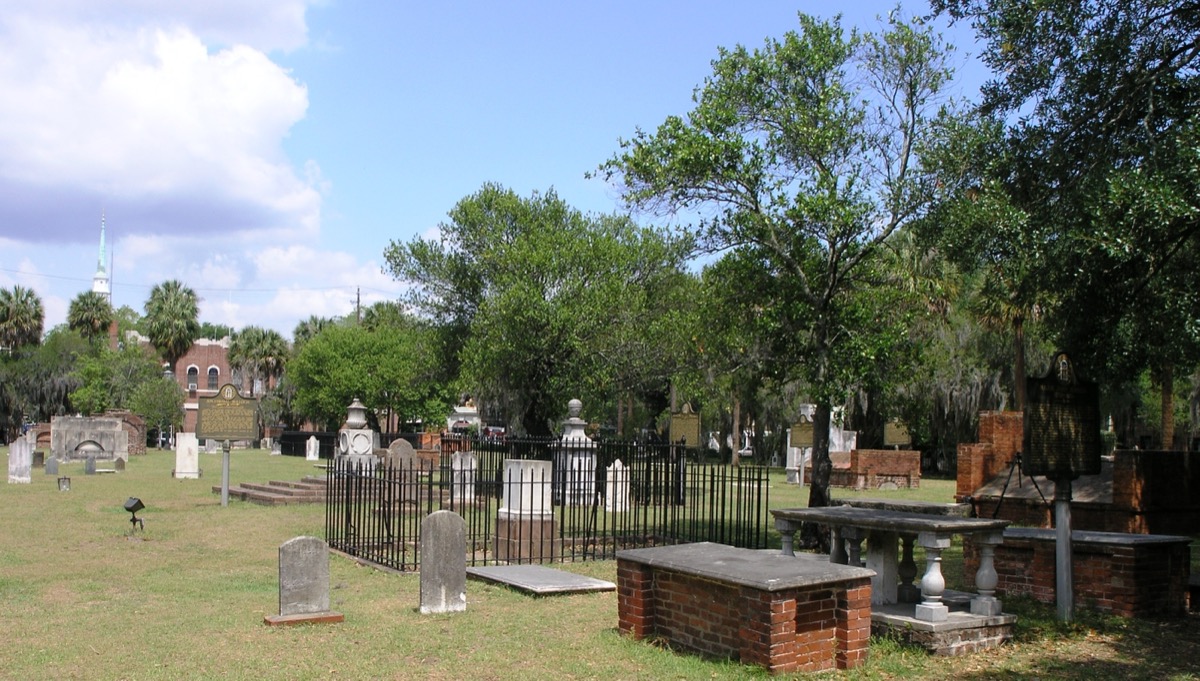
At Colonial Park Cemetery in Savannah, a few headstones record the dead living for centuries — one man to 421, his neighbor to 544. The story goes that Union soldiers recut the dates. The result is a graveyard whose own stones lie about who's underneath them.
Colonial Park Cemetery in Savannah, Georgia has graves that claim the dead lived for centuries. One headstone records a man dying at 421. A neighbor's puts him at 544. On another, the story goes, a son was born roughly a thousand years before his own father.
None of it is real arithmetic. The prevailing account is that after Union troops occupied Savannah on December 24, 1864, soldiers camped in the cemetery and sheltered inside the brick burial vaults — and while they were there, some of them recut the dates and ages on the markers by hand. What they left behind is a graveyard whose own stones lie about who's under them and how long they lived.
That suits the place. Established in 1750, it's Savannah's oldest surviving cemetery, closed to burials since 1853. An estimated 9,000 to 10,000 people went into its six acres, and fewer than 700 headstones are left to mark them — so most of the dead are already unnamed before you get to the recut ones. More than 700 victims of the 1820 yellow-fever epidemic are buried here, including two physicians who died treating the sick.
It was a place men came to die on purpose, too. In 1777, Button Gwinnett, a Georgia signer of the Declaration of Independence, was shot in a pistol duel fought near the cemetery — the two men stood twelve feet apart. He died of the wound three days later. The man who shot him, Lachlan McIntosh, is buried inside these walls.
What visitors report now is quieter. Guests on one night tour describe a low green mist drifting between the stones. Others say shadow figures move along the brick paths and the vaults. Tour operators tie a recurring male voice, caught on recordings, to the southeast corner.
Locals will also tell you about a seven-foot phantom who haunts the grounds. No record of him exists. He was never a real man — which makes him the one resident here whose dates were never carved at all.