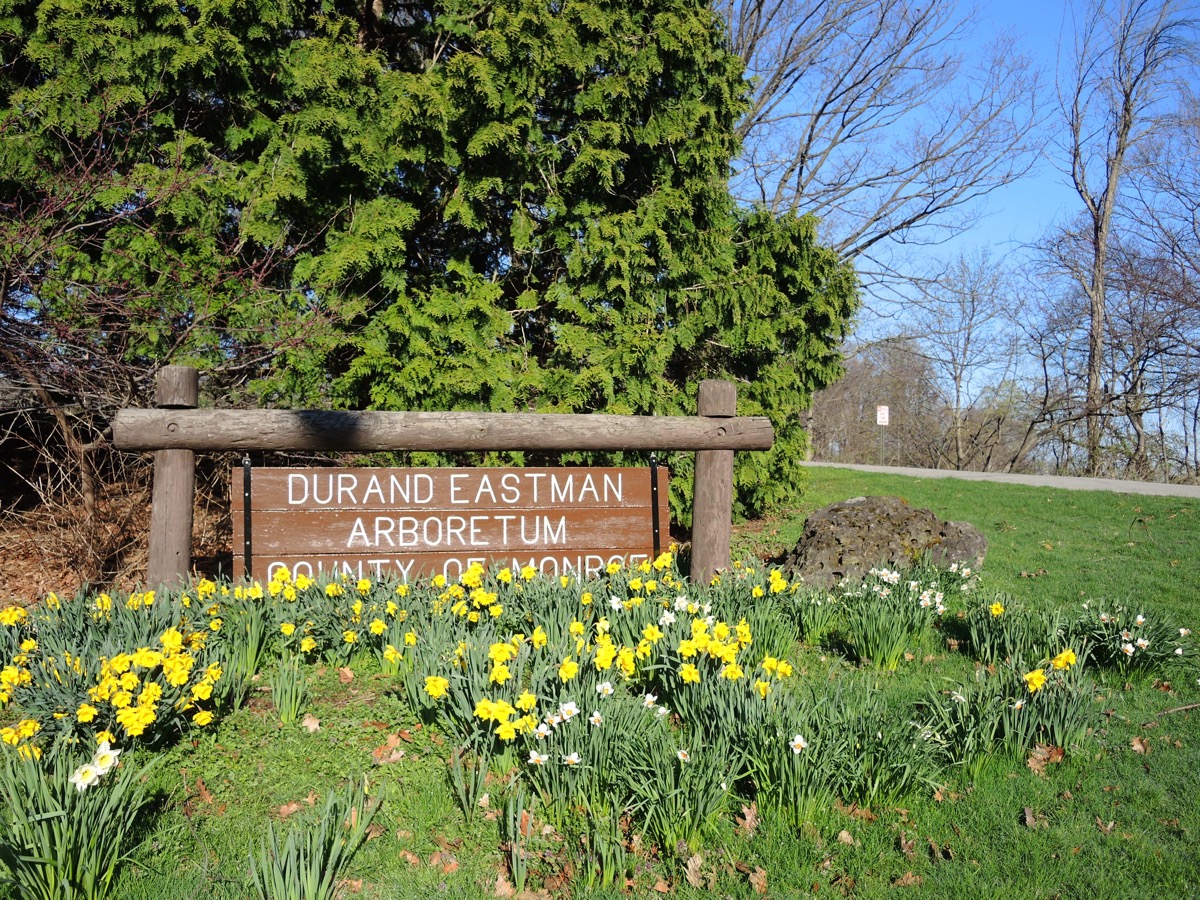
A grieving ghost called the White Lady is said to drift the night mist along Lake Ontario at Durand Eastman Park in Rochester, NY, searching for her lost daughter. In 2023 the county put up an official marker for her, then admitted it can't prove she was ever real.
On a roadside at Durand Eastman Park in Rochester, New York, there's an official county historical marker for a ghost. It reads: "THE WHITE LADY / GRIEVING WOMAN'S GHOST / AND HER WOLF-LIKE HOUNDS / APPEAR IN THE NIGHT MIST / SEARCHING THIS ROADSIDE / FOR HER LOST DAUGHTER."
The story behind the sign is older than the sign by a century. People around Rochester have reported the figure since the 1800s, passed down as oral tradition: a mother in white who drifts through the mist off Lake Ontario, two pale wolf-like hounds at her side, searching the shoreline for a daughter who walked to the lake one night and never came back. The tellings don't agree on what happened to the girl. In one she vanished. In another she eloped with a man who killed her. In another she was taken by marauders. They call the mother the White Lady, the Lady of the Lake, or Eelissa.
The park itself is real enough: 977 acres along the lake, donated to Rochester in 1907 by Dr. Henry Durand and George Eastman, the man who built Kodak. But the story has its own fixed point on the ground. Near the lake sits a stone ruin teenagers have long called the White Lady's Castle. It was never a castle. It was a dining hall or refreshment pavilion built for park visitors in the early 1900s, reduced now to bare stone walls.
The ghost is said to be sorrowful toward women and menacing toward men. In an older telling, she isn't a grieving mother at all but a wife who killed her unfaithful husband and his lover, and now turns on couples who wander in after dark. Ghost-tour guides tell of a man grabbed by the collar one night and dragged toward the castle wall.
In June 2023, Monroe County Executive Adam Bello unveiled the marker, funded by the William G. Pomeroy Foundation through its Legends & Lore series — which honors folklore rather than documented fact. "Perhaps the ghost story began as a warning to young people about the dangers of seeking adventure after dark," Bello said.
Irondequoit's town historian, Patricia Wayne, went looking. There are no death records for Eelissa. No missing daughter. No tragedy on file anywhere. By every measure she can check, the White Lady never existed.
The county read the same empty record and put up the sign anyway.