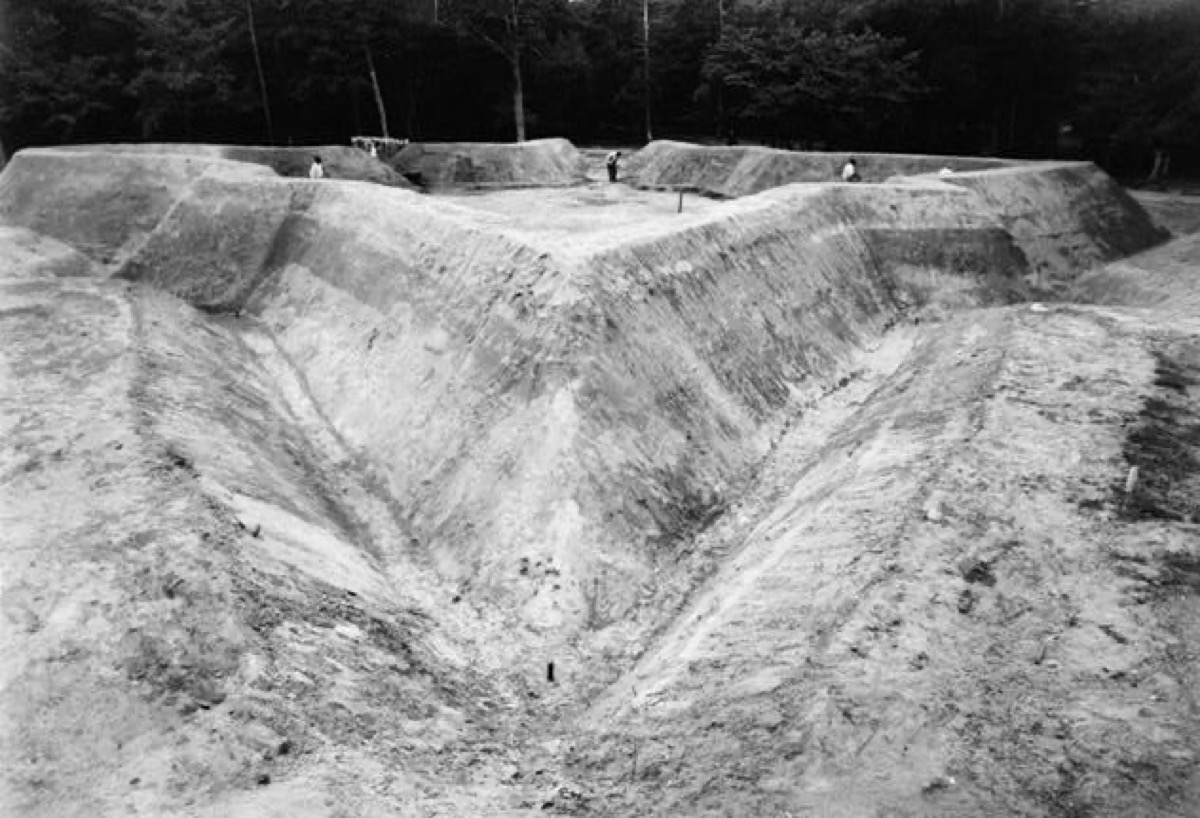
Fort Raleigh on Roanoke Island, North Carolina marks where England's first colony vanished. When John White returned in 1590, he found the houses taken apart, the people gone, and a single word cut into a post. No bodies. No graves. No struggle.
Fort Raleigh National Historic Site, three miles north of Manteo on Roanoke Island, North Carolina, preserves the spot where England's first colony in the New World simply stopped being there. More than a hundred men, women, and children landed in 1587. Three years later, every one of them was gone.
Their governor, John White, sailed back to England that first autumn for supplies. His granddaughter, Virginia Dare, had been born on the island a few weeks earlier — the first English child in the New World — and he left her behind with the rest. He meant to be quick. Instead the Anglo-Spanish War held him, pirates turned him back once, and he didn't reach Roanoke again until August 18, 1590. The date was Virginia Dare's third birthday. He had no way of knowing it would be.
He found the settlement deserted. The houses hadn't burned; they'd been taken down, board by board, and the ground enclosed behind a high palisade. Carved into one post was a single word: CROATOAN. On a nearby tree, the letters CRO. The colonists had agreed that if they left in danger, they'd cut a Maltese cross. There was no cross. White read it as a planned move and not a flight, but he could never go look. The NPS account is plain: his men "found remnants of the colonists but no signs of life," with "no signs of a struggle or of the colonists leaving in haste." He was forced back to England, never knowing what became of them.
Out of that four-hundred-year silence grew the island's other ghost. The story goes that Virginia Dare survived, raised among the natives by the leader Manteo, and grew into a young woman two men wanted. A spurned witch-doctor cursed her into a snow-white doe. A rival meant to break the spell with a magic oyster-shell arrow, but a hunter loosed his own arrow at the same instant — a silver one, said to be a gift from Queen Elizabeth — and the silver point was the one that killed her. They buried the doe in the middle of the old abandoned fort. Sallie Southall Cotten set the whole legend down in a 1901 poem, written, as it happens, to sell scuppernong wine.
NCpedia keeps the older note. "Well into the twentieth century, hunters emerged from the forests of Roanoke Island with tales of a strange deer that eluded them in the wilderness. It appeared suddenly in the darkness of midnight and vanished in the mist of dawn."