Emma Crawford was carried up Red Mountain by twelve men and buried at the summit in 1891. Thirty-eight years later her coffin came racing down the slope, and two boys found her skull on the grass below. The legend says she never wanted to leave.
On Red Mountain, above Manitou Springs, Colorado, there's a summit where a woman asked to be buried, and the story goes she's still trying to get back to it. Her name was Emma Crawford, and in 1891 twelve men carried her coffin up the slope by hand to put her there.
Emma was a concert pianist, born in Massachusetts in 1863 and trained by her mother. She came to Manitou Springs in the late 1880s sick with tuberculosis, hoping the mineral springs and the mountain air would cure her. She was a spiritualist, and she believed a guide was waiting for her on the mountain. After she hiked to the top of Red Mountain one day, she told her companion she wanted to be buried up there.
She died on the night of December 4, 1891. Her fiance, an engineer named Wilhelm Hildenbrand, honored the wish. He and eleven others hauled her up the slope to the summit and buried her where she'd asked.
She didn't stay put. The railway came through and moved her grave when it built a powerhouse and depot on the mountain. Then harsh winters and spring rains worked at the loosened ground for years. In 1929, what was left of Emma came down the mountainside.
On August 4 that year, two boys found her on the slope below a property on Waltham Avenue: her skull, bone fragments, pieces of the coffin, and the metal nameplate that was the only thing left to identify her by. She was stored away while the town searched for relatives, and in 1932 she was finally reburied across town at Crystal Valley Cemetery.
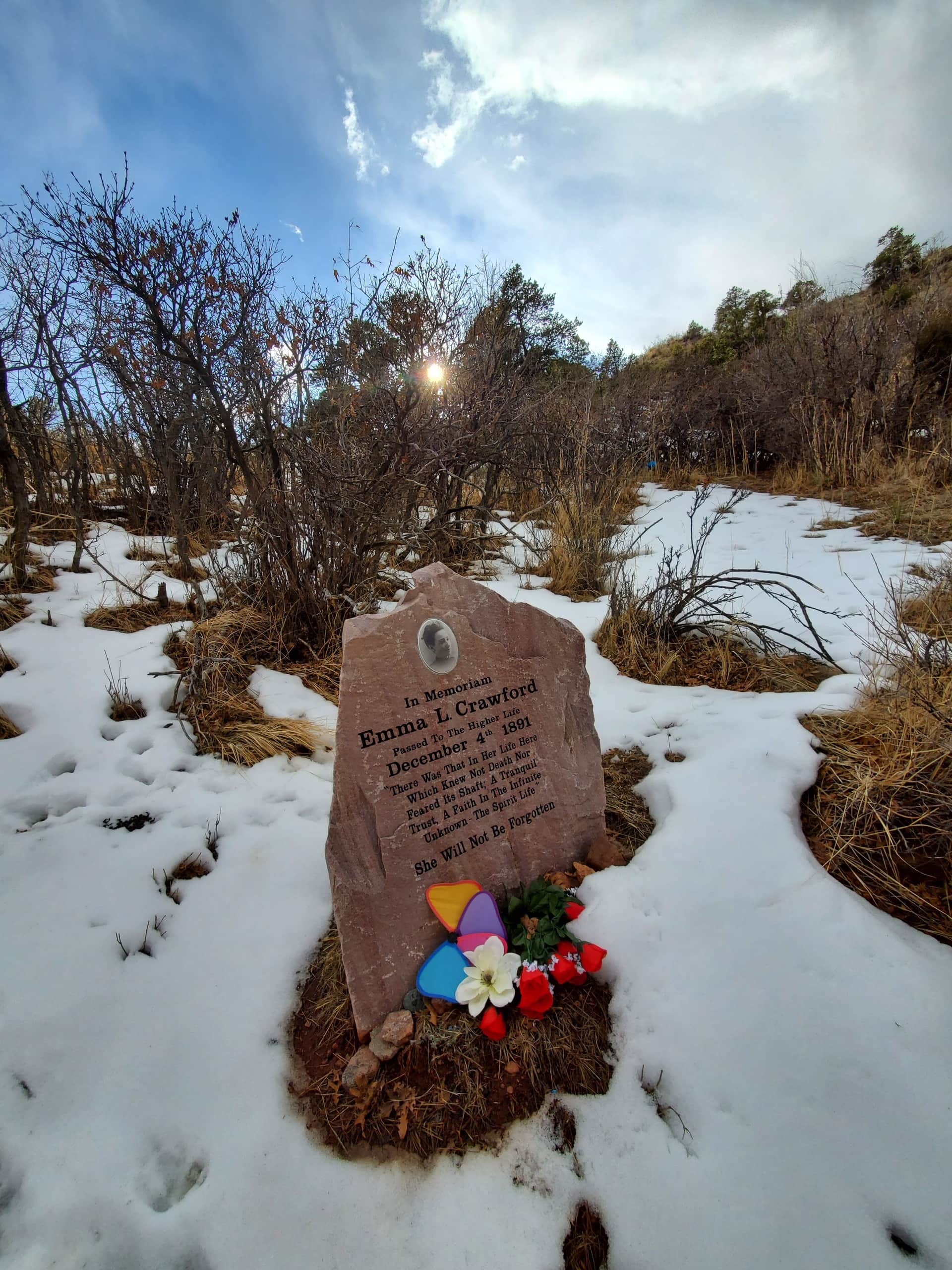
The legend says she still haunts Red Mountain, restless, until she's put back on the summit she loved. Manitou Springs remembers her every October now with coffin races down the main street, the first of their kind in the country, started in 1995. Her tombstone reads: "She Will Not Be Forgotten."