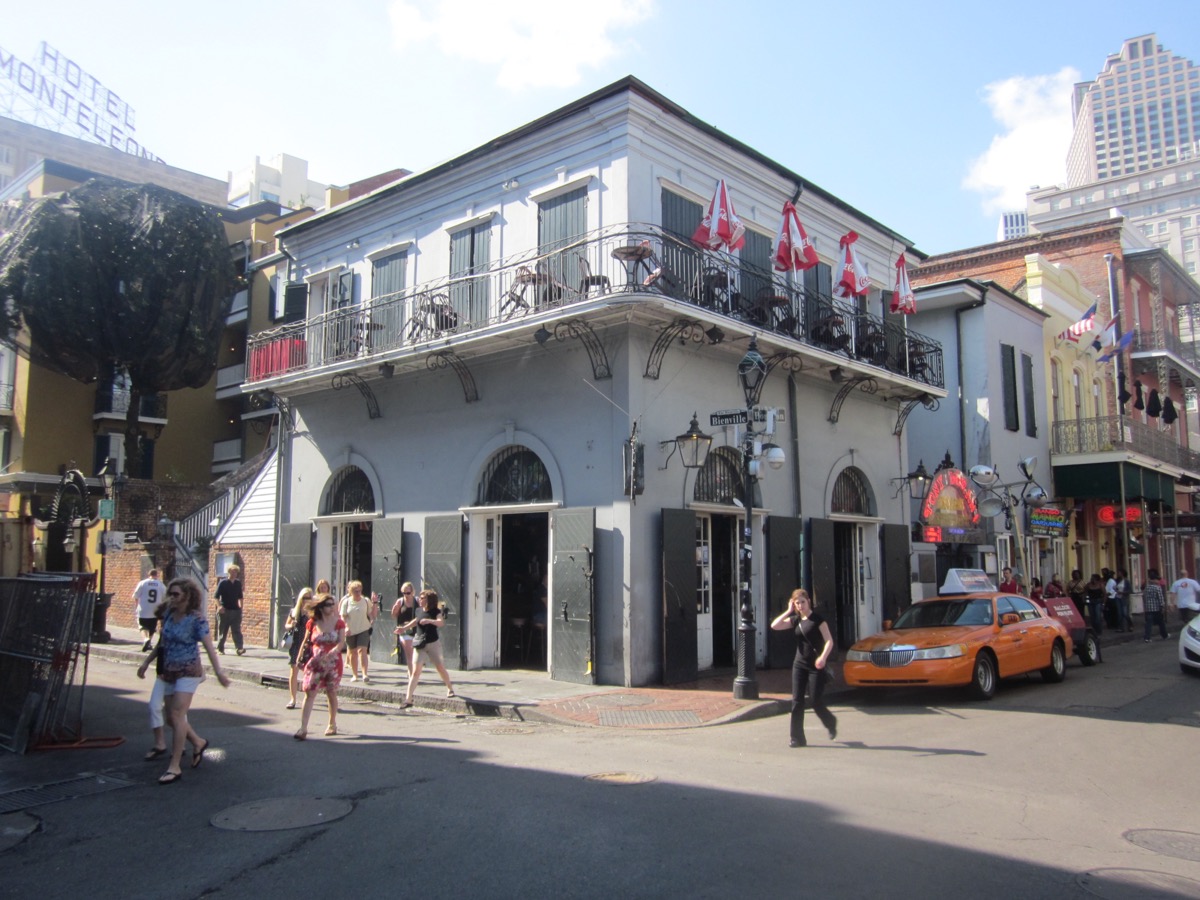
The Old Absinthe House on Bourbon Street in New Orleans collects ghosts the way it collects business cards. The men patrons claim to see after dark — Lafitte, Andrew Jackson, Marie Laveau — are the same ones who really drank here.
The Old Absinthe House sits at the corner of Bourbon and Bienville in the French Quarter, and the ghosts people report inside it are the same names that fill the history books. Patrons and former employees say the loudest of them is Jean Lafitte. They blame him for laughter in empty rooms, for carousing nobody can place, and the story goes he turns up in his pirate hat, throwing parties in rooms with no one in them.
He has company. Visitors and staff also report Andrew Jackson, the voodoo queen Marie Laveau, and Union general Benjamin Butler. Former employees put the Lafitte and Jackson sightings on the second floor, often near the windows. Marie Laveau, they say, just stands and stares into space. On the main floor there's a woman in a long white dress, and on the floor above, a child runs. Doors open on their own. Bottles and chairs move. The cold drops without warning, and from rooms that nobody is in come whispers.
The bar these ghosts haunt was built around 1806 by two Spaniards, Pedro Front and Francisco Juncadella, who ran an importing business out of it. The first floor became a bar around 1836, and by the 1870s a bartender named Cayetano Ferrer was building its name on the absinthe frappe, the green monster, absinthe poured over a sugar cube with cold water dripped slowly through it. Mark Twain drank here. So did Oscar Wilde and Walt Whitman and P.T. Barnum. Over more than a century, patrons pinned their calling cards, Mardi Gras doubloons, military decorations, and police badges across the walls and ceiling until the whole room was papered in them, every surface layered with the names of people who once came through.
The house also keeps a legend it can't quite prove. The story is that Lafitte and Jackson sealed a deal upstairs that helped win the Battle of New Orleans in 1815. Owen Brennan, who bought the bar in 1943, hung a plaque claiming the meeting in 1950. A rival establishment sued over it the next year, and the judge threw the case out. "Legend means nothing more than hearsay or a story handed down from the past," he ruled. The newspapers say there's no proof the two men ever met here at all.
It fits a bar named for a drink the country once outlawed. The federal government banned absinthe in 1912 and kept it banned until 2007, so for nearly a century the Old Absinthe House sold itself on a thing you weren't supposed to have. The names papered across its walls are the same ones patrons swear they still see after closing. The men who made the place are the ones who never left it.