At the North Carolina State Capitol in Raleigh, the State Library moved off the third floor in 1888. The watchman kept hearing books hit the floor up there anyway — and decades later, two staffers felt someone reading over their shoulders.
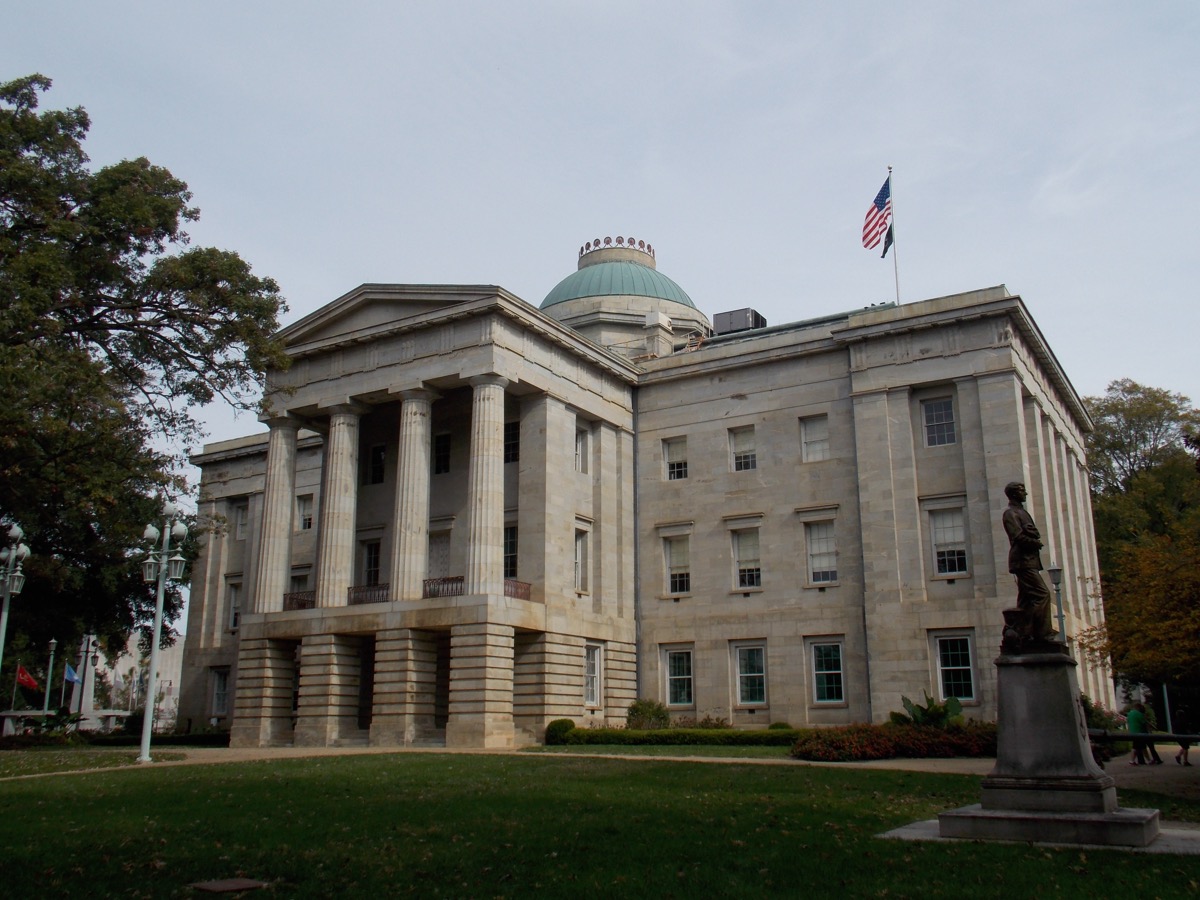
At the North Carolina State Capitol in Raleigh, the strangest haunting is tied to a room full of books that left in 1888. Until then the third floor held the State Library and the Supreme Court. When they relocated to their own building, the law and the books went with them. Something, by a long line of accounts, did not.
The granite building was finished in 1840, on the site where the old State House had burned in 1831, taking Antonio Canova's marble Washington with it. The night watchman who walked it starting in the 1920s heard the third floor first. He worked the place about 15 years, and the empty library kept giving him the same noise: books thudding to the floor up there, in the dark, over a room that held none. He'd climb the stairs to check and find nothing out of place.
The rest of his nights were no better. Doors slammed. Glass broke somewhere, and the windows were all whole when he reached them. Once, dead calm outside, a wind roared through the building. The 1951 elevator moved between floors on its own, though its controls sat inside the car where no one was standing. At the first-floor desk a cold hand pressed his shoulder, and he turned to no one. After locking up one night, he looked up at the second-floor gallery window and saw a Confederate soldier pacing behind the glass.
The library kept its hold long after he was gone. In the spring of 1981, Capitol curator Raymond Beck stayed late shelving books in that third-floor room, between roughly 10 p.m. and midnight, and felt someone standing close behind him, reading over his shoulder. No one was there. He kept it to himself until, about five months on, administrator Sam Townsend Sr. told him he'd felt the exact same presence in the exact same room.
Townsend collected his own. Pacing in a committee room off the empty Senate chamber. Keys jingling at a locked door. An apparition in the Senate doorway one evening that dissolved as he opened it. Beck never claimed to explain any of it. "There have been in the past several incidents," he said plainly, "that have occurred to both staff and security personnel at the capitol that are heretofore unexplained."
No murder, no hanging, no single tragedy anchors the place. The legislature met here until 1961 and moved out for good by 1963, and the building has been a state historic site since. The reputation rests on accumulated occupancy, on everyone who passed through and a few who apparently never left. The books left in 1888. Whatever was reading along never followed them out.