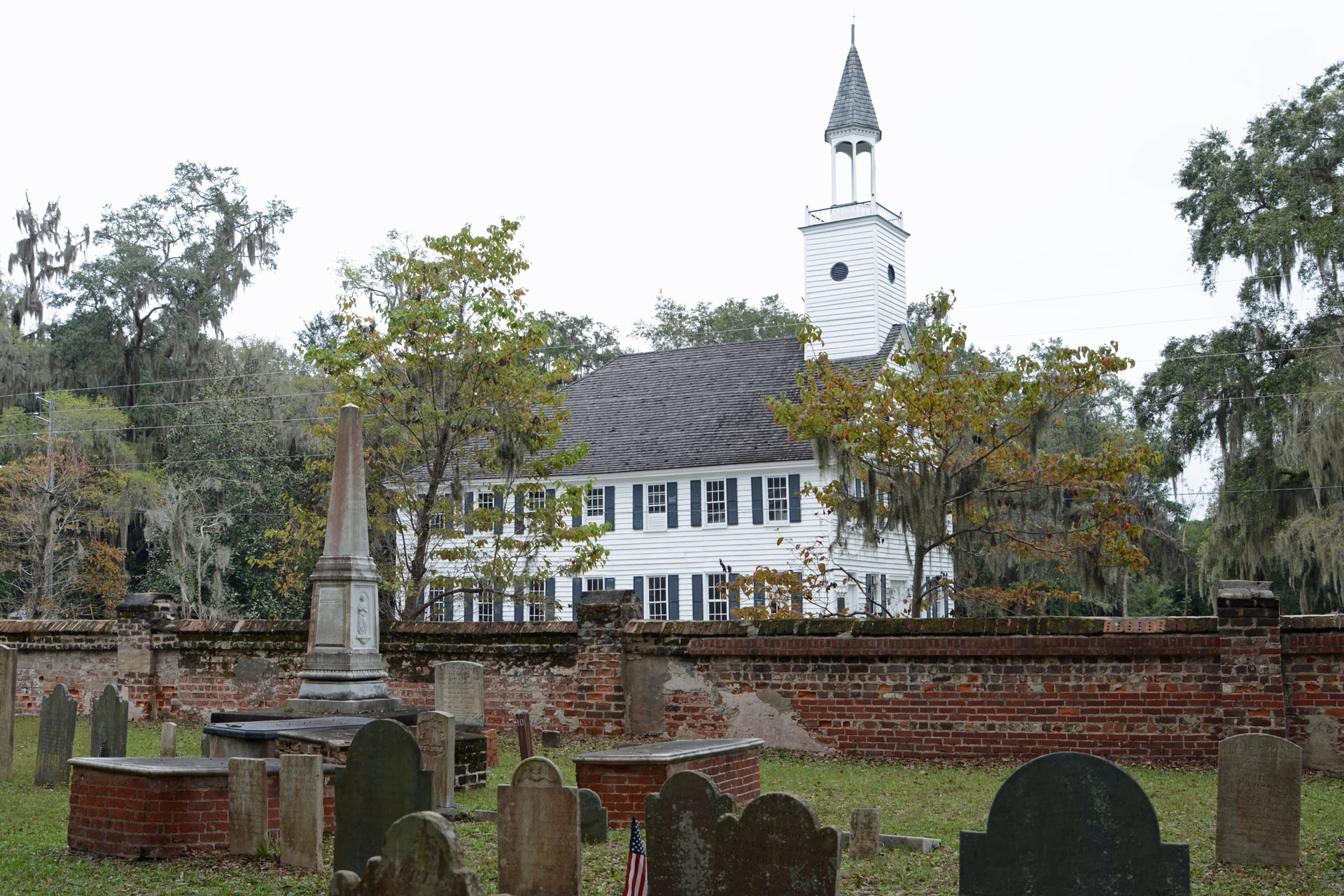
Midway Cemetery in Midway, Georgia, sits inside a brick wall built in 1813. The legend says a bricklayer was killed and sealed up in it. A crack in its north wall keeps coming back. Visitors also tell of two shadowy lovers under a tree.
The story goes that two enslaved men were building a brick wall around a cemetery in Midway, Georgia, and they couldn't stop arguing. They were kept late to finish the job, and one of them killed the other with a brick. Then he hid the body inside the wall, and in some tellings he told everyone the other man had run away.
That wall still stands around Midway Cemetery. It went up in 1813, about 6 feet high and 18 inches thick, built of brick shipped from England. Puritan settlers had come here from Dorchester, South Carolina, in 1752, and their wooden meeting house, finished in 1792, has never been modernized. About 1,200 people are believed to be buried inside the walls, among them Gen. Daniel Stewart, whose granddaughter Martha Bulloch became Theodore Roosevelt's mother. By 1929 there was no room left, so N.J. Norman was buried outside. In November 1864, Union cavalry under Maj. Gen. Judson Kilpatrick made the church their headquarters and used the cemetery as a corral, with the brick wall keeping the animals in.
A tree branch reaches into the cemetery, and visitors say they've seen two shadowy figures standing beneath it. People say they're Sylvia and Anthony. Sylvia was a wealthy man's daughter, and she loved Anthony, a man her father enslaved. Her father had Anthony killed and hanged from that branch, and Sylvia killed herself there.
Bryan County News says more than 30 children who died in an 1854 yellow-fever epidemic are buried here, and that on full moons "mysterious little eyes play hide-and-seek" with visitors. Oak roots have pushed loose the coffin of Dr. Abner Porter, and the legend says it's the cemetery rejecting him. The museum's tour describes him as a young doctor who died by suicide.
That tour is the Midway Museum's yearly Tales and Legends walk, led by guides in costume, and one of the stories they tell is Chloe's. A planter named William Robarts bought an enslaved girl named Chloe off a ship at Sunbury and put her to work in his house. She upset his wife, so she was sent to the rice fields, and the wife fell suddenly ill and died soon after. Chloe was brought back to the house, and she angered his second wife. Robarts sent her to the fields again and threatened to sell her, and the very next day that wife fell ill and died within a few hours. Years later a third wife lived a few years and died mysteriously too. By then the other enslaved people were afraid of Chloe, and some said she "totes poison." At a party on the night after Robarts's fourth wedding, a toast was proposed, and Chloe served the wine. At the last minute the bride and groom decided to swap glasses. As they raised them, Chloe ran up and knocked Robarts's glass away, crying, "That glass ain't for you!" She pulled a black vial from her dress, drank it, and ran out of the house yelling, "Chloe is gone ... gone ... gone!"
The guides say the 3 wives are buried here. A Southern marriages index does list 4 Liberty County marriages for a William Robarts, the first in 1804 and the last in 1821. It doesn't say they're one man or record any deaths, and nothing in it ties Chloe to them. The same paper says visitors may see a shadow on a tombstone that "likely would be Chloe, holding her little vial."
The museum's guides also tell of spirits still inside the brick walls, sometimes seen at night by passersby. The legend says that wall cracked and crumbled, and years later the bones were found. It was repaired, and in one telling the master had it torn down and rebuilt. The crack in the north wall came back anyway, and it's there to this day.