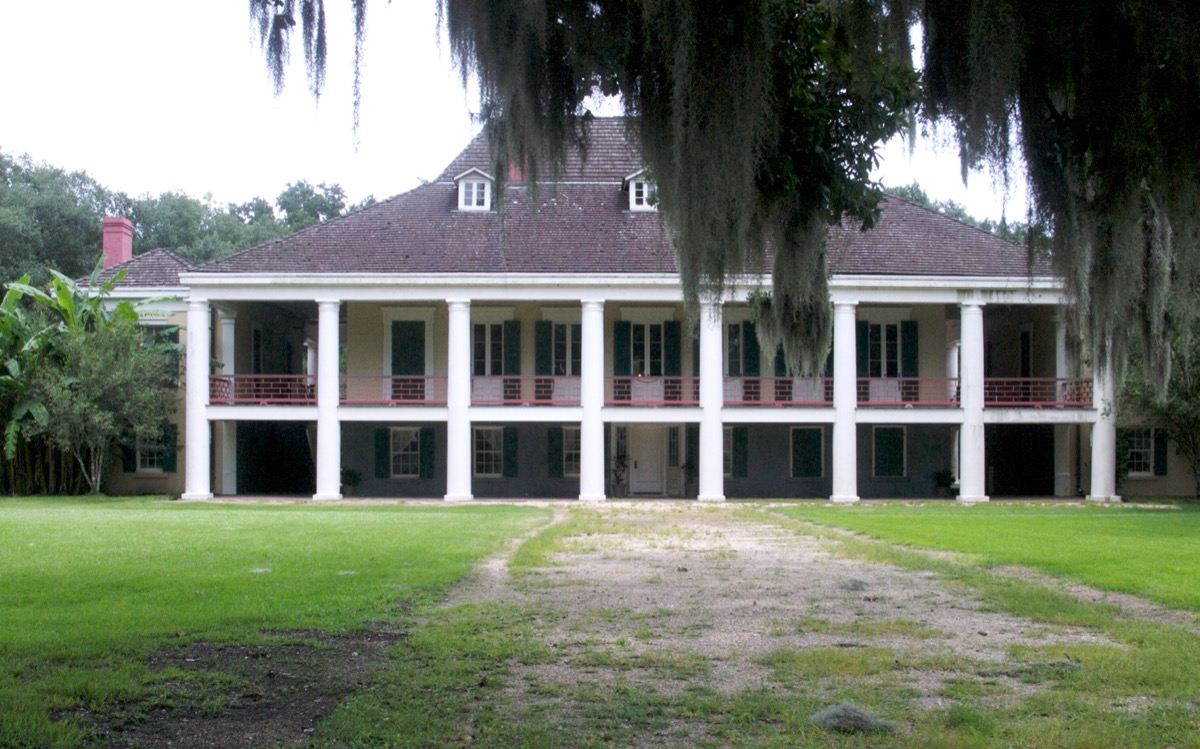
Visitors to Destrehan Plantation in Louisiana keep seeing a man in white walking the oak-lined front drive and standing motionless at an upstairs window. The story names him Stephen Henderson, who buried his young wife in 1830 and never recovered.
At Destrehan Plantation in Destrehan, Louisiana, visitors keep seeing a man dressed in white. He walks the oak-lined drive out front, stands motionless at an upstairs window, and sometimes rests in a chair on the grounds. The story names him: Stephen Henderson, a man who lived here and never really left.
Henderson was a Scottish immigrant who married into the family that owned the place. In 1816 he wed Zelia Destrehan. She was 16. He was 42. She died childless in 1830, and by every account he never recovered from it. He died in 1838, and his will read like a man trying to undo his life from the grave: it freed all the people he had enslaved, offered them passage to Liberia, and called for a city named Dunblane to be built on the grounds for them. The courts threw it out.
There's a second figure people report, this one on the staircase. A psychic visitor once described him in detail: dark hair, a sharp nose, a green waistcoat, and no right hand. Ghost-history sites match that description to Nicholas Destrehan, the original owner's son. What happened to the hand, no record says. The real Nicholas is remembered only as a scholar and inventor, so the missing hand belongs to the apparition and not to the man.
A third ghost is smaller. Visitors report a young blonde girl playing with toys in the nursery, running the foyer staircase, and hiding behind the tour guides' hoop skirts. No one has matched her to a name. A NOLA Ghost Riders guide, Trish Burns, says the spirit she's felt has a temperament: "She likes shiny things, she likes long hair, purses." Burns puts it more plainly, too: "I have been touched in there."
The house itself is the oldest documented plantation home left intact in the Lower Mississippi Valley. Its building contract is dated January 3, 1787, and the document still survives in the parish courthouse. There's even a legend that the pirate Jean Lafitte, a friend of Henderson's, hid treasure inside, though Lafitte is never documented to have set foot in the place. The legend was enough. Treasure-hunters came and left gaping holes in the walls.
But the heaviest thing the house holds isn't a ghost. In 1811, after the largest slave revolt in American history, one of the three tribunals that tried the captured men sat at Destrehan. It sent 18 of 21 to their deaths. Along the River Road afterward, nearly 100 severed heads were posted on the levee as a warning. None of the named ghosts are tied to those dead — the men the tribunal condemned aren't the ones people report seeing.
The staff don't lead with the hauntings. They tell the 1811 history first. But the late-shift docents have their own stories, and the executive director, Tracy Smith, came around against her own judgment. "I was probably skeptical at first," she said. "It's hard not to believe when you see the images that were captured."