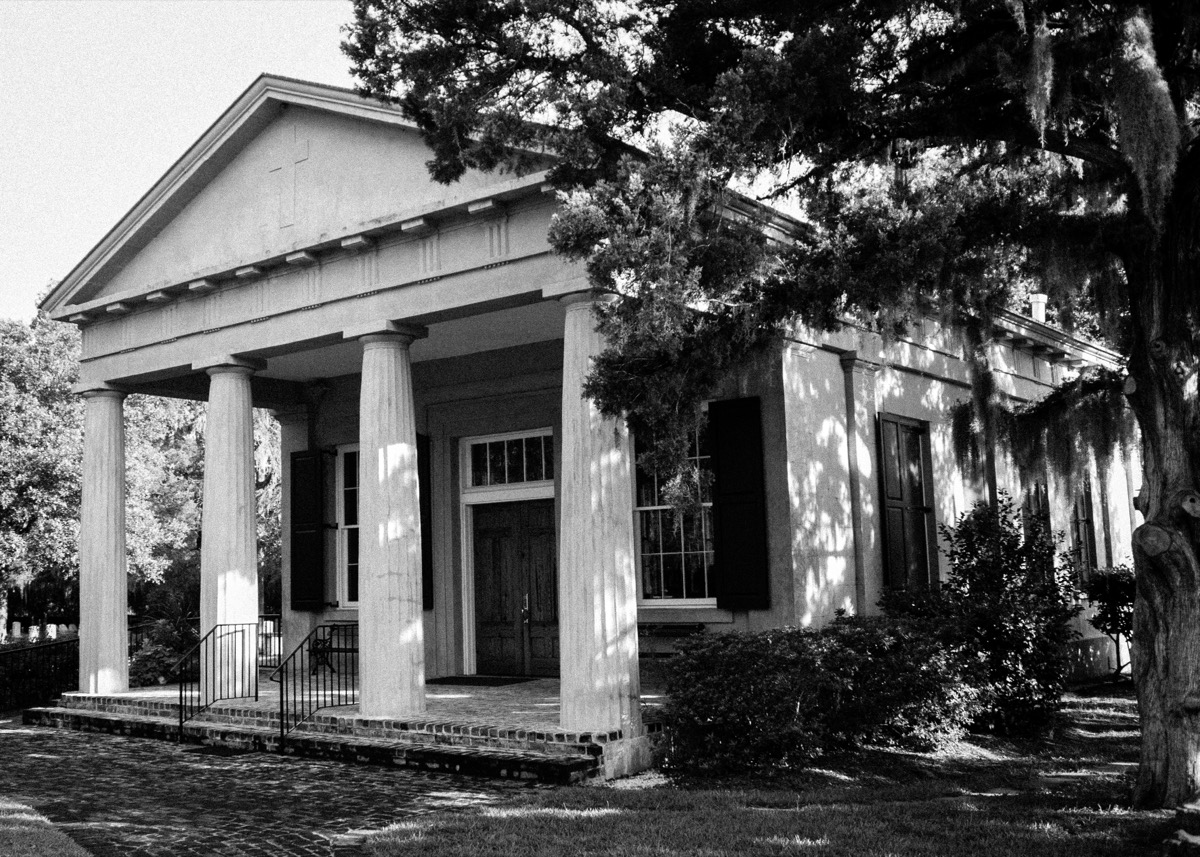
In the churchyard at All Saints near Pawleys Island, South Carolina, a flat slab reads only "Alice." Strangers walk backward around it thirteen times and leave rings, calling a dead girl who searched her deathbed for a ring her brother threw away.
In the churchyard at All Saints, near Pawleys Island, South Carolina, one grave is a flat marble slab that carries a single word: Alice. No surname. No dates. Just the first name of a girl, set beneath an oak toward the back of the cemetery.
Strangers come to it every weekend. The ritual is oddly precise: walk backward around the slab thirteen times, calling her name, and she is supposed to appear. People leave things on the stone for her — rings, coins, ribbons, flowers. And some women, standing there, feel a sudden tug at their own wedding band, as if something at the grave is trying to pull it loose.
The tug has a reason behind it. The girl under the slab spent her last days hunting for a ring.
Her name was Alice Flagg. She died in 1849, a teenager, of a fever, in a plantation house called The Hermitage over in Murrells Inlet, where she lived with her brother, Dr. Allard Belin Flagg. She had fallen in love with a man the doctor judged beneath the family, and he forbade her to wear the engagement ring where anyone could see it. So she hid it, on a ribbon, under her dress, against her chest.
When she fell ill, her brother found the ribbon. He tore the ring from her and threw it into the water. In her last hours, Alice searched the bed for it, begging the people at her bedside to bring it back. She died without it, in that house, miles from the churchyard where the rings pile up for her now.
They say she never stopped looking. Visitors describe her in a long white dress, one hand pressed to her chest, drifting through the churchyard as though she is still searching the ground for something she lost.
The marker that thousands circle and leave rings on may cover no one at all.
A historian named Catherine Lewis went through the records and published her findings in the Independent Republic Quarterly. Her conclusion was that the legend is "a blend of historical fact and folklore." The Alice of the love story, she found, was buried not at All Saints but at Belin Memorial in Murrells Inlet, in a churchyard once called Cedar Hill. And the parish's own records suggest the single-name slab is a memorial, not a grave.
So the ring-seeking girl in white may lie somewhere else entirely, under a name and dates on a different stone across the county. And the people walking backward thirteen times in the dark, laying rings on the marble for her to find, may be leaving them on an empty marker.