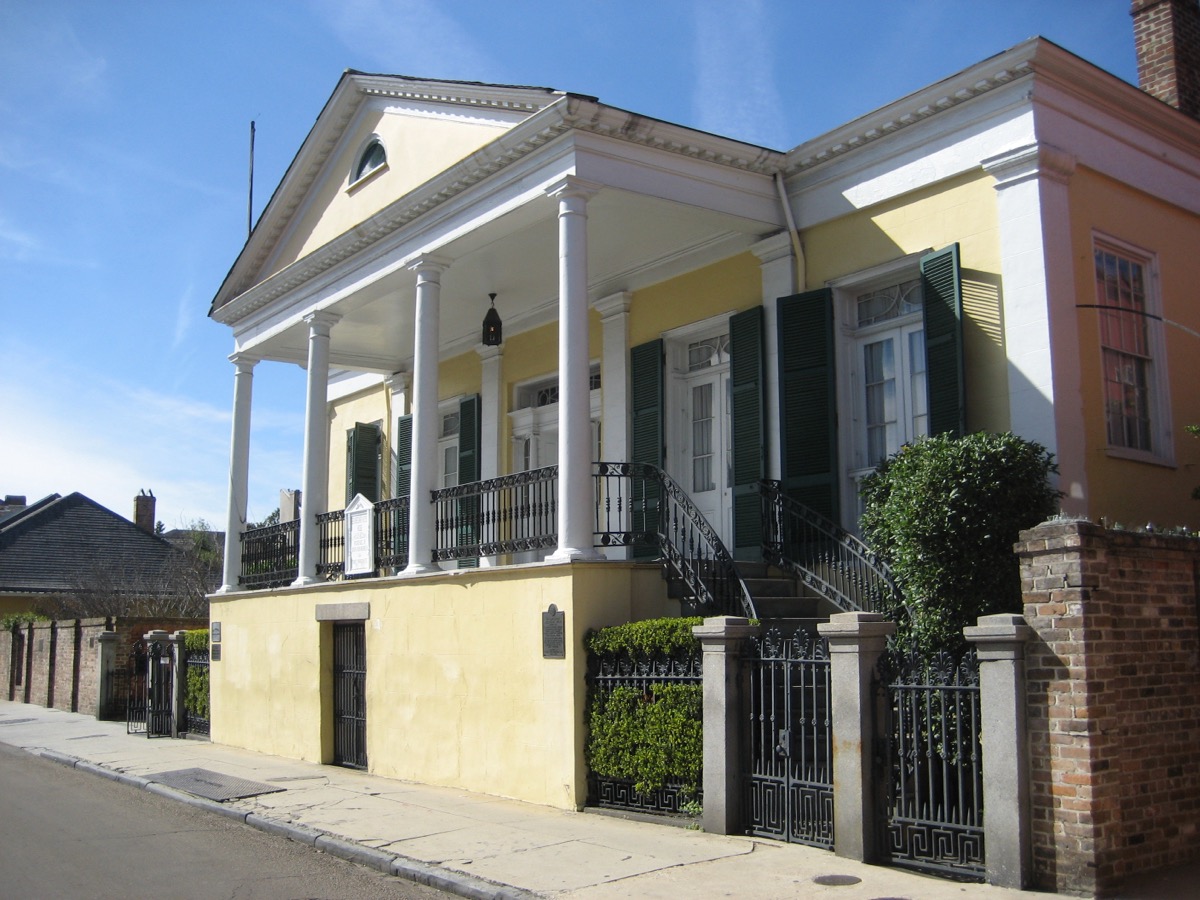
At the Beauregard-Keyes House on Chartres Street in New Orleans, the novelist who restored the place said she saw General Beauregard wandering at night, looking for the boots he was buried without. Other figures crowd in behind him.
The Beauregard-Keyes House sits on Chartres Street in the French Quarter, and the novelist who restored it in the 1940s said the general it's named for never left. Frances Parkinson Keyes claimed she watched P.G.T. Beauregard wander the house at night, and she had a theory about what he was after. He "pokes around at night looking for his boots," she said. "It seems they buried the poor man in his stocking feet."
Beauregard was only ever a tenant here, renting the rooms from 1866 to 1868 after the Civil War. The house was built in 1826, long before him, for an auctioneer named Joseph LeCarpentier, and the chess prodigy Paul Morphy was born inside it. But it's the soldiers people report, and Beauregard is not the only one. Visitors and passersby describe men in grey and butternut uniforms appearing with vacant faces before they dissolve, and they tell of phantom gunfire, groaning, and the smell of musket smoke drifting through the garden. The author Victor C. Klein wrote them down in 1993. "Men with mangled limbs and blown-away faces swirl in a confused dance of death," he wrote. The soldiers are popularly tied to Shiloh, the battle that was Beauregard's worst defeat.
None of that has a paper trail behind it. The bloodier story here is the one that does.
In June 1908, the house belonged to the Giaconas, a Sicilian family who ran a wholesale liquor business out of the basement wine cellar. They chose the place partly for that uncommon basement, where they could store the wine. They had also been receiving Black Hand extortion letters, and they had ignored them.
One night that June, Pietro Giacona and his son met four men on the back gallery. Pietro opened fire with a newly bought Winchester rifle. Three of the men died there. The fourth ran and was found wounded later.
The Giaconas were arrested and charged. In 1910 the case was dismissed as self-defense, and the Sicilian community celebrated father and son as heroes. They kept living in the house, kept selling liquor from the cellar, and didn't sell the place until 1925. The general's apparition gets the ghost tours; the men who actually bled on the property barely get mentioned.
It's a museum now, the parterre garden out front restored to white roses and jasmine. The general everyone tells you about only rented here for two years. The dead he keeps company with are the soldiers no record can confirm and the men shot on the gallery out back, who left a court case behind them.