A pale woman is said to walk Wright Square in Savannah, Georgia, asking strangers about her baby. People say she's Alice Riley. Riley was hanged in the square in 1735, after she gave birth. The Yamacraw leader Tomochichi was buried there too.
The woman people describe in Wright Square is pale, and she's looking for her baby. The ghost tours and visitor guides in Savannah, Georgia, tell of her stopping passersby to ask about a lost child, and the city's visitor guide, savannah.com, describes "a pale, redheaded woman begging for help finding her baby." Some say she follows pregnant women and mothers with infants.
They say she's Alice Riley, and the square on Bull Street, at President Street, is where Riley was hanged.
Alice Riley and Richard White were Irish indentured servants who came to Georgia late in 1733, and they were assigned to William Wise, a cattle farmer on Hutchinson Island. Wise is remembered as a cruel master. In March 1734, White strangled him with a neckerchief while Riley pushed his head into a pail of water, and it's described as the first murder in the colony. The two of them ran, and they were caught and sentenced to hang.
But Riley was pregnant, so her hanging was put off until the baby came. Her son was named James. On January 19, 1735, she was hanged in the square, which was called Percival Square back then, and she's widely called the first woman hanged in Georgia. In a letter written afterward, Edward Jenkins reported that she "was hanged yesterday," and that she denied the murder. Her body was left on the gibbet for three days before it was taken down. Richard White escaped from jail, and two brothers, Henry and William Parker, caught him again, and he was hanged too.
The baby didn't live long. In a letter dated March 19, 1735, Thomas Christie wrote that "the child is since dead."
The legend tells the hanging stranger than the record does. In that version Alice hung alive in the square for three days, and then she was gone from the noose.
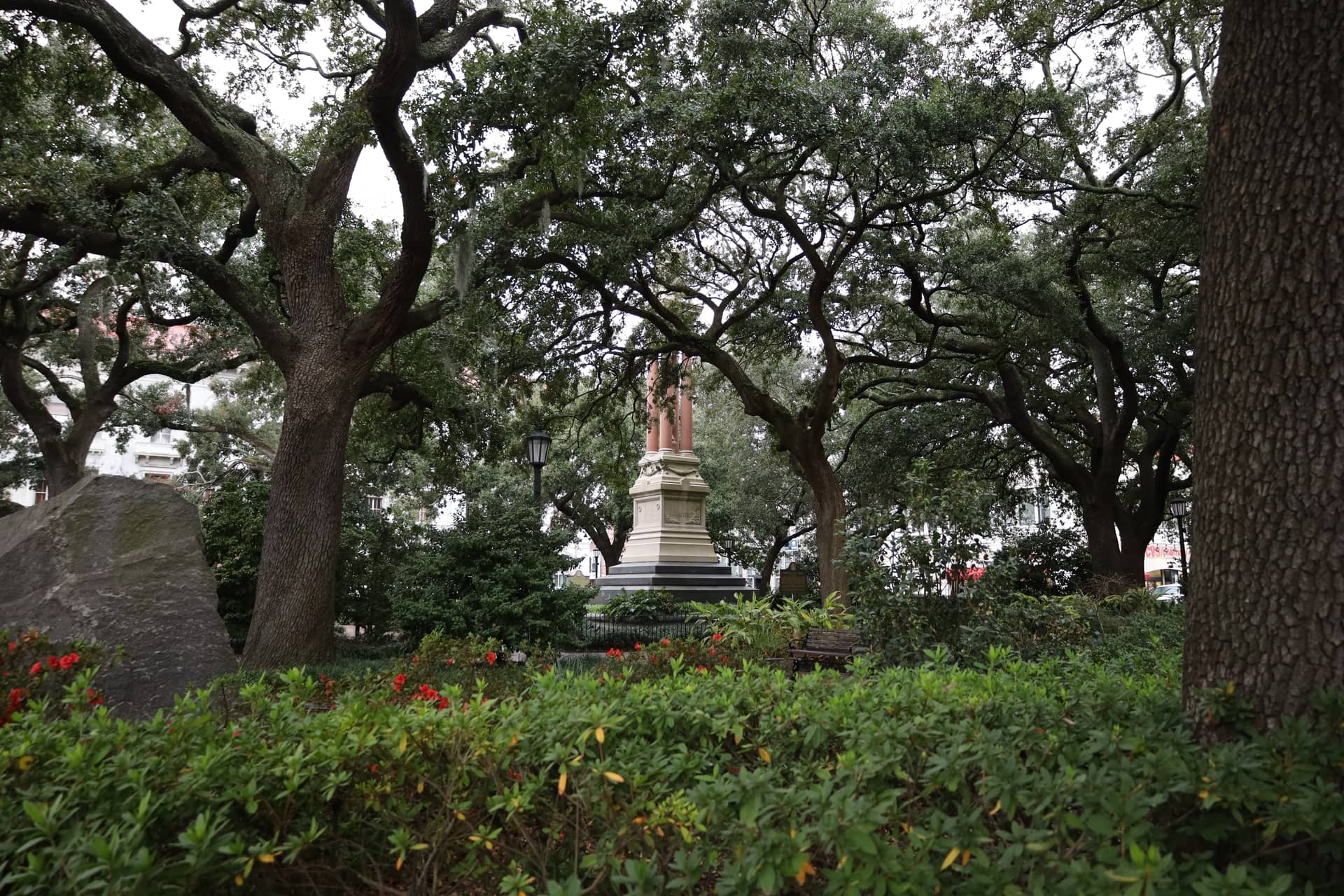
There's a second story about her, and it's in the trees. Spanish moss is said not to grow on the square's live oaks, or at least not on one side of them. Some tell it that Alice was a witch, and that she cursed the town. Others say the bare branches belong to someone else, because the rumor is that Tomochichi haunts Wright Square, and that the missing moss is his doing.
Tomochichi really is buried here. He was the Yamacraw mico who befriended Oglethorpe and the colonists, and he died on October 5, 1739. On Oglethorpe's orders he was buried in the square with a British military funeral, and Oglethorpe was one of his pallbearers. The grave was marked with a pyramid of stones. By the 1830s the pyramid was gone, and nobody knows what became of it.
The square itself had been renamed around 1763 for James Wright, Georgia's royal governor. Then in 1883 a red granite monument to William Washington Gordon, who founded the Central Railroad and Banking Company, went up at its center. It was Gordon's own daughter-in-law, Nellie Kinzie Gordon, who pushed for a new monument to Tomochichi. The Stone Mountain Monument Company offered the granite for free, and when she insisted on paying, she was sent a bill payable on "Judgment Day." The boulder was dedicated in 1899, and it stands in the square's southeast corner, off to the southeast of where the grave was.
The Gordon monument didn't just go up beside the grave. The mound at the center of the square was removed in 1883 so the monument could take its place, and the histories don't agree on what became of Tomochichi. Some say he was moved to the southeast corner, and others say he still lies under the Gordon monument.