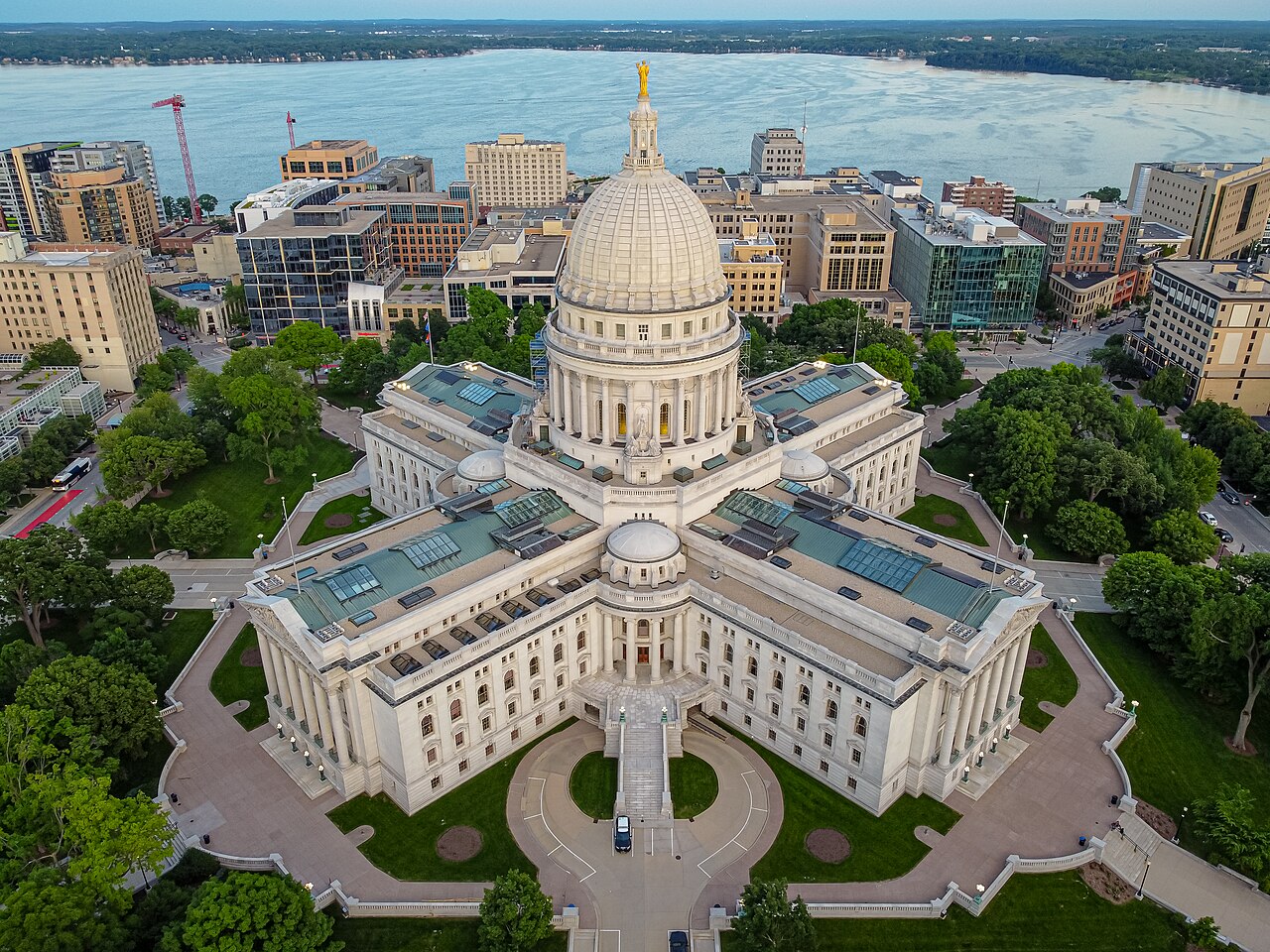
The Wisconsin State Capitol has a literal ghost in its Assembly mural, a painted-over Civil War soldier reappearing as 1913 oil paint grows translucent, plus the spirits of six workers killed in an 1883 construction collapse and a dome builder named Frank whose footsteps employees hear on the spiral staircase.
Look closely at the mural above the Assembly chambers in the Wisconsin State Capitol and you'll notice something wrong. A faint human shape floats behind the state badger, gaining definition every year. It's a Civil War soldier that artist Edwin Howland Blashfield painted out in 1913 to make room for the badger at legislators' request. As the oil paint has grown more translucent with age, the soldier has reappeared. Capitol tour guides call him the Ghost of the Assembly. "Over time, oil paint becomes more translucent," lead guide Ken Rosenberg has explained. "You can see through it a little more, so you can see that figure more." When the mural was cleaned with 20,000 Q-tips during the 1988 restoration, the soldier became noticeably visible. He hasn't faded since.
The painted ghost is a neat trick of chemistry. The real ghosts, if employees are to be believed, are something else.
On November 8, 1883, at 1:40 in the afternoon, the south wing extension of the third State Capitol collapsed with what witnesses described as a deafening crash, "like the rending of heavy timbers." Six laborers died: Barney Higgins, William Edgar, Michael Zwank, William D. Jones, James "Deerfield" Kelly, and James Dowell. Twenty more were injured. Madison had no hospital at the time, so the wounded were carried to government offices and private homes scattered around Capitol Square.
An inquest found the cause: columns and supports thinner than the architect's plans specified, plates too small to distribute the roof's weight properly. Defective workmanship and inferior materials. Among the people who watched the aftermath unfold was a schoolboy named Frank Lloyd Wright, who later described the scene in his autobiography, men emerging from the basement covered in white lime dust, fighting off falling beams and masonry.
Twenty-one years later, on February 27, 1904, a gas jet ignited freshly varnished woodwork in a second-floor closet at 2:30 in the morning. The fire burned for 18 hours. The university's water reservoir happened to be empty, and firefighters from Milwaukee arrived to find their equipment frozen solid in the cold. Everything except the north wing burned. The loss included the mounted remains of Old Abe, the eagle mascot of Wisconsin's 8th Regiment who had survived the Civil War only to die of smoke inhalation from a smaller Capitol fire in 1881. The legislature had voted to cancel the building's fire insurance shortly before.
Construction of the current Capitol began in 1906, designed by George B. Post and Sons of New York. It cost .25 million and was finished in 1917. Two workers died during the build. One was killed when a row of stones fell from the top of the west wing. Another, a worker named Frank, fell from the top of the dome through the interior all the way to the bottom after the ironwork had been erected.
Employees who work late in the Capitol report hearing footsteps on the spiral staircase near the dome, which some attribute to Frank. The fourth floor of the south wing, where the 1883 collapse killed six men, carries its own reputation. Doors open and close without explanation. Voices come from corridors where nobody is walking. Cold drafts appear in sealed rooms.
The building sits 284 feet tall from ground floor to the bronze "Wisconsin" statue that Daniel Chester French sculpted for the dome in 1920. She weighs three tons, wears a helmet shaped like a badger, and looks out over a city built on an isthmus between two lakes. Below her, the dome holds the world's largest granite structure, constructed from Bethel white granite shipped from Vermont, assembled from 43 types of stone sourced from six countries and eight states.
Somewhere below all that stone, Frank's footsteps keep climbing the stairs.