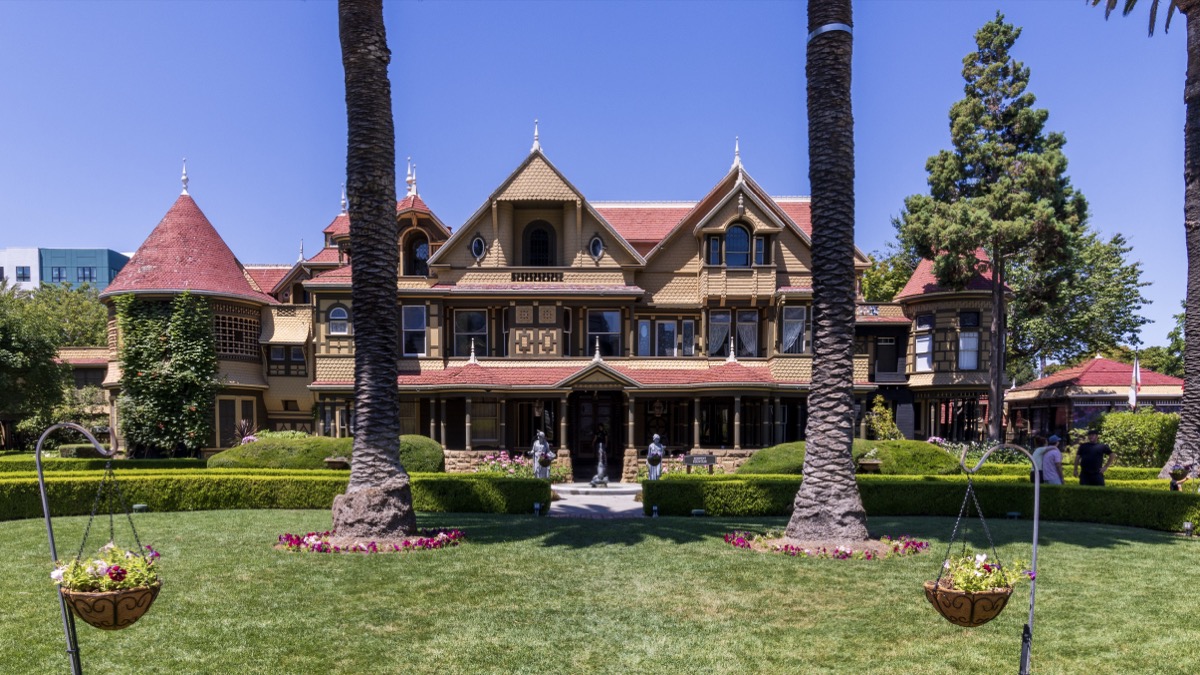
TLDR
Sarah Winchester spent 38 years building this 160-room labyrinth with staircases to the ceiling and doors that open to fifteen-foot drops, and she didn't stop until she died in her sleep in 1922. Historian Mary Jo Ignoffo found no evidence Sarah believed the seance story the papers invented. She was just a very lonely widow with $20 million and an interest in architecture.
The Full Story
There's a staircase in the Winchester Mystery House that goes straight up into the ceiling and stops. There's a door on the second floor that opens to a fifteen-foot drop onto the lawn. There are trap doors, secret passages, a skylight embedded in the floor of one room, and a window built into the floor of another. Sarah Winchester spent 38 years and an unknowable fortune building this house, and the longer you look at the floor plan, the more convinced you become that she was trying to lose something inside it.
The biography is sadder than the myth. Sarah Lockwood Pardee was "the Belle of New Haven," a Connecticut society woman who in 1862 married William Winchester, heir to the Winchester Repeating Arms Company. Their infant daughter Annie died of a wasting condition called marasmus just five weeks after birth in 1866. William died of tuberculosis in 1881. Sarah inherited roughly $20 million and half the Winchester fortune, and she was left in a house in New Haven full of the children and husband she no longer had. She moved to California in 1886 and bought an eight-room farmhouse in the Santa Clara Valley. Then she started building, and she didn't stop until she died in her sleep on September 5, 1922.
By the end of those 38 years, the house had 160 rooms, 950 doors, 10,000 windows, 47 stairways, 47 fireplaces, 6 kitchens, and 3 elevators. The number 13 appears everywhere: 13-paned windows, 13-paneled ceilings, 13-step stairways. The popular story is that a medium in Boston told Sarah that the ghosts of the people killed by Winchester rifles demanded endless construction to house their spirits. Historian Mary Jo Ignoffo's biography of Sarah, sourced from the letters and documents Sarah left behind, found no evidence she ever believed any such thing. The seance story was largely invented by yellow journalists in the 1890s who couldn't get into the property and made up the lurid parts. Sarah was an amateur architect, a grieving widow, and, by most accounts, a very lonely woman with a lot of money and a deep interest in building.
That doesn't mean the place is quiet.
The 1906 San Francisco earthquake hit at 5:12 a.m. on April 18 and collapsed seven stories of the mansion's tower. Sarah was trapped in the Daisy Bedroom for hours until servants pried her out with a crowbar. Instead of rebuilding those sections, she sealed them off. Rooms were nailed shut. Doors were boarded over. Hallways ended in walls that hadn't been there the week before. The house became a labyrinth on top of a labyrinth.
The most commonly reported ghost is "Clyde," a mustached construction worker in nineteenth-century clothes who appears pushing a wheelbarrow in the basement or working near the fireplace in the Grand Ballroom. Visitors sometimes mistake him for a costumed actor and mention him to guides, who patiently explain that the house does not employ costumed actors. Maintenance worker Denny reported hearing footsteps in the water tower that stayed exactly one floor ahead of him no matter how fast he climbed, and then stopped on the roof with nobody up there. The Daisy Bedroom, the same one Sarah was trapped in during the earthquake, has its own activity. One tour guide heard a loud sigh from the hall while presenting the room and then watched a small shadowy figure move away from the door.
Ghost Adventures has investigated twice. During the 2011 filming they captured a blue orb photograph and a temperature drop from 72 degrees to 65 degrees. On their 2016 return, Zak Bagans was reportedly shoved against a wall on a switchback staircase with enough force that he had back pain for two weeks. Their SLS camera detected a figure standing on a chair in the seance room. An EVP captured a voice identifying itself as "Russell." Another captured children's voices saying "I want to go home."
Executive Director Walter Magnuson has logged his own experiences at work. "I have experienced windows slamming shut during meetings as if they were exclamation points, doors slowly opening down the hall as I approached, and voices in an adjacent room when I believed I was the only person onsite." His summary: "You never feel alone at Winchester Mystery House."
Over 12 million people have walked through this place since it opened to the public on June 30, 1923. Harry Houdini toured it in 1924, visited the seance room, and suggested the name "Winchester Mystery House," which stuck. The house has never stopped being strange. Sarah Winchester isn't here because she was afraid of ghosts. She's here because she built a shelter for her own grief, and the shelter got away from her, and now the shelter is standing open on a Saturday morning and letting tourists through. You don't need a ghost story to feel something in the Daisy Bedroom. You just need to think about whose bedroom it was.
Researched from 12 verified sources. How we research.