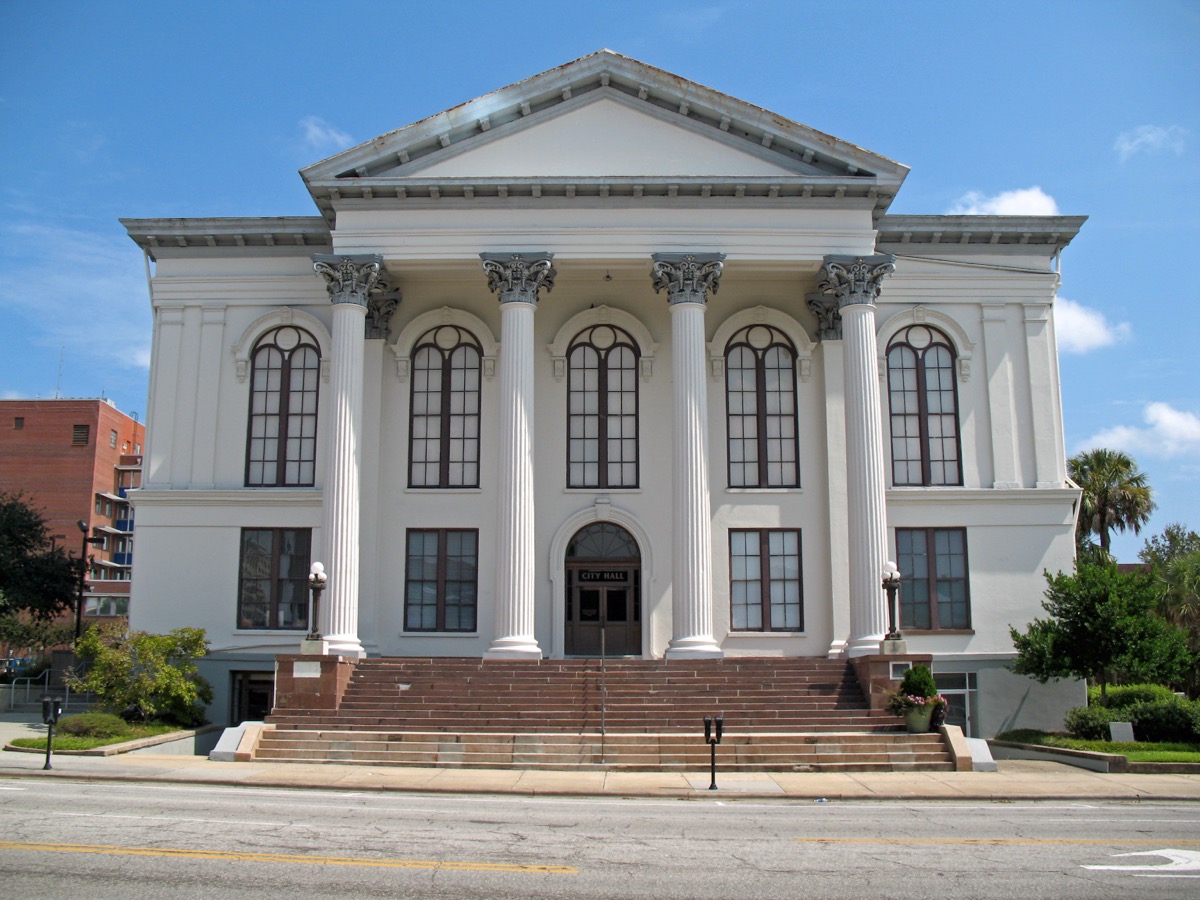
Thalian Hall in Wilmington, North Carolina has run as a theater since 1858. In 2009, crews renovating it pulled human bones out of the auditorium floor, in the same spot remains had turned up roughly twenty years earlier — and three watchers still keep the balcony.
Thalian Hall in Wilmington, North Carolina has staged plays since 1858, and in 2009 a renovation crew working inside the auditorium pulled human bones out of the floor. They found them in the back-center of the room, under where the audience sits. By the local account, an arm bone and a jaw bone — and they appeared to match partial remains turned up in the same spot during an earlier renovation, roughly two decades before. Nobody could say whose they were.
That is the floor people sit on to watch a show.
Up in the first balcony, in the center seats, three figures are said to keep the best view in the house. Two men and a woman, all in Edwardian dress, watching the stage. The story goes that staff and actors run into them the way you run into anyone in an old building — cold spots backstage, a voice in an empty corridor, a presence in the dressing rooms with no one there to cast it. No source names the three, or says who they were, or why those seats.
There's a reason a town this size built a hall this grand. Around 1850, P.T. Barnum came through touring Jenny Lind, the Swedish Nightingale, and declined to put her on the stage of Wilmington's old Innes Academy. "My orchestra would fill a large part of that space," he scoffed, and took her to Charleston instead. The slight stuck. The cornerstone for the new hall went down in 1855, and the city built it to seat roughly a thousand — about a tenth of everyone living in Wilmington at the time. It opened with a gala in October 1858.
The company that performs here is the Thalian Association, organized in 1788 and the oldest community theater in North Carolina. The hall itself was built as a combined theater, library, and city hall, and Wilmington still keeps its city offices in the building. Buffalo Bill Cody played it. So did Oscar Wilde and Frederick Douglass.
One name in the record lands stranger than the rest. John T. Ford — the man who ran Ford's Theatre in Washington, where Lincoln was shot — later moved to Wilmington and managed this house, renaming it the Opera House. The man who owned the most infamous theater in the country came south and took over this one.
Members tell a story, too, that nobody can date or pin to a name. A director's dog got up to the gallery, the second balcony, went over the railing, and fell two full stories — and walked away unhurt, as if something had caught it on the way down.
The bones are still the only part anyone dug up.