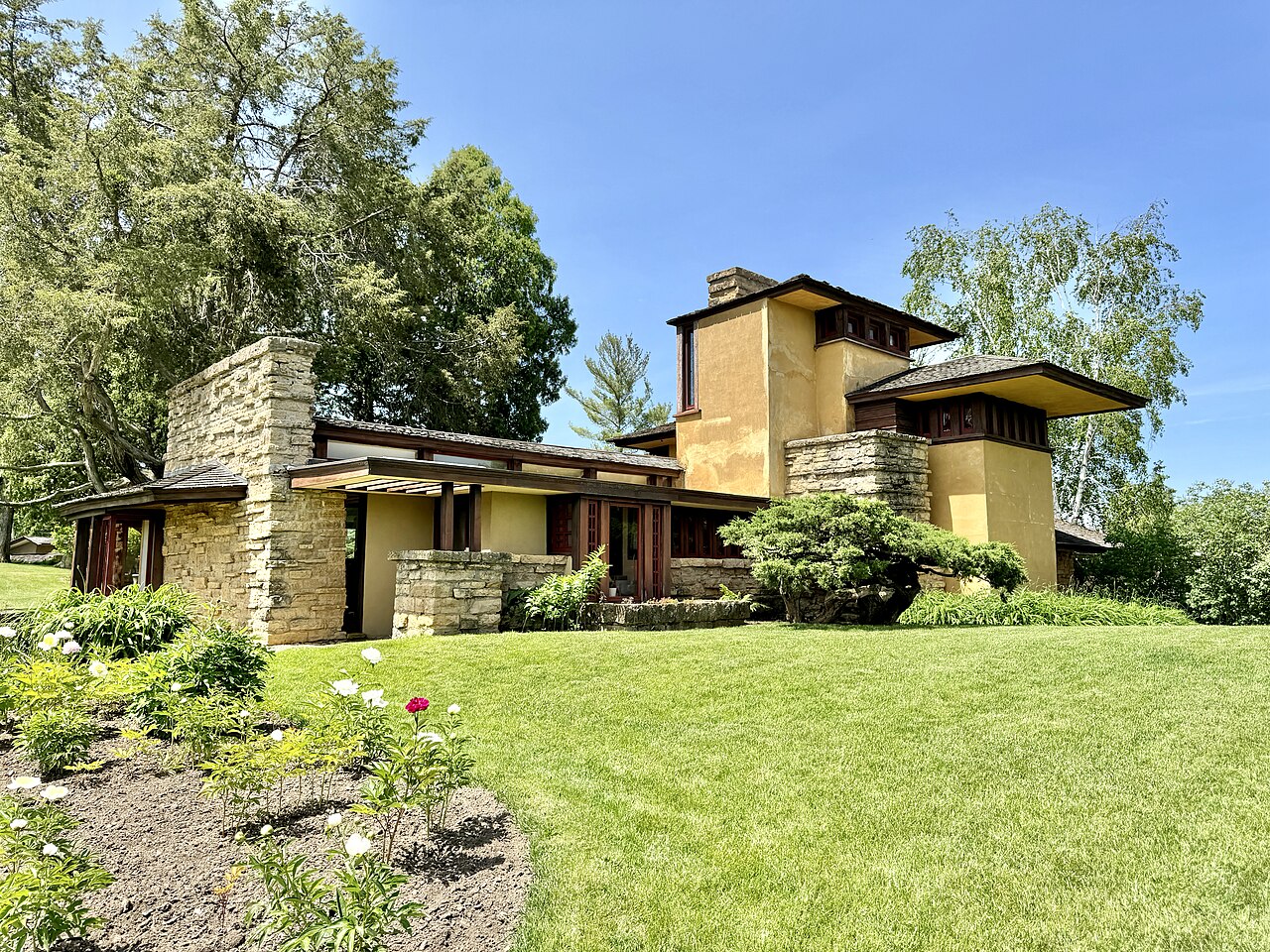
On August 15, 1914, servant Julian Carlton killed seven people with a shingling hatchet at Frank Lloyd Wright's estate, including Wright's mistress Mamah Borthwick and her two children, then set the building on fire. The rescue cottage up the hill, Tan-y-Deri, is where most ghost reports center: phantom smoke, children's voices, and a distraught woman in white.
"Why mark the spot where desolation ended and began?" Frank Lloyd Wright left Mamah Borthwick's grave unmarked. No headstone, no memorial. The seven people killed at Taliesin on August 15, 1914, got no monument either.
Julian Carlton was a thirty-year-old chef from Barbados, hired for the summer. By August, he'd grown paranoid. A housekeeper observed him staring out his window late at night with a butcher knife in his hand. Wright gave him notice on August 15th, his final day.
That afternoon, while Wright was away in Chicago, Carlton served lunch to Mamah Borthwick and her two children, John (twelve) and Martha (eight or nine, sources differ), on the dining room porch. He walked away, came back with a shingling hatchet, and killed all three. Then he poured gasoline under the dining room doors, around the outside walls, and lit the house on fire with the workers trapped inside. As men tried to escape the burning building, Carlton attacked them with the hatchet. Seven people died in total: Mamah, her two children, draftsman Emil Brodelle, foreman Thomas Brunker, gardener David Lindblom (who survived the initial attack but died of his burns), and thirteen-year-old Ernest Weston, the son of carpenter William Weston.
Two people survived. Herbert Fritz, a nineteen-year-old draftsman, and Billy Weston, a thirty-five-year-old master carpenter. Carlton was found barely conscious in a fireproof furnace chamber in the basement. He'd swallowed muriatic acid in a suicide attempt that burned his esophagus but didn't kill him outright. He refused to eat after his arrest and died of starvation seven weeks later in the Dodgeville jail, never explaining why he did it. The Bemidji Daily Pioneer reported on October 9, 1914, that "he had refused to eat since his arrest following the tragedy."
Wright rebuilt the residential wing by the end of the year.
The rescue workers carried the dead and dying up the hill to Tan-y-Deri, a cottage where Wright's sister lived. That cottage became the center of the haunting reports. Lights flash on and off. Windows open and close on their own. Doors slam. People smell smoke and gasoline in rooms where there's no source for either. Children's voices come from empty spaces. A woman in white, described as visibly distraught, has been seen inside the cottage and vanishes when approached.
The ghost stories at Taliesin have never been the focus of formal paranormal investigation, and the Frank Lloyd Wright Foundation doesn't promote the haunting as part of the estate's identity. But the accounts have accumulated quietly over decades from staff, visitors, and neighbors. The tragedy is too specific and too violent to not leave a mark on the place. Seven people hacked to death and burned on a summer afternoon, by a man who then crawled into a furnace and swallowed acid rather than explain himself. Wright poured everything back into rebuilding. Taliesin burned again in 1925 (an electrical fire this time) and he rebuilt it again. The estate he kept resurrecting now operates as a museum and UNESCO World Heritage Site, drawing visitors for the architecture. The cottage up the hill draws a different kind of attention.