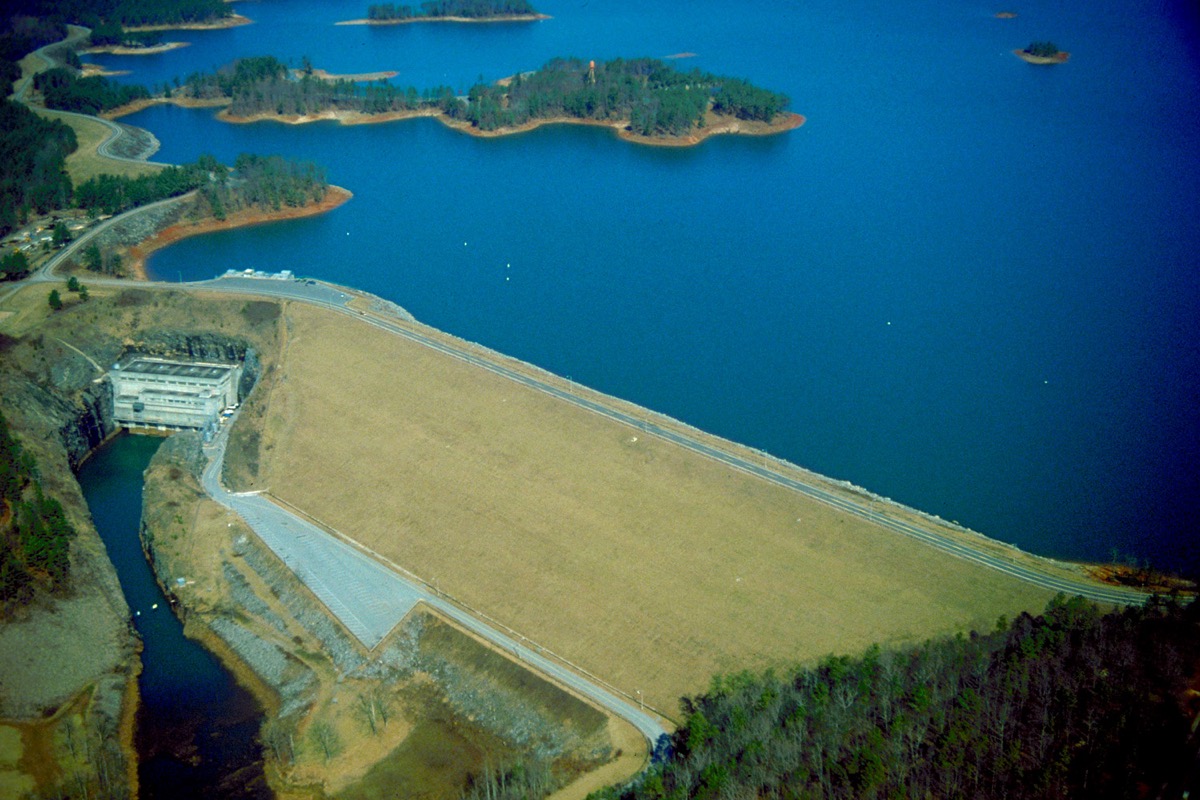
Lake Lanier near Buford, Georgia is the lake Georgians warn their kids to stay out of. Swimmers say a handless woman in a blue dress walks the shore and grabs ankles in the dark water. By the most defensible count, the lake has killed more than 200 people since 1994.
Lake Lanier, the Army Corps reservoir northeast of Atlanta near Buford, Georgia, is the lake people here warn their kids to stay out of. The reason they give isn't the drownings. It's the woman in the blue dress.
Swimmers tell it the same way: a figure walking the shoreline at the edge of sight, in a blue dress, with no hands. They call her the Lady of the Lake. Get too close to the water near the old bridge, the story goes, and she reaches up from below and pulls you under by the ankles.
The legend traces to a real night. In 1958, two friends, Delia Mae Parker Young and Susie Roberts, left a dance, skipped paying for gas, and lost control of a 1950s Ford crossing a bridge over the lake. Both drowned. A decomposed body surfaced near a bridge the next year, missing its hands, later identified as Young. The car, with Roberts still in it, wasn't recovered until 1990, more than thirty years later. Accounts differ on which of the two women is the ghost; the blue dress and the missing hands stay the same.
The drownings are real, and worse than folklore. By Georgia DNR figures, more than 200 people have died at Lake Lanier since 1994, the deadliest lake in the Southeast. Some viral counts run as high as 700 across its full life, though no single tally backs that. The defensible explanation isn't a ghost. When the Corps flooded the valley in the 1950s, the structures at Oscarville were never demolished, and cemeteries were never moved. Submerged trees up to 60 feet tall, barbed wire, and old buildings still wait under the surface to snag a swimmer.
The darker history sits beside the lake, not under it. The water covers the site of Oscarville, in a Forsyth County that violently expelled its entire Black population in 1912 and stayed almost all white into the 1990s. The flooding came forty years after, with no one left to drive out.
A blue dress is easier to talk about than that.