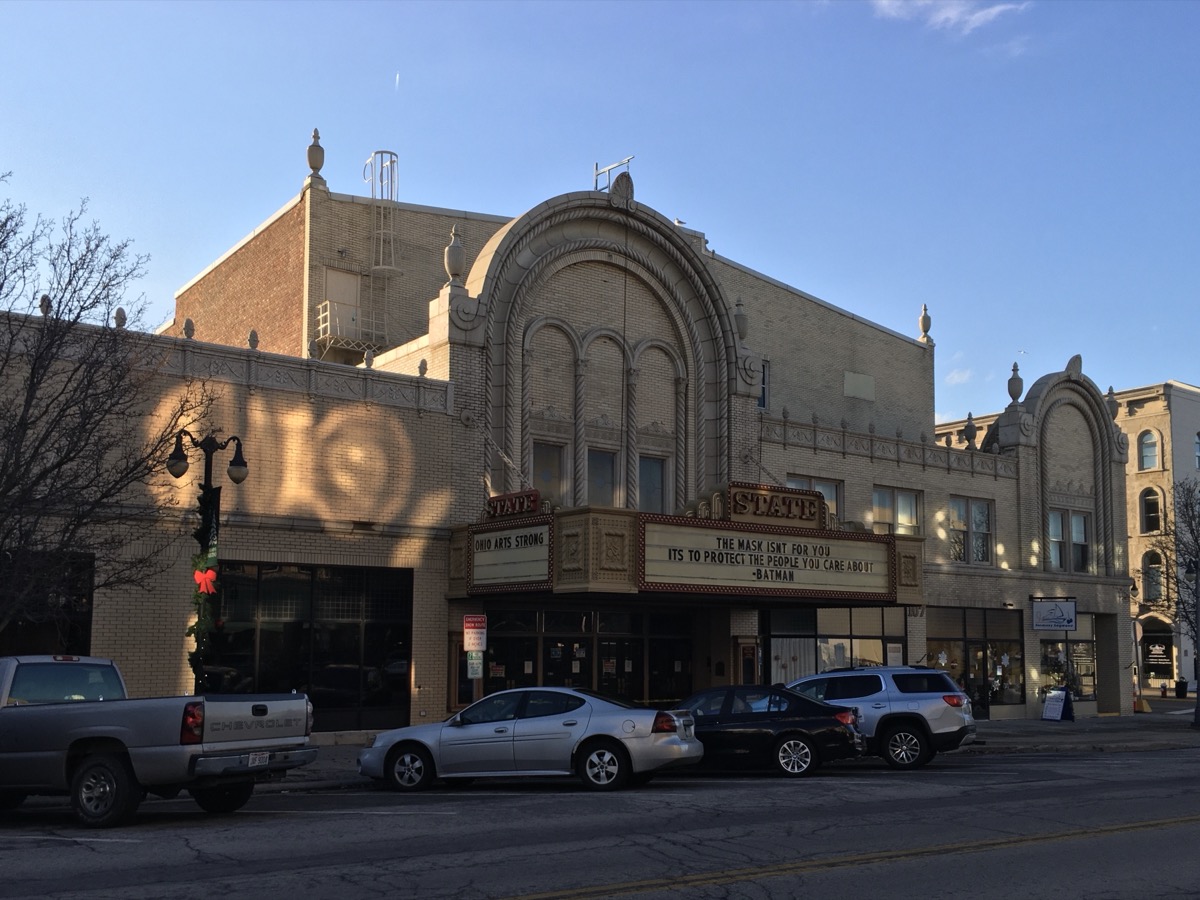
The Sandusky State Theatre opened in 1928 as a downtown movie palace, and the Ohio Exploration Society says at least four spirits stayed on — among them a voice in the projection booth whispering "Change the focus," and footprints that form on a freshly mopped floor.
The Sandusky State Theatre in Sandusky, Ohio, keeps its strangest ghost in the projection booth. A worker up there alone, surrounded by the original 1928 equipment, reported hearing a voice whisper the same instruction over and over: "Change the focus." No one else was in the room. The projector eventually stopped on its own. It's an oddly technical thing for a ghost to ask for. Whoever said it knew how the machine worked.
The Ohio Exploration Society documents at least four spirits inside the 1,800-seat movie palace, though only three of them turn up in the accounts. One is the voice in the booth. Another belongs to an employee mopping the auditorium floor after hours, who heard footsteps cross the room and turned to watch wet footprints press into the fresh surface, one after another, with no one making them. The third was seen from the balcony: a cleaner looked down and saw a glowing, light-blue figure in 1920s clothing walking across the stage, who stopped, looked directly up at the witness, and was gone.
The place opened on October 12, 1928, as the Schine State Theatre. A local tailor named William F. Seitz built it on the footprint of the old West House Hotel and leased it to New York theater magnate J. Meyer Schine. It was a whole night out under one roof: the basement held a bar, a barbershop, and 13 bowling lanes, where local boys set the pins by hand. A Page pipe organ, built up the road in Lima, Ohio, accompanied the silent films. The first feature was The Night Watch, starring Billie Dove.
For decades that was the story. Then, on June 10, 2020, a windstorm with gusts over 55 mph tore the roof off the building. The auditorium ceiling collapsed onto the seats. Bricks fell into the street, and a broken water main flooded the interior. The stage where a cleaner once watched a blue figure cross, the booth that held the 1928 equipment — much of it came down or went under in a single afternoon.
It's being rebuilt now. The restoration, about 90% finished as of late 2025, is recreating the gilded ceiling dome, four seasonal landscape murals, and a cloud mural overhead, with a community goal to reopen in late 2026 or 2027. No one has worked a late shift inside since the storm tore it open. Whether the voice in the booth is still asking anyone to change the focus, nobody can say.