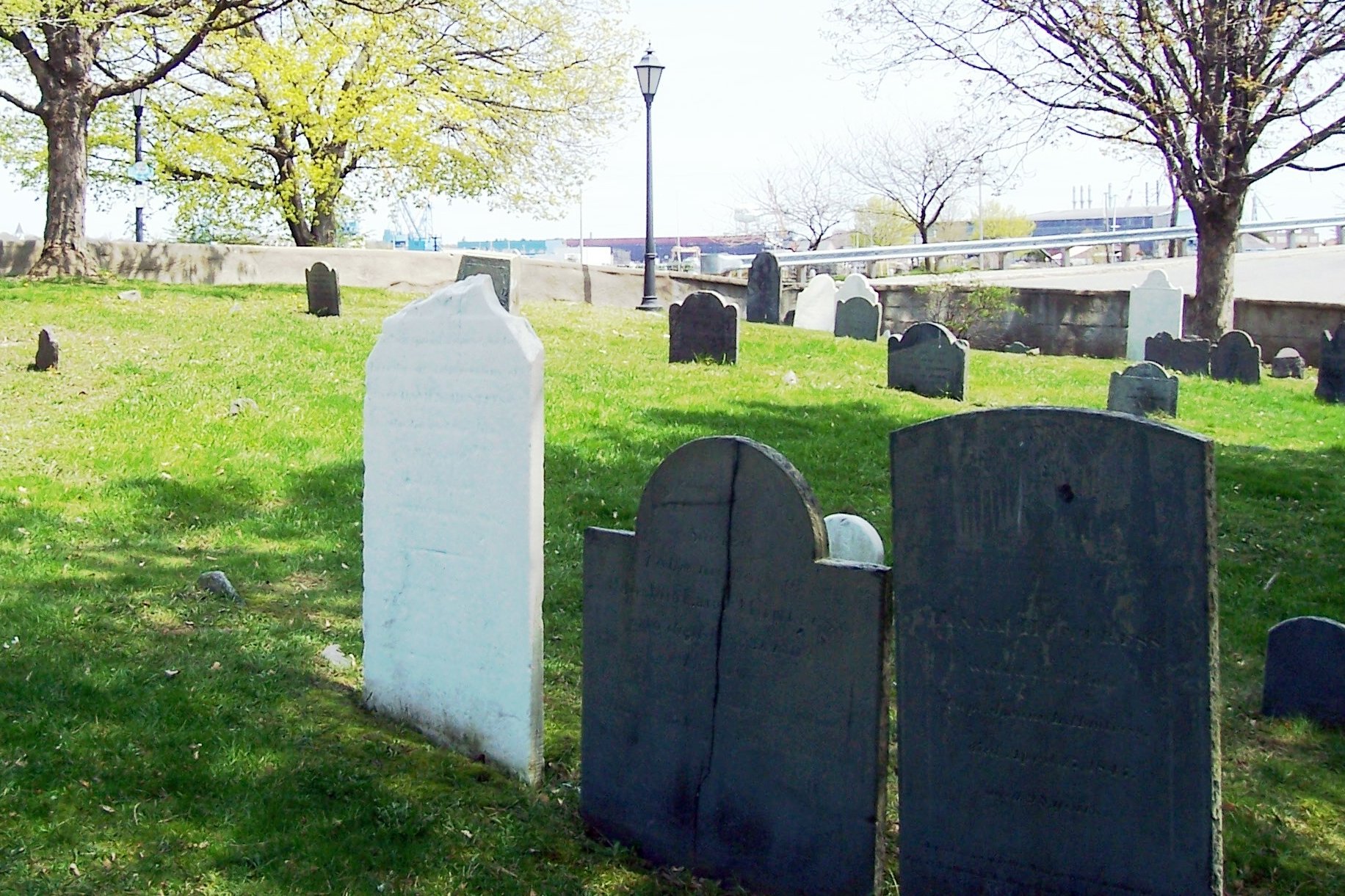
Point of Graves is the oldest burying ground in Portsmouth, New Hampshire. In its right-hand corner sits a stone tomb that keeps turning up lit from inside in visitors' photographs, an orange glow on no other shot from the same camera.
In the right-hand corner of Point of Graves, the oldest burying ground in Portsmouth, New Hampshire, there is a raised stone tomb that people keep photographing by accident. The pictures come back wrong. The tomb glows from the inside, an orange-yellow wash that shows up on that one shot and nowhere else on the same camera roll.
It belongs to the Vaughan family. A stairway runs down from it into a crypt, and the story goes that when 19th-century Vaughan descendants opened that crypt to build the tomb, they found 28 skeletons laid out on shelves. No one could say who they were. The count is the documented tradition; the names were already gone.
Roxie Zwicker has walked tour groups through this half-acre off Mechanic Street for around 17 years, and she stays skeptical about the rest of it. People report figures climbing out of the tomb at night, and she puts the question plainly: "do you want to go with the belief that there are people climbing out of the ground, or that there's just shadows from light in here?" Her hour-plus cemetery walk through these stones is one of her most popular.
She is less sure about Elizabeth Peirce's stone. Peirce died in January 1717, and her marker carries a winged skull, a death's head with feathers, the kind colonial carvers cut to mark the soul taking flight. Standing near it, Zwicker has described "a little push from an unseen presence on her back."
The ground was set aside in 1671 on land deeded by Captain John Pickering, on a point overlooking the Piscataqua River near where it meets the Atlantic. That point of land is where the name comes from. Nothing legible survives from before 1682, and the reason is mundane and grim: Pickering's cattle kept grazing among the markers, and they wore the early stones away. About 125 slate stones are left, cut by some of early New England's named carvers.
One stone belongs to Elizabeth Elatson, who died at 45 in January 1704 of burns from a fire at a Portsmouth minister's house, an event later regarded as the first published house fire in America. Her marker still reads, "HERE LYES YE BODY OF MRS ELIZABETH ELATSON AGED 45 YEARS DIED IANRY 1704." The same fire took the minister's youngest child, who shares the stone.
Another is tall and slanted, set for two children under three from one family, both lost in a 1790s yellow-fever epidemic. Visitors stop at it and cry without knowing why. Zwicker has watched it happen and offers them shadows and light. The strangers stand at the children's stone anyway, weeping for a grief that, on paper, is more than two hundred years gone.