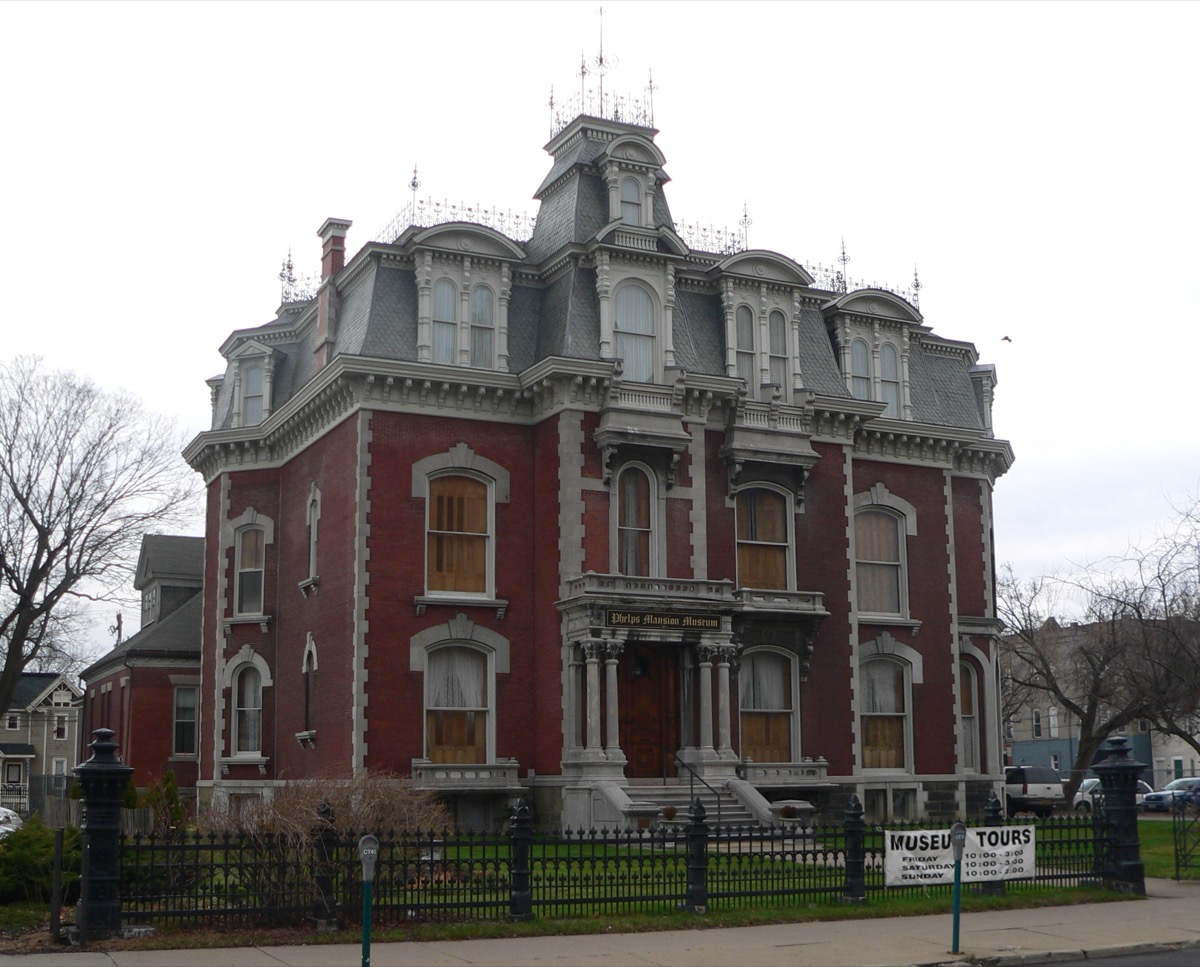
Sherman Phelps built the finest house in Binghamton, New York, in 1870. Within about a dozen years every member of his family who lived there was dead, one after another, while the servants stayed perfectly healthy. A docent-medium says Sherman never left.
The Phelps Mansion in Binghamton, New York has a problem that the servants never shared. Sherman David Phelps built the place in 1870 as the finest house in the city, and within about a dozen years every member of his family who lived there was dead, one by one. The people who worked the house stayed perfectly healthy.
Phelps was a banker and former mayor who'd won his election by a single vote. He'd started the city's gas company and put money into its cigar factories, and when he built his house he built it to last. He hired Isaac G. Perry, the architect who would later design the New York State Capitol, and spent $100,000 on three stories of brick and stone. The drawing room got maple woodwork, the library walnut with a hand-carved mirror frame, the dining room oak, and the floors imported marble. He moved in around 1871. He was dead by 1878, at 64, six years after the first night under that roof.
Then his family followed. His youngest son Arthur died at 21, the lore says on Halloween. The rest went in sequence over the next few years, and by 1882 the house stood empty. Rumors in town blamed arsenic in the green Victorian wallpaper, a real poison in real pigments of the day, but it was never proven, and it never explained the one thing that mattered: only the family fell. The servants who breathed the same air went on living.
A women's civic group bought the empty house in 1905 and ran it for a century. It's a museum now, and the staff say the first owner never went anywhere. Robert Keller, a trained medium who works there as a docent, calls Sherman a "hoverer." "Sherman Phelps has not gone over," he says. "It seems to him that no time has passed since he died, but he can see things happening in his house." Keller adds that he doesn't like crowds in the place.
Visitors on tours report figures in period clothing watching them from doorways. A clock no one winds chimes at random hours. Candlesticks are taken from their holders and set down flat. Objects weighing three and four pounds jump from the fireplaces. And the elevator, installed for accessibility and built to require its safety features engaged before it will move, travels between floors with no one in it, the staff say, the safety mechanisms somehow already set.