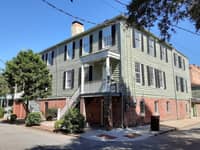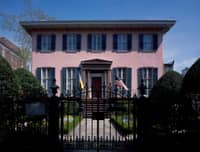
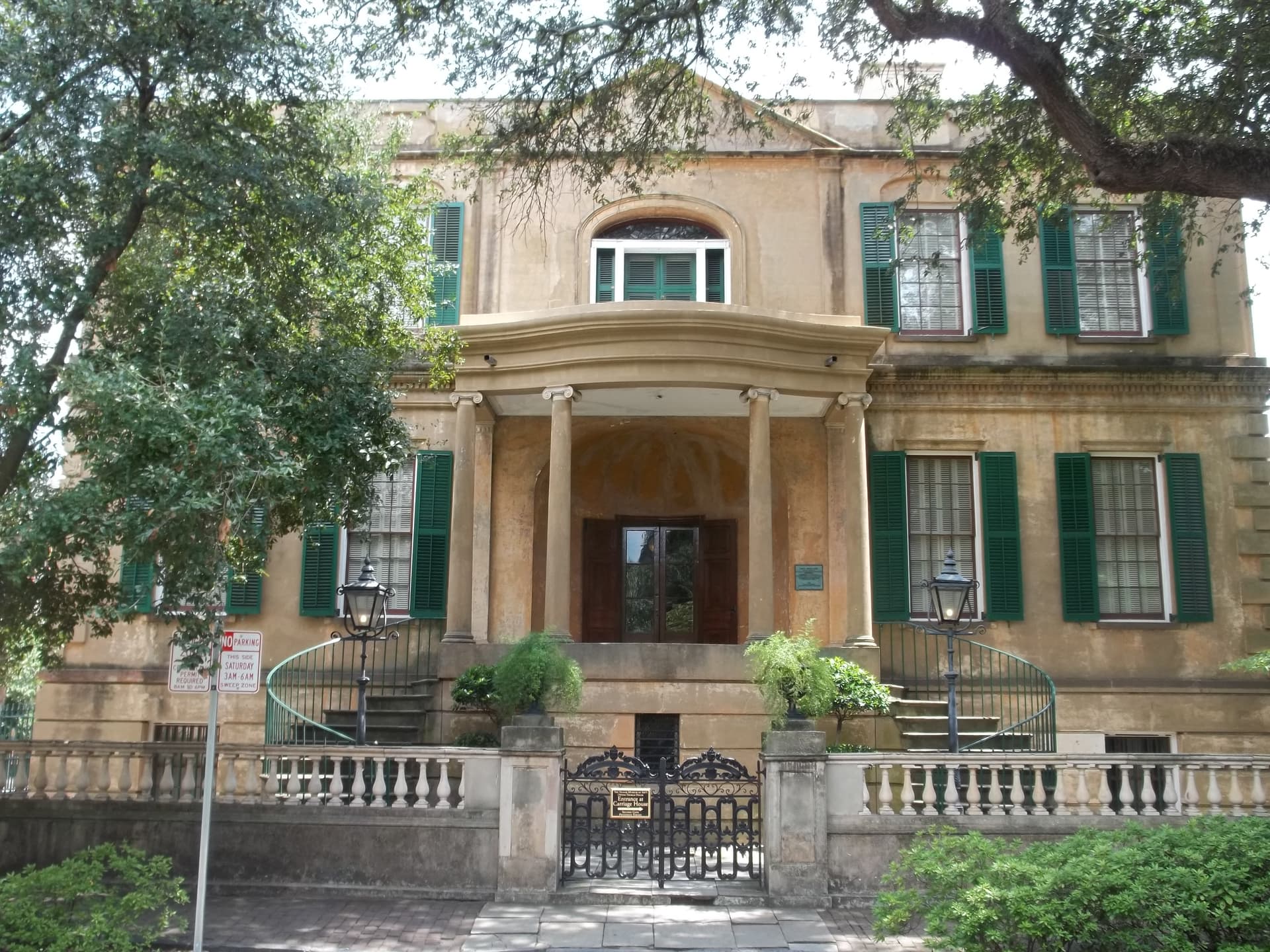
The Owens-Thomas House in Savannah, Georgia, was finished in 1819. The ghost tours say a dark-haired man in 1830s clothes watches visitors from a corner of its parlor. In the dining room, a chair keeps turning up pulled out. A Lady in Gray walks the garden at dusk.
The ghost tours in Savannah, Georgia, tell of a man who stands in a corner of a front parlor and watches the visitors. He's well built, with jet-black hair and clothes from the 1830s, and he doesn't move or say a word. Then he turns and walks off through the wall, at a spot where a guest room used to be. The parlor belongs to the Owens-Thomas House on Oglethorpe Square, and the tours take him to be George Owens, the lawyer and congressman who bought the house in 1830.
The dining room has a story of its own. The staff set the period table before closing, and one chair keeps turning up pushed away from it. Some mornings, the tours say, the chairs have been pulled out or knocked over and the silverware is scattered. A former maid who locked up one night came back the next morning to find the table in disarray and a chair pulled out, "as if someone had just eaten a meal."
The house went up between 1816 and 1819, an English Regency mansion drawn by the architect William Jay for Richard Richardson and his wife Frances. Richardson was a shipping merchant, a bank president and a domestic slave trader. In 1822 Frances died, one of their children died, and Richardson lost his fortune and sold the house. Owens bought it a few years later, and his family kept it for about 120 years.
People were enslaved here from 1819 to the end of the Civil War, under both families. The museum names some of them: Emma, the nanny, Diane, the cook, and Peter, the butler. Their quarters, in the old carriage house, are among the oldest and best-preserved urban slave quarters in the South, and the ceiling there is still painted haint blue, the color Gullah tradition uses to keep ghosts and evil spirits away. It's said to be the largest stretch of original haint blue in North America. One of the tour companies says the quarters show no signs of spirits at all, and it puts that down to the ceiling.
The guides have stories too. Ghost City Tours says that on one late-evening tour, guide Missy Brandt's group heard a match strike, smelled tobacco and saw smoke coming from nowhere. "Yes, I saw a match flare up behind you, and smoke puffing out of thin air," one of the guests said.
Then there's the man in the riding coat. The company's telling goes back to the 1960s, when Jim Williams, of Mercer House, and his business partner were in the house. They watched a man in a riding coat and boots, carrying a riding crop, pace one of the front rooms for about 10 minutes. He passed right through a couch. They could see his blue eyes and the sweat on his brow, and then he was gone. "Only in Savannah would a ghost sweat," Williams is supposed to have said. A friend of theirs who was renting a room upstairs ran into the man again a week later, and moved out.
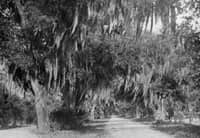
Out in the garden, at twilight, people tell of a woman in a gray shawl and a large hat. They call her the Lady in Gray, and they say she's Margaret Thomas, Owens's granddaughter, who left the house to the Telfair in 1951 on the condition that it carry her grandfather's and her father's names. The story is that she stays because she loved the house and its gardens, and staff are said to see her at night before closing.
A writer for Genteel & Bard, a Savannah ghost-tour company, says she saw a woman in a gray shawl and hat in the garden behind the house after tours, nearly every night for months. She took her for a docent in costume, so she waved. The woman smiled and nodded.