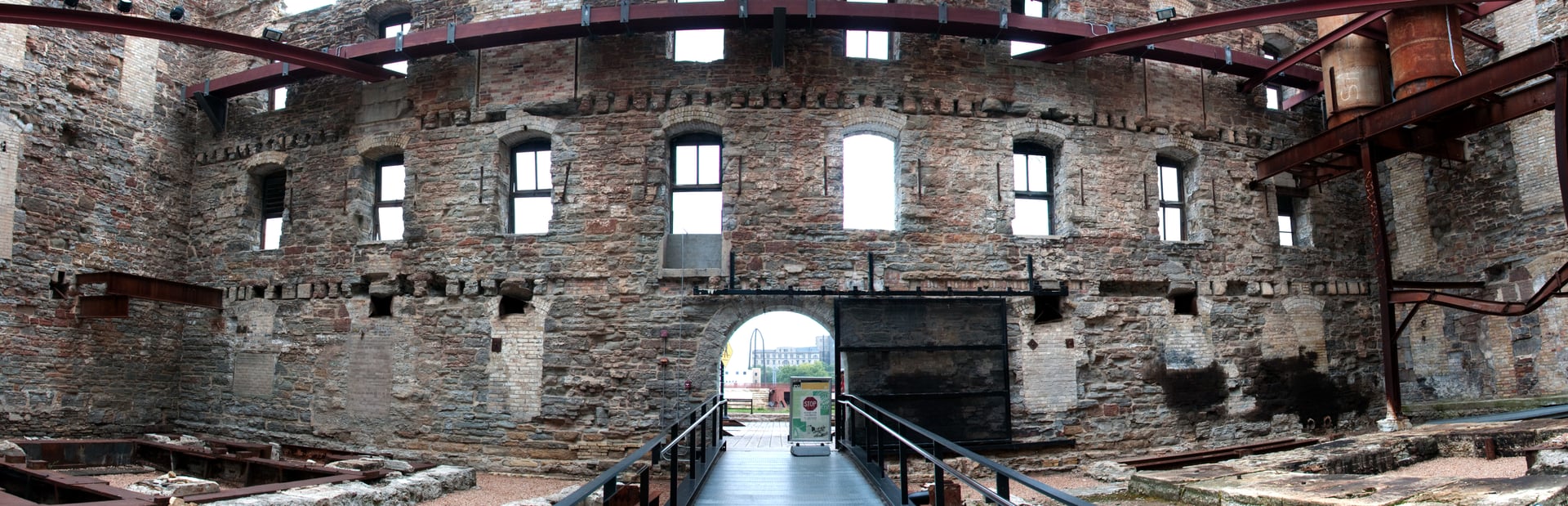
The Mill City Museum in Minneapolis is built inside the burned-out shell of the Washburn A Mill, where a flour-dust explosion killed 18 men in 1878. An elevator ride still reproduces the boom, and ghost tours say the dead never left the ruins.
The Mill City Museum in Minneapolis is built inside the ruins of the place that killed the men ghost tours say still haunt it. The walls around you are the surviving limestone of the Washburn A Mill, four feet thick at the base, scorched and rebuilt and burned again. People who run tours of the city tell you the 18 workers lost here never left.
On the evening of May 2, 1878, around 7 p.m., the night crew was on shift inside what was then the largest flour mill in the world. Cadwallader Washburn had built it four years earlier, and on a working night the air inside it was thick with flour dust, the way it always was. Two dry millstones rubbed together and threw a spark. The dust ignited, and the building detonated in a fireball heard 10 miles away in St. Paul.
Fourteen men inside died instantly. The blast spread fire to the neighboring Diamond and Humboldt mills and killed four more. Debris came down across roughly eight city blocks. Six mills were destroyed before it was over.
Eighteen dead, in seconds.
Washburn rebuilt the mill by 1880, this time with an Austrian engineer's dust-collection system so it could never happen again. The company he ran became Washburn-Crosby, then General Mills, the name still on your cereal box. The mill itself ground Gold Medal Flour until it closed in 1965. Then it sat empty for decades, until a fire gutted the vacant building in February 1991 and left only the limestone walls standing. The city stabilized those ruins, and in 2003 they reopened as the museum, beside Mill Ruins Park on the bank of the Mississippi.
The centerpiece is the Flour Tower, a freight-elevator ride up through recreated mill floors. At one point it plays a thundering boom that recalls the 1878 explosion. The museum means it as exhibit, history made loud and physical. Ghost tours mean it as something else. The Minneapolis tourism bureau's own blog says visitors here can "hear thundering booms evoking the 1878 explosion and perhaps feel the presence of those unlucky 18."
No one is named. The lore never settles on a face, only on the number, the spirits of the Washburn A Mill told as a single crowd of 18. There are no witness accounts on the record, no dated sightings, just the tours that work the ruins and the old tragedy underneath them. The men themselves are honored across town at Lakewood Cemetery, under an 1885 monument carved with wheat, a millstone, and a broken gear.