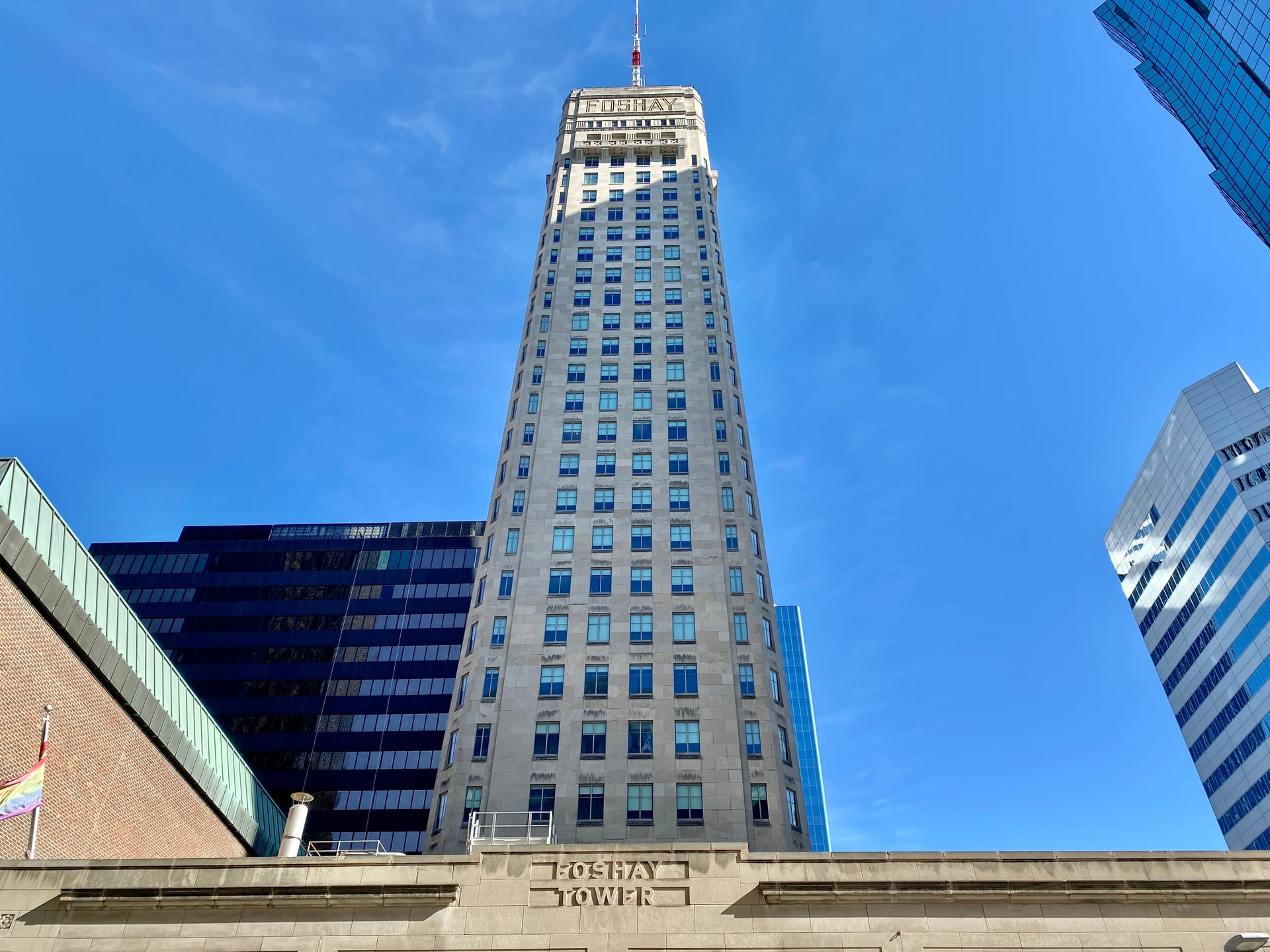
At the Foshay Tower in Minneapolis, elevators stop at random floors and a man in old clothes turns up where no one should be. People say it's Wilbur Foshay, who threw a party for the ages, then lost everything in the crash that followed.
At the Foshay Tower in Minneapolis, the elevators don't always stop where you ask them to. Staff and visitors report cars halting at floors no one selected, the lights cutting out for no reason, and a man in old-fashioned clothes turning up on the upper floors. The story says it's Wilbur Foshay, the man who built the place and then watched it take everything from him.
He built it as a monument to himself. The tower is a 447-foot Art Deco obelisk, a deliberate skyscraper copy of the Washington Monument, narrowing floor by floor to a point, clad in Indiana limestone, with FOSHAY spelled out in giant lightbulbs across the top. When it opened over Labor Day weekend in 1929, it was the tallest building between Chicago and the West Coast. Foshay threw a three-day party to celebrate, and paid John Philip Sousa to compose a march for the occasion. High up, he had a private three-bedroom apartment built for himself to live in.
He never moved in. Two months after the tower opened, the stock market crashed. His utility empire, which had stretched across thirty states, collapsed. The check he'd written Sousa bounced, and a furious Sousa forbade the march from ever being played again until the debt was paid. It wasn't paid until 1988, decades after both men were dead. Foshay was convicted of mail fraud for the stock he'd sold and sent to Leavenworth.
The lore likes to say he leapt from his own tower. He didn't. He died of a stroke in a nursing home in 1957, broke, a long way from the building that carried his name in lights. The man people report on the upper floors is watching over something he lost almost as soon as he had it.
The tower's backstory holds a darker thread, too. The lone holdout juror at his first fraud trial, a woman named Genevieve Clark, had quietly worked for Foshay and never said so when the lawyers asked. Her concealment was convicted as contempt of court, all the way up to the Supreme Court, where she lost. Weeks after the ruling, she, her husband, and their two young sons were found dead of carbon monoxide in their car on a roadside near Prior Lake, a hose run from the exhaust pipe into the cabin.
The building outlived all of it. Today it's a 230-room hotel, with Foshay's name still carved at the crown and lit at the top. He never got to keep it. By some accounts, he never left it either.